As the daily stream of visitors to the Kamloops Art Gallery (KAG) starts to thin out by 4 p.m., Secwépemc youth art instructor Ruby Liddy and Secwépemc and St’át’imc art instructor Charlie Napoleon are just beginning their Thursday shifts.
Coffees in hand, the pair whirl around the empty studio space on the second floor of KAG. They collect strings, scissors and instructions from the supply closet and line up small bottles containing a colourful array of bugle and seed beads. The studio is crowded with long tables draped in black cloth so it is easier to see the beads being used. Liddy begins snipping a piece of string that stretches twice across their wingspan while Napoleon settles into a chair and begins working on their beading project.

On Thursday evenings at KAG, Liddy and Napoleon facilitate two back-to-back beading circles, the Beaded Junction and the Bead Social. The Beaded Junction is a free drop-in beading circle that offers supplies and the opportunity for people ages 14 to 19 to learn how to bead alongside other youth. The Bead Social is a recent addition to KAG programming and is a beading circle for adults that also welcomes beginners, offers instruction and supplies free materials.
Liddy, a spunky 18-year-old with a passion for art, pitched the idea to start a beading circle last summer, when they were working as an intern at KAG fresh out of high school.
While talking to Emily Hope, KAG’s education and public programs director, Liddy shared her ambition to be an art teacher one day.
Hope encouraged them to pitch a workshop idea if they were interested, and Liddy ended up pitching a beading circle, feeling like there was a gap in cultural connection for Indigenous youth in the city, a community that is both diverse and growing.
“When I was younger, I definitely had a hard time fitting in with white people and First Nations people…and I didn’t really grow up in a First Nations environment,” Liddy tells The Wren. “When I found beading, I was like oh this is cool, my culture is really cool and I want to learn more.”
However, being 17 years old at the time, Liddy couldn’t facilitate a workshop at the KAG alone. After meeting Thompson Rivers University visual arts student Napoleon through previous KAG workshops, Liddy requested their help teaching the beading circles.
Napoleon didn’t know how to bead before the workshops and learned for the first time through Liddy’s guidance.
“I do have family that knows how to bead but I was always too shy to ask them to teach me because they’re so good,” Napoleon says. “Having someone close to my age is a lot easier to learn how to bead from and I feel like that’s also the same probably for people we teach too.”
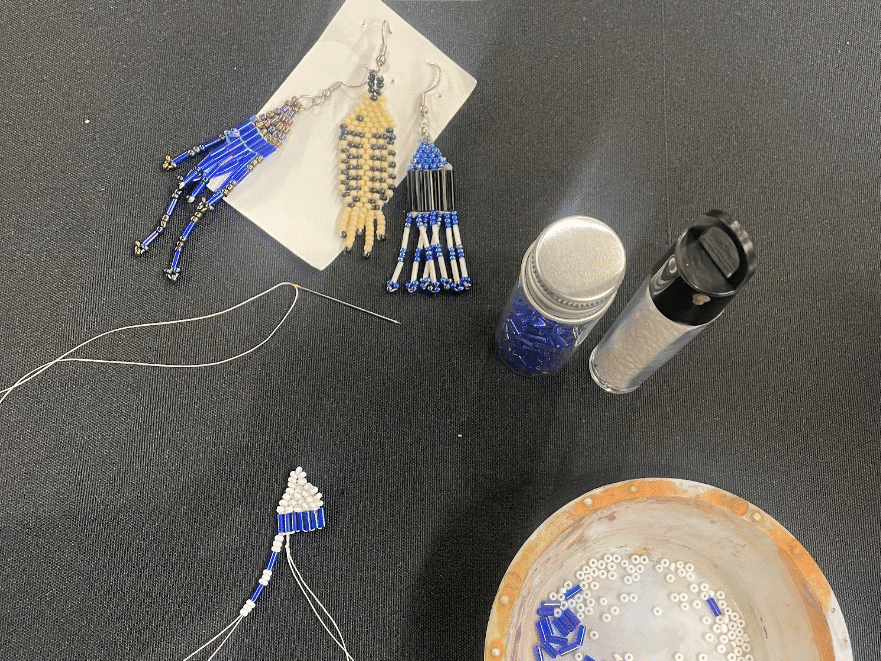
Exploring culture and connection through beading
Both Liddy and Napoleon describe beading as a way to explore elements of their Indigenous culture through an art form. One of Liddy’s favourite pieces they’ve created is a skull broach. The skull gem in the middle was a metal piece that fell off Liddy’s belt.
“I’ve been trying to incorporate my beading into my other art stuff,” Liddy says. “So doing the skull…that’s more my style but still has cultural elements too.”
For Napoleon, the process of becoming a teacher for the workshop and learning to bead from Liddy has helped them reconnect with their heritage.
“There was a long while, especially being in school, where I was focusing on making art from myself and not drawing any references from my own culture,” Napoleon says. “So getting into beading helps me think more about my culture and include that in my identity again.”
According to the two artists, the amount of people that come to the workshops often varies. Some days, Liddy and Napoleon are split up and work quickly to help everyone get started on their projects. On other days, the studio remains quiet, allowing the two to focus on their projects, relax and listen to some music. Regardless of the participant size, both workshops consistently remain a safe space for Indigenous people and those from other cultures who want to learn how to bead in an encouraging environment that fosters intercultural learning, creativity and connection.
“Every single person I teach, I learn a new way how to teach,” Napoleon says. “I teach a standard general pattern, and then I let people explore what kinds of things they want to make…I guess you can consider it more contemporary beading where it’s not specific to any region, but it’s more just being creative with beads.”
Liddy and Napoleon both hope to run the workshops at KAG next year and aspire to expand beyond the gallery to do workshops at local high schools, hoping to foster more community connections.
“A lot of people want to get reconnected with their culture and don’t necessarily have that option at home,” Liddy said. “Beading is kind of a difficult thing to learn by yourself if you don’t have a family or connection, so having more resources like this makes it a lot easier.”
So do we. That’s why we spend more time, more money and place more care into reporting each story. Your financial contributions, big and small, make these stories possible. Will you become a monthly supporter today?
If you've read this far, you value in-depth community news