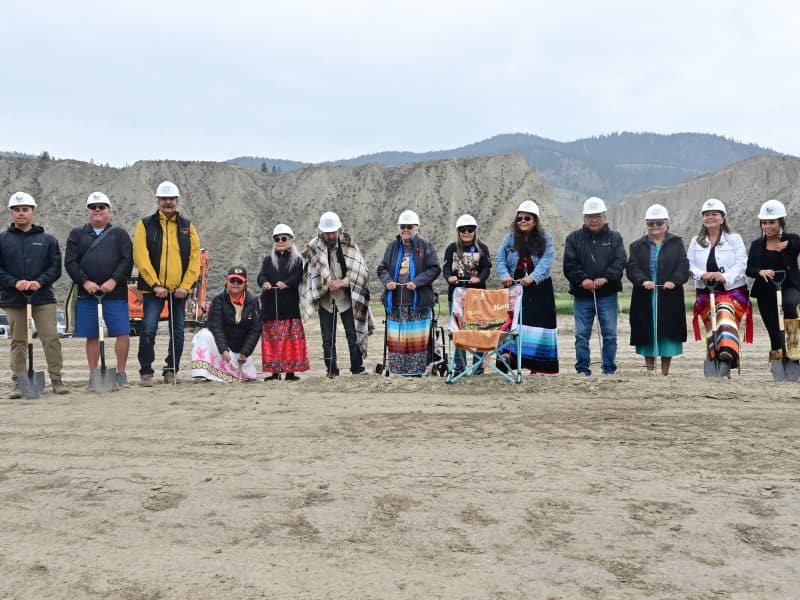
At the heart of Skeetchestn territory is the Deadman Watershed, a living landscape of roughly 900 sq. km of forest and grassland northwest of Kamloops (Tk’emlups).
Industrial logging and the roads it requires has been a major stressor on this area, and the 2017 Elephant Hill wildfire and the 2021 Sparks Lake wildfire consumed much of the remaining forest.
“The Deadman Watershed has been absolutely devastated,” says Shaun Freeman, senior wildlife and habitat biologist with Skeetchestn Natural Resource corp. “What we ended up with is a lot of hydrological issues.”
In the early spring, the snowpack melts all at once, with little water retained in the upper watershed due to vegetation loss, he explains. This has knock-on effects for the entire ecosystem
Tsecmenúl̓ecwem-kt (We Repair the Land ) is a project led by Skeetchestn Indian Band to remedy this situation.
Since launching this year, their goal is to restore the watershed and enhance its resilience in the face of worsening climate change, while simultaneously studying how mitigation measures following severe wildfires can help protect landscapes.
They have many partners including Thompson Rivers University, the province and the Secwépemc Fisheries Commission. But the arguably most hardworking collaborator is one you may not expect — an ancient ally in ecological stewardship known in Secwepemctsín as sqlew’uwi and in English as the North American Beaver.
Bring in the beavers
To help the land, Skeetchestn’s Tsecmenúl̓ecwem-kt project has successfully populated the upper watershed with one beaver, known as Doug, with the goal to re-introduce more over coming years.
Beavers like Doug have a natural instinct to build dams across flowing water, creating ponds to evade predators. These ponds influence local hydrology, enhancing the habitat for countless other species, including plants, waterfowl, amphibians, invertebrates and of course salmon.
“Having ponds and wetlands keeps moisture in the soil and keeps that deciduous component healthy,” which Freeman says is important because those tree species don’t burn to the extent of evergreens. This creates natural fire breaks which can stall or potentially stop a wildfire from moving across the valley.
This calm pond created by beavers at Tsútswecw park offers habitat for many other species. Video by Lyssa Martin / The Wren
What’s even more important is slowing down the flow rate to maintain downstream flow into the heat of summer, when low flows block fish passage and can even be fatal.
“We are trying to make sure that the streams are not just a pile of rocks when it comes to August and September because everything, including us, needs water,” Freeman says. “Healthy ecosystems require water which is why we are trying to have the beavers help us do that recovery.”
Tales from the beaver hotel
“In terms of relocating beavers, it’s a little bit more complex than just grabbing them, putting them in the truck and dropping them off,” he says. They must be set up for success.
Since the 2021 Sparks Lake wildfire, there has been good regrowth of deciduous species, including aspen and willow which are important to beavers as food and building material. Three sites with good conditions were selected for possible reintroduction.
But the timing of the beaver capture and release is critical.

“We don’t want to be in a position where we’re capturing beavers that have kits in the lodge,” he says. Which means capturing needs to happen in the late winter or early spring.
They also need time to prepare their infrastructure — the lodge, feed pile and any dams they need to control the water level — in their new habitat. If you put them in too late, the chance of successful colonization is reduced.
So, the first step was to prepare the holding facility where the beavers will stay between capture and release: the beaver hotel.
In creating a good habitat for Doug the beaver, the Interior Wildlife Rehabilitation Society was very helpful, and the team visited the Summerland beaver hotel to learn how it works and design their own.

The first guest of the Skeetchestn beaver hotel, a female the team named Willow, was not quite what they expected.
“Unfortunately, Willow decided to climb the seven foot chain link fence, as evidenced by the muddy footprints she left behind,” says Freeman, something they didn’t know a beaver could do.

In contrast the second beaver they caught, a male they named Doug, was more than satisfied with his accommodations.
“He knew the gravy train was coming to him.”
There were a couple of times he was so deeply asleep the team thought, “Oh geez, Doug’s dead!” And they would have to wiggle his cage and tip him out.

Skeetchestn is not the only community interested in the positive effect beavers and their dams have on ecosystems. Elsewhere in the province the 10,000 Watersheds Project is building Beaver Dam Analogs, an alternative to natural beaver dams which seek to mimic their effect on hydrology.
While these are an exciting technology, Freeman says they have drawbacks. Humans have to build them and, unless the analog is adopted by beavers, humans are responsible for maintaining them too.
“They are also liable if something goes wrong,” says Freeman. “But you can’t sue a beaver.”
Human partners hard at work, too
While the busy beavers are the charismatic stars of the Tsecmenúl̓ecwem-kt project, the human partners are hard at work, too.
Despite interest in beavers as a partner in ecosystem restoration, there isn’t much in the scientific literature evaluating a habitat before and after beaver reintroduction.
“This is where the Western science monitoring comes into place,” says Freeman. “The province and our fisheries team are involved with measuring the hydrology, downstream flow, water temperature and such so that we have that baseline.”
They will be monitoring over time to establish what influence the beavers have on the watershed.
The team has conducted drone surveys of the habitat, mapping the water and vegetation distribution, while also ensuring no beavers have moved into a separate area that will be monitored as an experimental ‘no beaver’ control — the standard for comparison in a scientific study.

They are also doing an inventory with respect to the species at risk that call this watershed home, including both terrestrial species like Western rattlesnake, Great Basin Spadefoot toad and Louis’ woodpecker to name just a few, and aquatic ones especially salmonids like Chinook, Coho and Steelhead.
Don Ignace and the Secwepemc Fisheries Commission are doing a lot of the aquatic restoration work.
There are also researchers from multiple B.C. universities and government agencies working on other aspects of restoration, like planting and road deactivation.
The federally and provincially co-funded BC Salmon Restoration and Innovation Fund is providing $4 million dollars.
A beaver hub for Secwépemc territory
This first year has been mostly successful, Freeman says. The team wants to focus on introducing beavers in pairs so that they can establish a colony, but unfortunately Willow’s escape was not the only hurdle the team faced on that front.
The beaver colonies in the lower watershed that had been the targets for relocation suffered deaths over the winter. The team was not keen on taking any additional beavers from them at their current population level.
So, Doug was introduced alone to the upper watershed and he seemed to like the location the team selected, suggesting their assumptions about the habitat’s suitability for supporting beaver are very likely correct.

“He went right at it, barely leaving the site we released him from and just started building,” he says. Doug actually built two lodges.
“I think he decided the first one wasn’t up to his specifications, whatever those may be,” he says, but Doug seems much happier with the second.
Next year the team will be sourcing beavers from some of the areas where they are overly abundant.
“Because we do have the ability to host beavers for as long as necessary, we’re able to really start sourcing and looking at some of these other areas which have similar problems in future to and basically become the beaver hub, so to speak, for Secwepemc territory.”
They have already had offers from staff in Tk’emlúps that have some issues with beavers in high numbers. If beavers overpopulate a watershed, they can do damage, he explains.
“So, we have a job for them. It may not be in the low part of the drainage, but we definitely have a job for them in the top,” Freeman says.
“It’s just a case of shifting from where we have an over abundance, putting them where we don’t have any, then letting them work their magic to help us recreate the hydrology into something that’s going to sustain the whole water table.”

The Wren is a community driven local news outlet. Your questions and ideas help guide what we dig into. Your feedback after we publish a story helps ensure we're always improving our reporting to better serve you
What do think about this story?