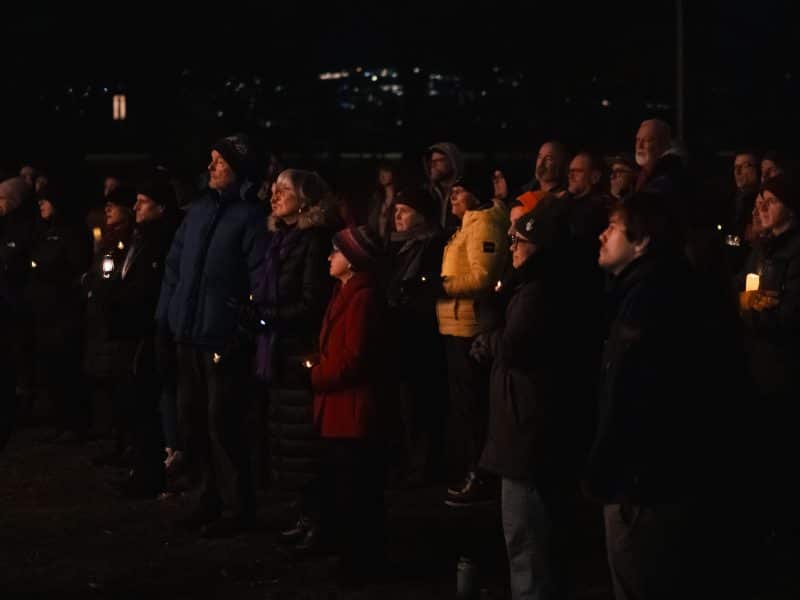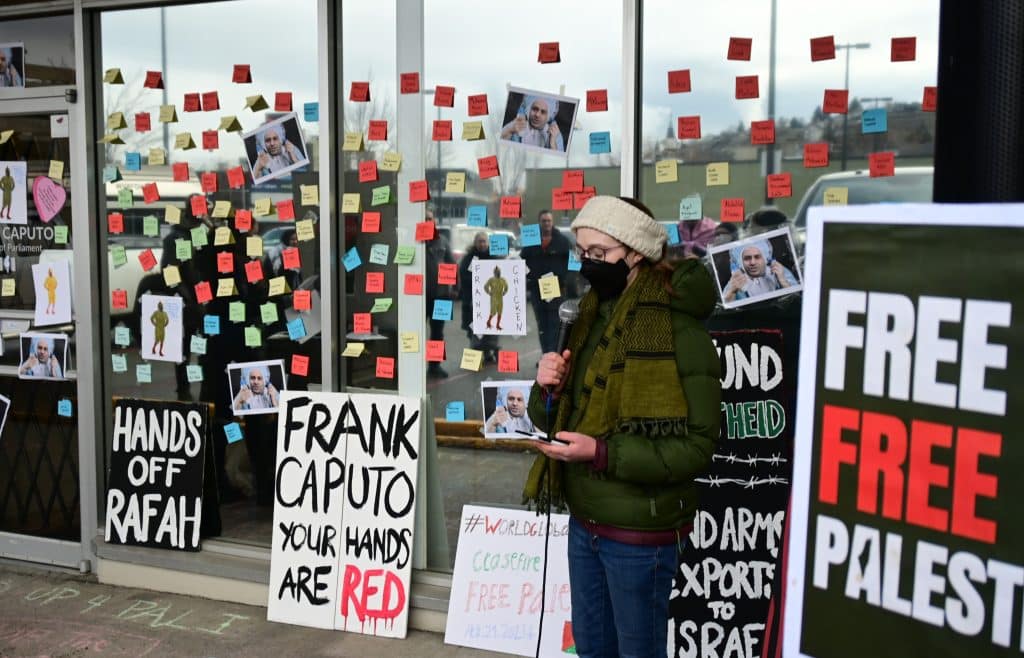
On Feb. 21 organizers with Palestine Solidarity Kamloops headed for Member of Parliament Frank Caputo’s office to advocate for the human rights of the people of Gaza and an end to Canadian arms trade with Israel.
However, demonstrators were met with a sign saying the office was closed.
Joanne Hammond, an organizer of the event, tells The Wren the protest was a family-friendly, musical event where the group hoped to hand their petition to the Kamloops-Thompson-Cariboo MP in person.
The petition called on Caputo to “act in Ottawa to support a permanent ceasefire, humanitarian interventions and an end to Canada’s arms trade with Israel,” Hammond says.
“We expect[ed] a few dozen people. Unfortunately, and somewhat shamefully, Mr. Caputo… decided to close his office rather than listen to his constituents.”
The Wren reached out to Caputo’s office to inquire about why the office was closed during the protest and learn more about how constituents can get their interests on his desk.
In an emailed response, Caputo says he had not seen a formal Notice of Petition, but that one may have been sent in.
He says his office does not close to prevent petitions, but added that this protest appeared to be related to one on Feb. 13, which he says created unsafe conditions for his staff and constituents in his office.
“This included, but was not limited to, yelling through the office mail slot with a megaphone while constituents and staff were present,” he says. “Staff and constituents were also unable to exit the building for a period. RCMP eventually attended and protestors dispersed. I will always support the right to lawfully protest, but I will not place staff and the public in an unsafe situation – ever.”
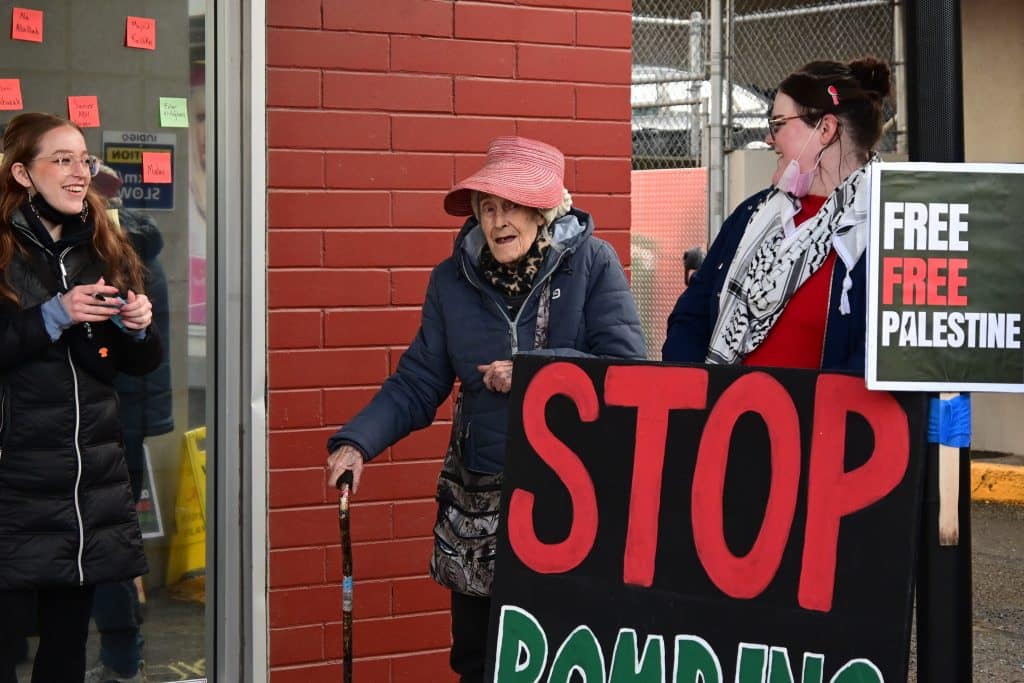
Other sources in attendance that day provided a different account of events, describing it as a small lunchtime protest — from 12 p.m. to 1 p.m. only— with some speaking, reciting of poetry and chanting.
“One protest attendee rang the office doorbell [and] asked if the staff wanted to join us, they said no,” demonstrator Umme Mansoory tells The Wren.
When asked about the RCMP presence Hammond says, “Corporal Jeff Raffle didn’t come over to speak to us until most of the attendees had left, and he did not indicate we had done anything wrong.”
The Wren followed up with Kamloops RCMP about the Feb. 13 protest and was informed by Const. Crystal Evelyn: “at 12:15 officers attended a demonstration at 3rd Ave and Seymour Street. There was a small crowd. The protest was peaceful.”
How can constituents exercise their democratic rights?
If you ask Caputo, he says the mail slot on his office front door is the way constituents can “deliver petitions and exercise their democratic right.” You can also mail them free of charge.
“These petitions must meet House of Commons requirements,” he explains to The Wren.
These requirements include rules governing the language used, format and minimum number of signatures among other details. A petition cannot concern a matter that is outside of the authority of the Parliament of Canada, for example related to local drinking water or education, which are municipal and provincial matters. Nor can it concern a matter that is currently the subject of legal proceedings, which as of March 5 includes petitions regarding arms exports to Israel. A group of Canadian lawyers, including Canadian Lawyers for International Human Rights, has sued Canada’s Foreign Minister Mélanie Joly for exporting military goods and technology to Israel during the Gaza conflict.
The disclaimer on the House of Commons petitions web page explains “[t]here is no obligation on the part of the House of Commons or any Member of Parliament to authorize the publication of an e-petition or to present an e-petition or a paper petition to the House of Commons.”
As an alternative, you may ask any MP to present your petition to parliament even if they do not represent your electoral district.
When asked about the roles of an MP and their responsibilities to their constituents, House of Commons staff provided this helpful guide.
“The most obvious task of MPs is to represent their constituents,” the guide states, which can look like conveying their constituents’ views in Parliamentary debates or appealing to ministers on issues related to public policy.
However constituency service also often involves providing advice related to government services.
The guide also acknowledges that “since many MPs owe their electoral success to their political parties, ‘party politics’ may occasionally dictate the sacrifice of constituents’ concerns.”
There is no consensus as to the role of MPs within and beyond their constituency.
“It is uncertain whether, as representatives, MPs ought ideally to interpret, and ultimately shape, public opinion, or whether their purpose is rather merely to relay their constituents’ views to those in positions of authority.”
Why solidarity with Palestinians?

On Oct. 7, 2023 an attack by Hamas launched from territory illegally occupied by Israel ignited a flare-up in hostilities. Humanitarian organizations have been calling for all nations to cease arms trade with both combatants. However, the disproportionate impact of violence inflicted on the civilians of Gaza by Israeli forces has drawn widespread condemnation.
As Hailey Cant with Palestine Solidarity Kamloops wrote in an email to MP Frank Caputo on Dec. 21, “They represent a staggering death toll, highlighting the indiscriminate nature of the Israeli military’s actions by intentionally targeting civilian homes, hospitals and schools.”
She also says that Canada cannot hope to reconcile with Indigenous peoples while it supports a violent occupation overseas.
She notes in that message that as of the 75th day of the conflict, over 20,000 Palestinian civilians and 80 journalists had lost their lives.
On Dec. 29, South Africa brought Israel before the International Court of Justice (ICJ) with charges of genocide. While the ICJ ruling could take years, “the Court emphasizes that the State of Israel remains bound to fully comply withits obligations under the Genocide Convention and with the said Order, including by ensuring the safety and security of the Palestinians in the Gaza Strip.”
As of March 6, more than 31,000 Palestinian civilians, mostly women and children, have been killed by the Israeli military in the Gaza Strip and an estimated 72,654 injured. More than 75 per cent of buildings in the north half of Gaza have been destroyed with thousands of people still buried in the rubble and an estimated 8,000 people missing. At least 100 journalists have been killed in the fighting so far. The latest numbers from Israel report 1,139 dead and 8,730 injured.
What is Canada’s role?
At the Feb. 21 protest Cant tells fellow Palestine Solidarity Kamloops demonstrators that she didn’t receive a reply to her email until Jan.30, nearly a month and a half later, frustratingly slow given the pace of destruction.
She says that Canadian tax dollars are directly funding Israel’s war machine and thus it is the responsibility of every level of government to speak out against this violence and injustice.
A pair of reports from Global Affairs Canada revealed by The Maple shows the extent of that trade. Canada has authorized at least $28.5 million in arms exports to Israel since October, blowing past previous annual records in only a few months. The Maple also called attention to a recent announcement that Canada is purchasing $43 million in controversial Israeli-made missiles for Canadian Armed Forces (CAF) troops stationed in Latvia.
On Feb. 28, protestors blockaded the offices of arms dealers in six Canadian cities demanding an end to military exports to the conflict zone. An organizer told The Maple: “If you are not going to impose the arms embargo, then we will impose an arms embargo down on the ground.”
In a lawsuit filed on March 5, a coalition of Palestinian Canadians and human rights lawyers say the Canadian government is breaking its obligations under international humanitarian law by exporting arms to Israel.For months, demonstrators have marched in cities across Canada to demand a ceasefire and an end to human rights abuses.
After weeks of public pressure, on March 8 the Canadian government announced it will resume funding the United Nations Relief and Works Agency for Palestine Refugees (UNRWA) after pausing funding in response to allegations made by the Israeli government that some staff were involved in the Oct. 7 attacks.
Palestine Solidarity Kamloops protesters persevere despite facing intimidation and harassment
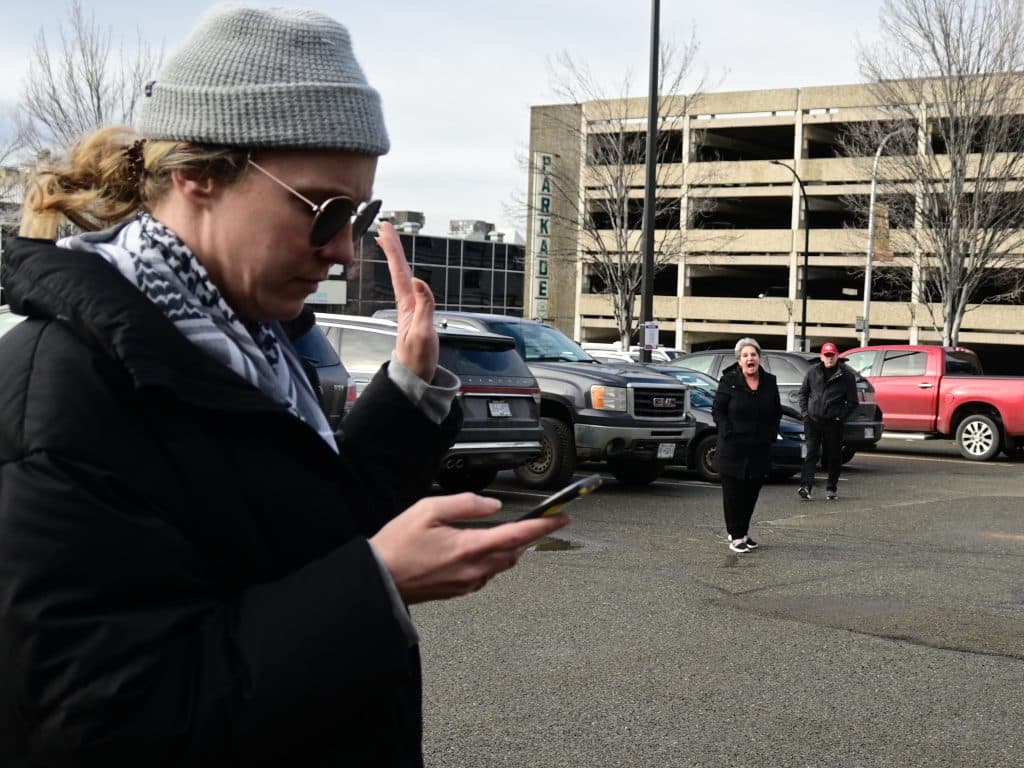
According to an RCMP report obtained by The Wren, on Jan. 13 Joanne Hammond was pinned between her vehicle and a white pickup truck by the truck’s driver. Witnesses say the driver hurled slurs at the protesters as they recorded his actions.
Demonstrators at the Feb. 13 protest at Mr. Caputo’s office reported a different man in a pickup shouting obscenities and advocating violence against Palestinian civilians.
During the Feb. 21 protest, The Wren witnessed a number of harassment incidents. While many of these individuals were watching from across the parking lot, they did not approach the protestors until after the CFJC team, and their TV cameras, had departed.
These are not isolated incidents.
Despite this violence, and Caputo’s resistance to demonstrators’ attempts to meet with him face-to-face and advocate for their cause, protestors in Kamloops (Tk’emlúps) are undeterred.
Organizers with Palestine Solidarity Kamloops tell The Wren that they will continue to show up and protest peacefully, advocating for solidarity with Palestinians and an end to Canada’s arms trade with Israel.
So do we. That’s why we spend more time, more money and place more care into reporting each story. Your financial contributions, big and small, make these stories possible. Will you become a monthly supporter today?
If you've read this far, you value in-depth community news