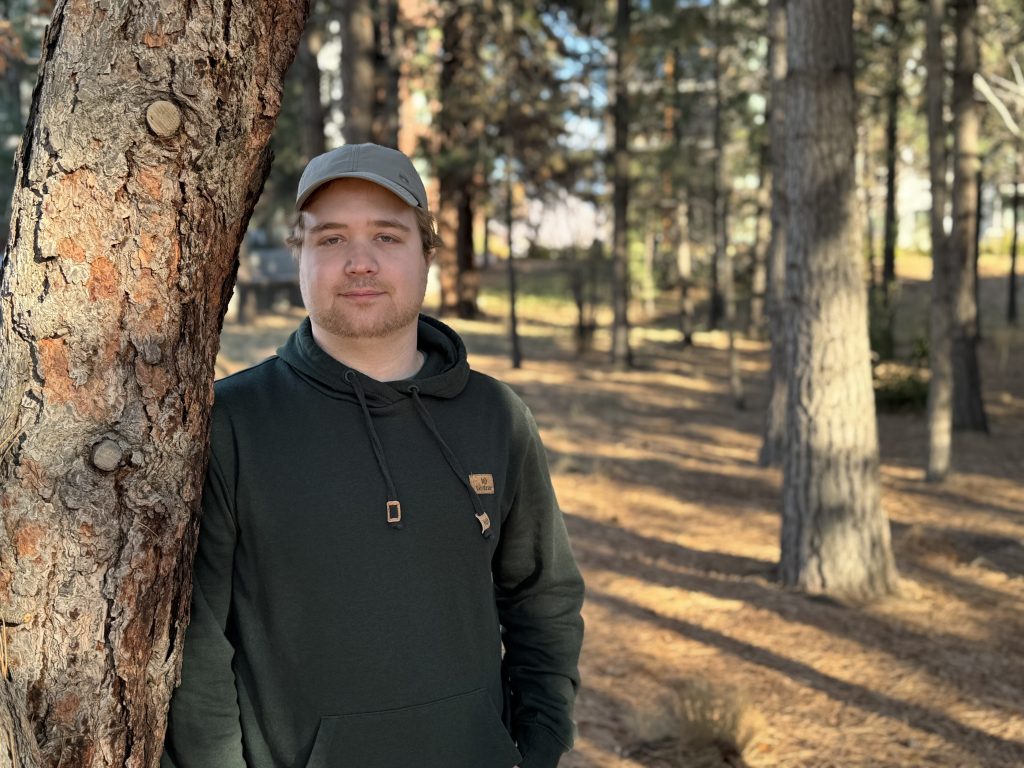
Liam is a twenty-five-year-old undergraduate student studying biology at Thompson Rivers University in Kamloops, British Columbia. He has a twin brother and spends his summers working and living at his parents’ family home in Nakusp, a small community in British Columbia’s Kootenay region nestled along the shores of Upper Arrow Lake. When he can, he spends time fishing and enjoying the picturesque valleys and alpine peaks the area has to offer — though Liam isn’t very fond of hiking. He has worked a variety of summer jobs, such as construction and paving. But, during the 2024 fire season, he found himself working at a motel liquor store where he met everyone from wary tourists and exhausted evacuees to fireline workers.
I was back for the summer, staying at my parents. They were house flippers so they have a pretty nice house: red on the outside, a big wooden porch, backyard with a nice wooden fence, our little dog area and a hot tub.
This summer my daily routine was just getting up, biking the five minutes to work at the liquor store attached to a hotel, and heading back home at the end of my shift. There’s not too much to do in Nakusp. I’m either fishing, kayaking, hunting outdoors, gaming or hanging out with my friends.
There was quite a few fires in the West Kootenays that summer. They began in early June until the beginning of September. It wasn’t just one. It was a whole bunch of small fires. The smoke was crazy. To the point where you couldn’t go outside. It was like fog. Hard to walk through and it smelled bad. The smell stained your clothing. You couldn’t open your doors and windows during the night to let the cool air in. The air quality being so bad did make me worry for my twin brother, Caleb, because he has asthma. He was inside, at least, where we could mitigate some of the smoke.
From town, you could see three small, red sparks in the hills, like someone’s having a huge bonfire. That was nerve-wracking. A lot of houses in Nakusp situated on the outskirts were more susceptible to the flames, fires, and ash. The winds could have caused it to come downhill, and that would have been bad. I don’t think it was ever at the point where we’re packing up bags and getting ready to go. We were in a pretty safe position in the middle of town.
The biggest communities that were affected were definitely New Denver and Silverton. The road from Silverton to New Denver was closed down. The fires were too close and essentially melted the asphalt. About six properties burned down. A rest area was burned out and it’s charcoal now. Many people had to evacuate. They came to Nakusp looking for rooms. Sometimes they couldn’t even find a place to stay. The hotel was fully flooded by a lot of fire rescuers and foresters, working to combat these fires.
One guy, we call him Whiskey Mike, was worried because he had to move his parents out of the house. He really didn’t want to have them leave their home because they grew up there for most of their lives.
Another evacuated guy came in frequently. I’d ask him how his day’s going, stuff like that. Common customer service questions. He’s like, “Oh, man, it sucks. Ugh, I hate it.” All you have to say is, “I’m sorry to hear that.”
They vented a lot of frustration towards me. They were worried about their stuff because we get a bit of theft and people’s valuables get stolen. The RCMP had to ban drones because people were using them to scout out empty houses.
It’s sad how many people had to evacuate. Fires are so common you just get used to it at this point. You just have to distance yourself and worry about yourself. We also got a lot of tourists. They came in, and they would tell me how bad the drive was, how they didn’t realize how much smoke there was. They underestimated how bad the fires were going to be. I was like, “Buddy, why are you still here?
I’m always checking where these fires were, any alerts or evacuations. Even if you think it might not affect you, it’s still good to be concerned with and updated with the news.
I have a lot of friends that worked in fire rescue and forestry. They worked hard to try and fix this. It’s hopeful seeing them come out and try and solve the issues. At the same time, it’s not getting any easier. The West Kootenay fires this summer made me concerned for the future. If these fires are becoming exponentially worse then what are we gonna do?
It’s a difficult and complicated issue. I hope we have more government resources allocated to get a lot of people educated and into jobs. There are so many certificates and qualifications that you need to be a forest firefighter. They could have it summarized into a program or a course over months to just get these people ready and get going.
I feel a lot more concerned for the environment now, a lot more concerned about climate change and global warming. Climate change is definitely real and it definitely needs to be dealt with. It is kind of selfish that I’m only having these feelings now that I’ve experienced a bad fire. But I think it’s important that we are able to share our experiences and our feelings in order to bring awareness to these issues.
This story is a part of a series created by Thompson Rivers University students and led by instructor Jennifer Chrumka as part of the Climate Disaster Project.
So do we. That’s why we spend more time, more money and place more care into reporting each story. Your financial contributions, big and small, make these stories possible. Will you become a monthly supporter today?
If you've read this far, you value in-depth community news