When it comes to discussions around recovery and addictions, clear definitions are helpful. In the Roadmap to Recovery series, the following words may appear one or more times. Here is some context on a few key terms.
SUBSTANCES / SUBSTANCE USE
The word substances is another word for any drug (from a pharmacy, the streets, or misusing items like gas, hand sanitizer, energy drinks, glue and others). Substance use means drug use.
DRUG POISONING
Another term to describe overdose as a result of using toxic, street-level drugs — drugs from an unregulated supply, not prescribed by a doctor.
OVERDOSE OR TOXIC DRUG POISONING CRISIS
The phrases given to describe high levels of deaths in Canada, as a result of overdosing on toxic or poisonous drugs.
SUBSTANCE USE DISORDER
What is Substance Use Disorder (APA)
Substance use disorder is a diagnosis, found in the Diagnostic and Statistical Manual of Mental Disorders, used to describe drug addiction.
RECOVERY
Choosing to change your relationship to drug and alcohol use to improve overall health. Recovery will look differently for each person. In general, recovery involves starting new habits, learning new coping skills, setting goals and finding new purpose. You do not need to be sober in order to be in recovery.
RELAPSE
A relapse means returning to using drugs or alcohol after a period of sobriety or being in recovery.
SLIP
A small setback in recovery. A slip is a brief lapse of drug or alcohol use before returning to recovery.
STIGMA
Addressing Stigma – Interior Health Fact Sheet
Reducing Stigma – Toward the Heart
Stigma refers to negative beliefs, thoughts and stereotypes associated with drug use and/or people who use drugs. Stigma impacts the language we use, such as calling someone a junkie, using words like clean to describe sobriety which implies addiction is dirty and how we treat people who use drugs.
PERSON-FIRST
Person-first language combats stigma by seeing the whole person, not just their struggles.
Using person-first language acknowledges the complexities of trauma and substance use disorder.
PERSON WHO USES DRUGS
A person-first alternative to “addict” to describe someone who uses drugs.
LOW BARRIER
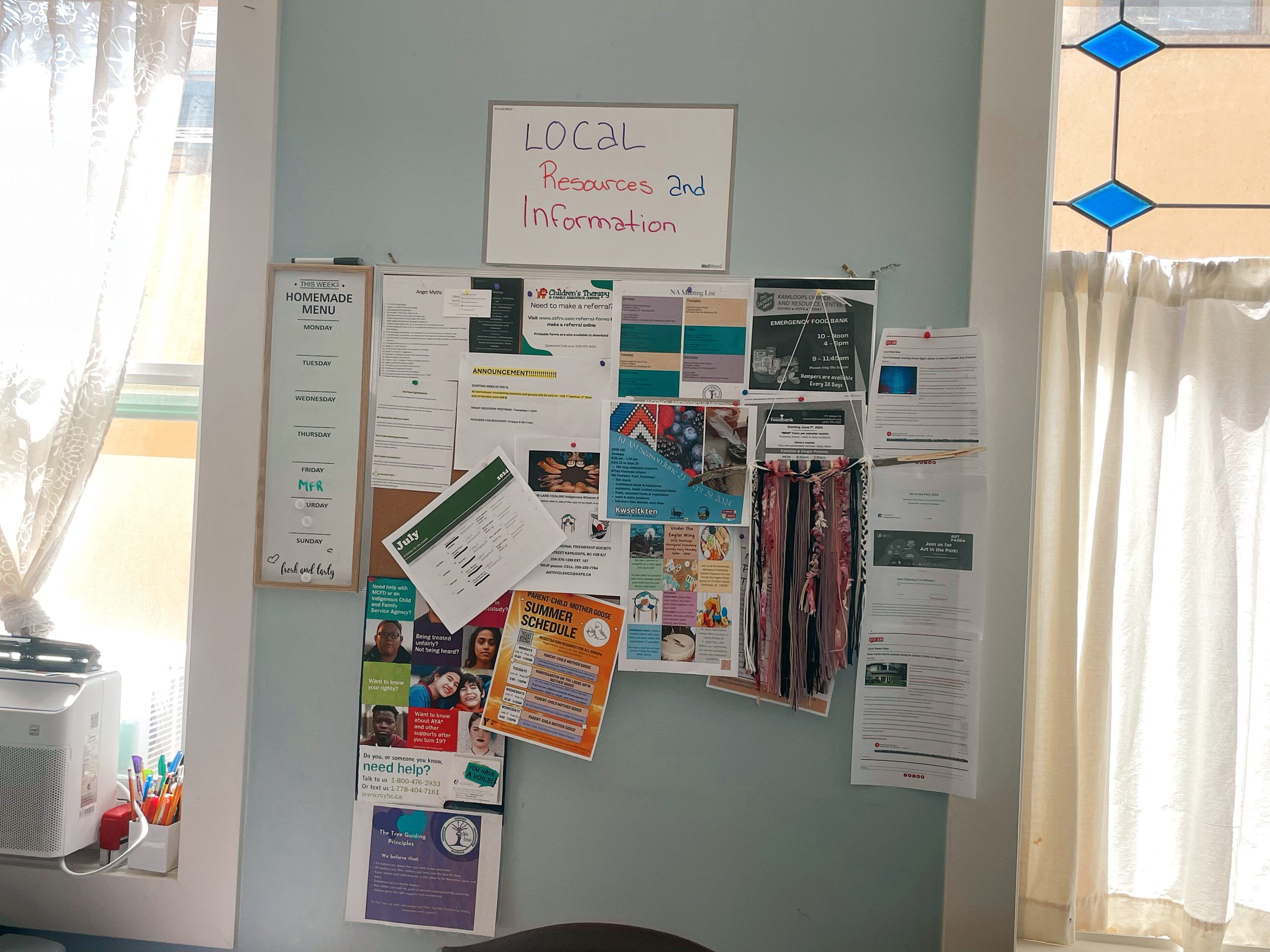
Low barrier refers to support services that are accessible to people struggling with poverty, trauma, homelessness, substance use or other physical and mental health concerns that may create barriers to receiving help.
STREET ENTRENCHED
Street entrenched describes someone who is chronically homeless, and takes into consideration the barriers involved in exiting homelessness and comorbidities such as drug and alcohol use.. People who are street entrenched are impacted by poverty and may struggle to meet basic needs like food and shelter.

HARM REDUCTION
In the most basic sense, harm reduction are actions taken to reduce harm to ourselves when we know we are at-risk. For example, wearing a helmet while riding a bicycle, a life jacket while boating and using a condom are all forms of harm reduction. When talking about recovery, harm reduction is used to meet people where they are at. Examples of harm reduction related to drug use include safer smoking and injection education and supplies, drug testing and naloxone kits. Harm reduction can also make environments safer for people who don’t use drugs. Sharps disposal bins in public washrooms, parks and busy streets, for example, prevent others from hurting themselves on a used needle.
SUPERVISED CONSUMPTION SITE or SAFE CONSUMPTION SITE
A supervised consumption site is a private health care space for individuals to consume drugs while supervised by trained staff to prevent overdose. Consumption sites do not provide drugs for people to use. The staff, a nurse or harm reduction worker, provides recovery resources and after-care, ensuring the person is safe and connected to other support services. Supervised consumption sites prevent public drug use and overdose by providing people with an appropriate location to use drugs. A barrier to supervised consumption sites is the lack of supervised inhalation sites for people who use drugs by smoking. The BC Coroners Report on 2024 Unregulated Drug Deaths indicates that smoking (inhalation), is the most common way to use drugs, responsible for 71 per cent of deaths.
When The Wren visited the supervised consumption site at Kamloops Mental Health & Substance Use at 235 Lansdowne St, Jessica Mensinger, the substance use team clinical operations manager, shared that the supervised consumption site is the least used service they offer at their location.
DETOX
Detox, or withdrawal management, is the act of stopping alcohol or drug use and returning to a sober state. Withdrawal from certain substances such as alcohol and benzodiazepines pose serious health risks and it is not advised for a person to detox without medical supervision and support. In recovery programs, detox programs safely support someone in managing withdrawal symptoms with medical supervision. Programs are short-term, usually lasting five days, and do not alone address underlying reasons for drug use. Information on where to access detox near you can be found on the B.C. government website.
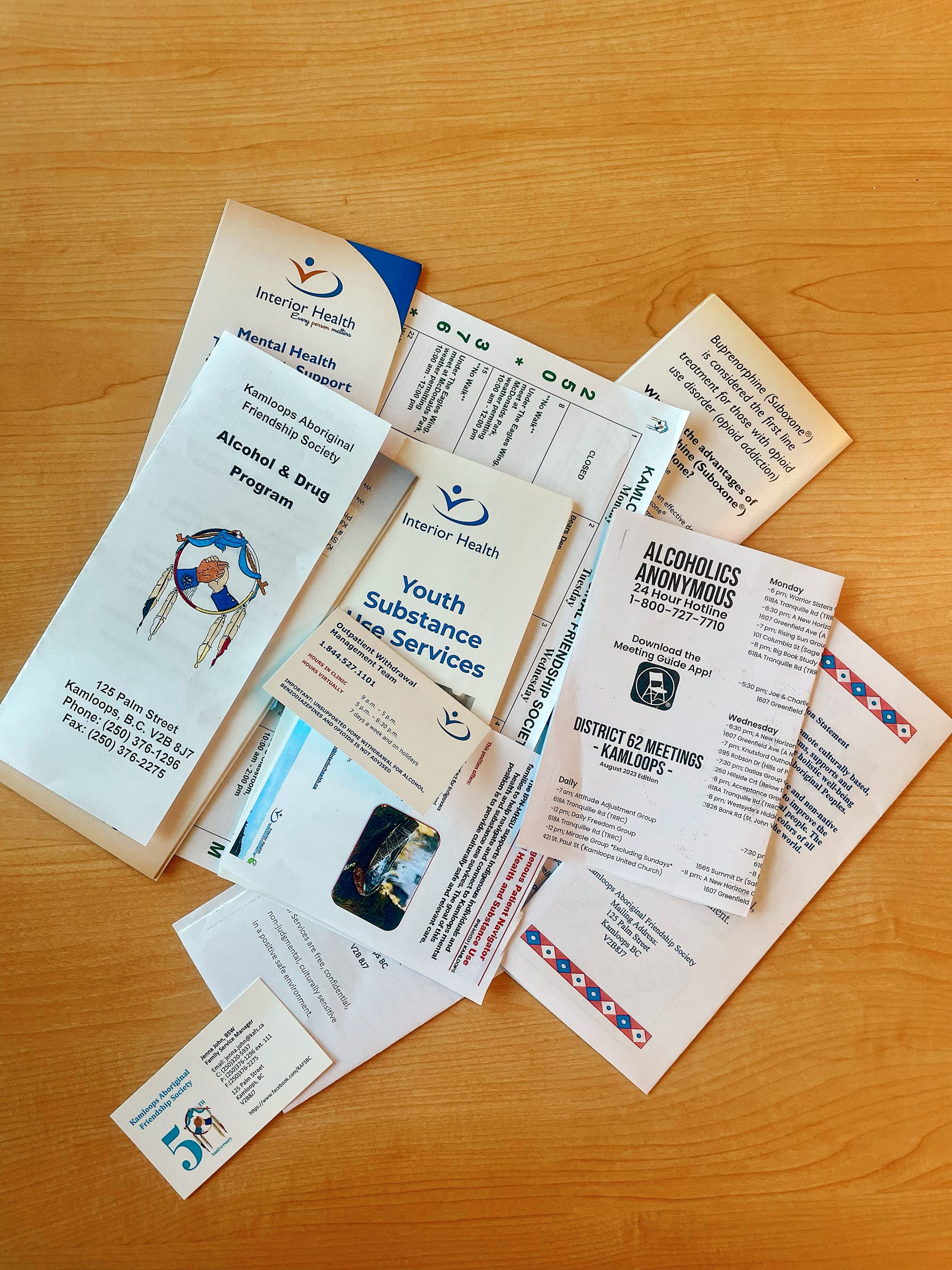
The only in-patient detox centre in Kamloops is Day One Society. Out-patient withdrawal management services are offered through Interior Health.
OPIOID AGONIST THERAPY (OAT)
Opioid Agonist Therapy (OAT) is a form of treatment that provides a daily prescription medicine for people addicted to opioids including fentanyl, heroin, morphine, oxycodone, hydrocodone and codeine. Examples of OATs are Suboxone, Sublocade, Methadone and Kadian. OATs can also be called ‘tie-out therapies’ (see Interior health OAT Fact Sheet).
Suboxone is a patch containing Buprenorphine and Naloxone, applied to the tongue, and is the first recommended OAT to try. Sublocade is an injection of Buprenorphine, meant to block opioid receptors in the brain. Methadone is a liquid oral medication, distributed daily by a pharmacist. Kadian is used for extreme cases of opioid dependence, when Suboxone and Methadone are ineffective. All OATs are used to reduce withdrawal symptoms and cravings and stabilise patients. Use is tapered off under the care of a physician.

FIRST STAGE
First stage programs are literally the first step in residential treatment. Clients must complete a period of detox. Detox may be considered the first stage as it is typically a requirement to enter a program. Clients are expected to be in the beginning stages of their substance use recovery, and would benefit from supervision, case management and mandatory programming. First stage programs are usually 30 days but some programs may be up to 90 days. Day-based or outpatient programs may fall under ‘first stage,’ like a mobile clinic or outreach services.
SECOND STAGE TREATMENT
After detox, the next step is second stage treatment. This will look different for each person.
During The Wren’s recovery series research, a gap identified by experts and service providers is the wait between detox and second stage treatment options. Second stage programs require a detox period, usually five to nine days sober, before starting. The programs can include therapy, stabilisation and transitional services, outpatient treatment or residential treatment.
Clients are expected to be active participants in their recovery, by engaging with staff and developing new coping and life skills through mandatory programming and groups. Second stage programs are longer than first stage, but still short term. Length varies by program but range from 90 days to four months. Some programs may be up to one year. The goal of second stage is to continue building the recovery and life skills necessary for independent living.
DAY TREATMENT
Day treatment refers to structured substance use recovery services accessed during the day rather than bed-based or live-in treatment programs. This could look like support groups, individual counselling and practicing coping skills.
RESIDENTIAL TREATMENT
Substance use treatment where a client lives in the program. Clients receive on-going supervision, individualized treatment planning and life-skills building. These spaces are communal and have requirements for staying like participating in groups and planned activities, engaging with staff, committed to staying in recovery and ability to live with others. Length of stay varies by program, and the minimum is 30 days. Government-funded programs are free or may charge a low per diem monthly rate. Private, not government-funded or owned residential programs can cost thousands of dollars but offer more individualized or specialized treatment not offered in traditional services. In Kamloops, SAGE Health Centre is a private residential treatment program.
OUTREACH
Outreach is support services on a street-based level. This typically involves an outreach worker,connecting with people in-person or by phone/texting. Outreach workers help connect street-entrenched folks with appropriate resources such as substance use treatment while helping meet basic needs such as shelter, food, hygiene products and harm reduction supplies.
CULTURALLY-GROUNDED
Culturally grounded resources are services run by Indigenous peoples or through a First Nations Health Authority. The approach to treatment is rooted in Indigenous knowledge and practices, such as connecting with Elders and Knowledge Keepers, sweat lodges, smudging kits and land-based practices. Research shows that substance use disorders disproportionately affect people who have survived trauma, including Indigenous people.
HOLISTIC
Holistic is a word used to describe treatment or therapy that accounts for an individual’s whole self. This means focusing on a person’s mental, physical, emotional, and spiritual health, and how they impact each other. Examples of holistic treatment include breathwork, yoga, acupuncture, meditation, and mindfulness (therapeutic techniques to bring awareness to the present).
Let’s move on to residential treatment or in-patient recovery services. These programs are considered live-in, meaning you will stay short term in a recovery house. There is some overlap in definition. For example, a program can be considered second-stage and also abstinence-based, or second-stage and supportive recovery based.
SUPPORTIVE RECOVERY
Supportive recovery refers to a short-term substance use treatment program, where clients live in the program. These programs are usually staffed 24/7, providing on-going support to clients during their day-to-day life while in recovery. Supportive recovery programs are communal, participants must be able to live in a group setting. Clients participate in structured routines, including recovery groups, therapeutic activities and life skill building. Staff support participants to maintain recovery by creating individualized relapse prevention plans and goal-setting. Supportive recovery programs use harm reduction, meeting people where they are at. This means a person could potentially have a slip (a small setback in recovery), and not be asked to leave, as long as they work with staff to move forward, committed to recovery.
ABSTINENCE-BASED
Abstinence means stopping use of alcohol and all drugs. Abstinence-based programs require participants to not use any substances, and remain committed to sobriety to continue receiving services. Also known as ‘dry.’
SOBER LIVING
A communal house or living space for people committed to not using drugs and alcohol, with a desire to live with other sober people. Clients in a sober living house are a few months or years into sobriety. Clients are required to engage in recovery-based activities (attending groups, counselling), while maintaining life skills (employment, education, relationship-building).
TRANSITION HOUSE
According to the Canadian Observatory on Homelessness, transition houses or transitional housing offer a safe, supervised living space for a short term basis, usually under a year, preventing homelessness during vulnerable transitional periods. Transition houses may support people leaving foster care, fleeing intimate partner violence, waiting for permanent housing, or being released from jail. Houses are staffed and structured, residents are expected to follow program rules.

ALCOHOLICS ANONYMOUS (A.A.)
An anonymous, free, peer support group for people who struggle with alcohol use. A.A. emphasises a higher power but is not associated with any religious affiliation. According to Alcoholics Anonymous’ website, “we are not allied with any group, cause or religious denomination.” There is no sign-up necessary to attend A.A. meetings. A.A. is open to people of all ages who want to improve their relationship to alcohol.
12-STEP/ THE TWELVE STEPS
12-Step refers to a core set of recovery principles and practices used in Alcoholics Anonymous. The 12-Steps are step-by-step actions or goals to work through, with the goal of recovery from alcoholism. The 12-Step model emphasises a higher power like A.A.
SPONSOR
A peer-mentor providing recovery support to someone in an earlier stage of recovery. Provided through A.A.
NARCOTICS ANONYMOUS (N.A.)
N.A. is an anonymous, free, peer support group for people who struggle with substance use. There is no sign-up necessary to attend N.A. meetings.
SMART RECOVERY
SMART is Self-Management and Recovery Training . Focusing on self-improvement, choice and mutual support, SMART uses strategies from Cognitive Behavioural Therapy and Rational Emotive Behavioural Therapy. SMART was created in response to the demand for an alternative recovery group option that wasn’t 12-Step. SMART meetings are free to attend, led by a trained facilitator, and offer peer-to-peer support.
RECOVERY DHARMA
Recovery Dharma uses Traditional Buddhist teachings and practices (including meditation), to help people find empowerment in their recovery. Recovery Dharma is trauma-informed and person-centred, meaning it acknowledges an individual’s whole self (mental/physical/spiritual health), and the impact trauma has as a result. Recovery Dharma meetings are free to attend, led by a trained facilitator, and offer peer to peer support.
YOUTH PROGRAMS
Services specific to young people and young adults. Programs vary in what they consider to be ‘youth,’ but are typically 12 to 24 years old. Youth services may be for youth in recovery, or living with someone in recovery/active addiction.
The Wren is a community driven local news outlet. Your questions and ideas help guide what we dig into. Your feedback after we publish a story helps ensure we're always improving our reporting to better serve you
What do think about this story?