
How a grassroots group created Kamloops’ first car share
‘If you want something done, you can’t just go out in the community and ask people to do it for you,’ says the co-founder of Propel Us Carshare Co-Op.
As residents of a car-dependent city, Kamloopsians are familiar with persistently high fuel prices, which have averaged $1.65 per litre over the last few years. The cost of maintaining a vehicle along with housing expenses has also increased for many households.
So it’s no surprise that a survey commissioned by Kamloops’ own car share service, Propel Us Carshare Co-Op, found that 54 per cent of respondents would use a car share service if it was available to them. A similar car share industry survey found that one in 10 people in British Columbia plan to stop owning a vehicle for financial reasons.
To fill these gaps, Miles Pruden co-founded Propel Us Carshare and is planning to launch the pilot program early next year.
The car share aims to be fully active by 2027 with cars available in select neighbourhoods in Kamloops.
What is a car share service?
Although car-sharing services first started back in 1948 in Switzerland, the first car share in Canada was introduced in 1994 in Quebec, and the Communauto program is still operating today.
But what actually is a car share or car sharing?
Car sharing is a type of car rental designed mostly for people who use a vehicle for a few hours each week or month. “For retired people, or people who work from home, who only need a car for errands, they could actually share a car,” Pruden says.
As described by the Government of B.C., in some cases, drivers pay a basic monthly fee and an hourly usage without having to pay for insurance, gas or repair costs. In other cases, users pay for how long they had the car and the distance travelled.
In most cases, the types of vehicles used for car sharing are hybrid or electric vehicles.
How will Propel Us Carshare work in Kamloops?
Pruden and a group of people got together after learning that parking drives up the cost of housing because land in B.C. is so expensive and parking takes up space.
“In a multi-family housing, if you have a parking garage, each stall in that parking garage will cost probably somewhere from the neighbourhood of $40,000 to $65,000 and it can go quite a bit higher.”
According to Pruden, parking fees could add 25 per cent to the cost of a home.
While they were looking to get the cost of parking reduced, Pruden heard the city might be amenable to giving parking reductions in spaces that have car shares.
They sought to bring a car share company to Kamloops and work with them but no one jumped on the opportunity, especially after the pandemic when fewer people were out and about.
After trying to enlist a car share company that already existed, they decided to create their own.
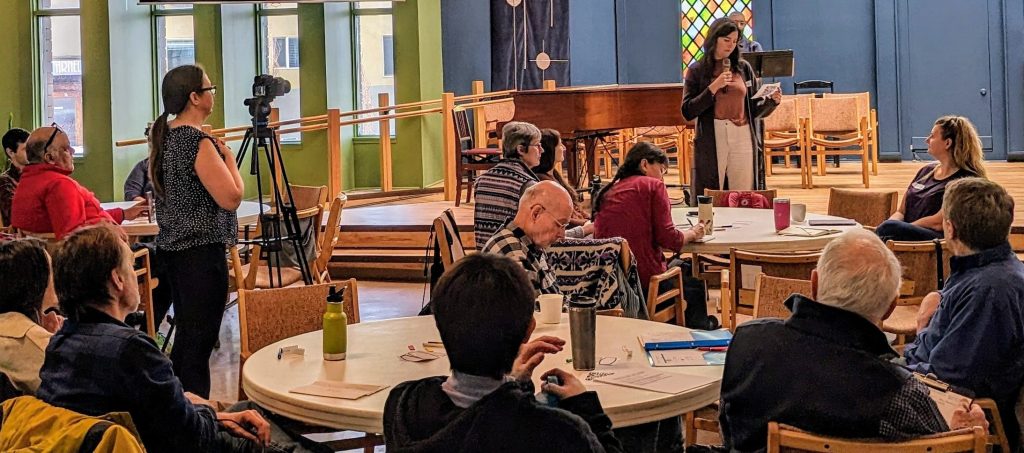
In fall 2022, Transition Kamloops was one of the groups that received a grant from the Canadian Community Economic Development Network to deliver a community climate action program. The funds were used to hold the Climate Action Fest, on April 29, 2023.
After Pruden proposed the carshare along with a group of volunteers who signed up, they were awarded $2,500 which was used to incorporate a co-operative owning model.
“If you want something done, you can’t just go out in the community and ask people to do it for you,” Pruden says.
Then in 2024, Transition Kamloops received a Social and Community Development grant from the City of Kamloops for Climate Action Fest 2.0. At this event the carshare was awarded an additional $1500 which they put towards their business plan.
There are different models of car share services and the model they are proposing is a round-trip car share rather than a service designed for one-way trips commonly found in larger cities like Vancouver.
“It works a lot like having a personal car. You just walk out your front door and there would be a car close to your house,” he explains. “This works in areas that are dense enough that there can be enough houses close enough to the car share.”
Propel Us Carshare Co-Op will have a pilot program with simple infrastructure, but the idea is to eventually have someone scan in with their phone or fob to use the car. The plan is to have folks pay for the time they are using the car on an hourly basis. The service will take care of maintenance, fuel or other issues and the idea is to provide access to various vehicles.
Their research shows respondents would use the carshare service if it was available to them. “In our calculations, 25 per cent would use it as their only vehicle, and 75 per cent would use it as a secondary vehicle, or third vehicle,” Pruden says.
For the neighbourhoods like Sahali which have become densely populated in Kamloops, the plan is to eventually have two cars within walking distance of 20 households, Pruden states.
The locations of cars will be geographically limited and focused on these neighbourhoods. Although they are still figuring out what type of vehicles will be available, once the pilot program starts, two electric cars will serve a limited geographic area.
“Electric cars are great for getting around town and maybe trips to some neighbouring cities, but we’ll probably have a plug-in hybrid electric so people can go on long trips without having to worry about charging. Probably we will have a truck so that people can use it for a moving day,” Pruden says.
Once the service is fully up and running, folks will be able to book a car in advance through a website that will later be converted into an app.
How does that help communities?
According to a report by Ratehub published earlier this year, the average cost of owning a car in Canada is $1,387 per month making it $16,644 annually.
Pruden says the average cost per month for the car share would be $100, helping households save money.
For households that have two vehicles or just use a car for errands, car sharing can alleviate some costs and provide flexibility. But he acknowledges they aren’t useful for every task.
“They’re not good as a commuter vehicle because the metre is running when it’s parked. It would be probably more expensive than a personal vehicle to use for a commute,” Pruden says.
In addition to providing more options to households, the car share service can also lend a hand to the Community Climate Action Plan by reducing the number of personally owned cars and greenhouse gas emissions.
“It allows people to rely more on transit and active transportation, because especially in a sprawling city like Kamloops, you can’t do everything on bike or by bus,” Pruden says.
The Wren is a community driven local news outlet. Your questions and ideas help guide what we dig into. Your feedback after we publish a story helps ensure we're always improving our reporting to better serve you
What do think about this story?
Author

Related Articles
Here’s how general election candidates will tackle affordability in Kamloops
Kamloops’ 2026 general election candidates share what steps they’d take to improve affordability.

Here’s how general election candidates will navigate homelessness and mental health issues in Kamloops
Kamloops’ 2026 general election candidates share share how they’d respond to homelessness, mental health issues and addiction.

Indigenous Film Festival returns ahead of National Day for Truth and Reconciliation
Indigenous storytelling shapes fifth annual film festival over three days this weekend.
