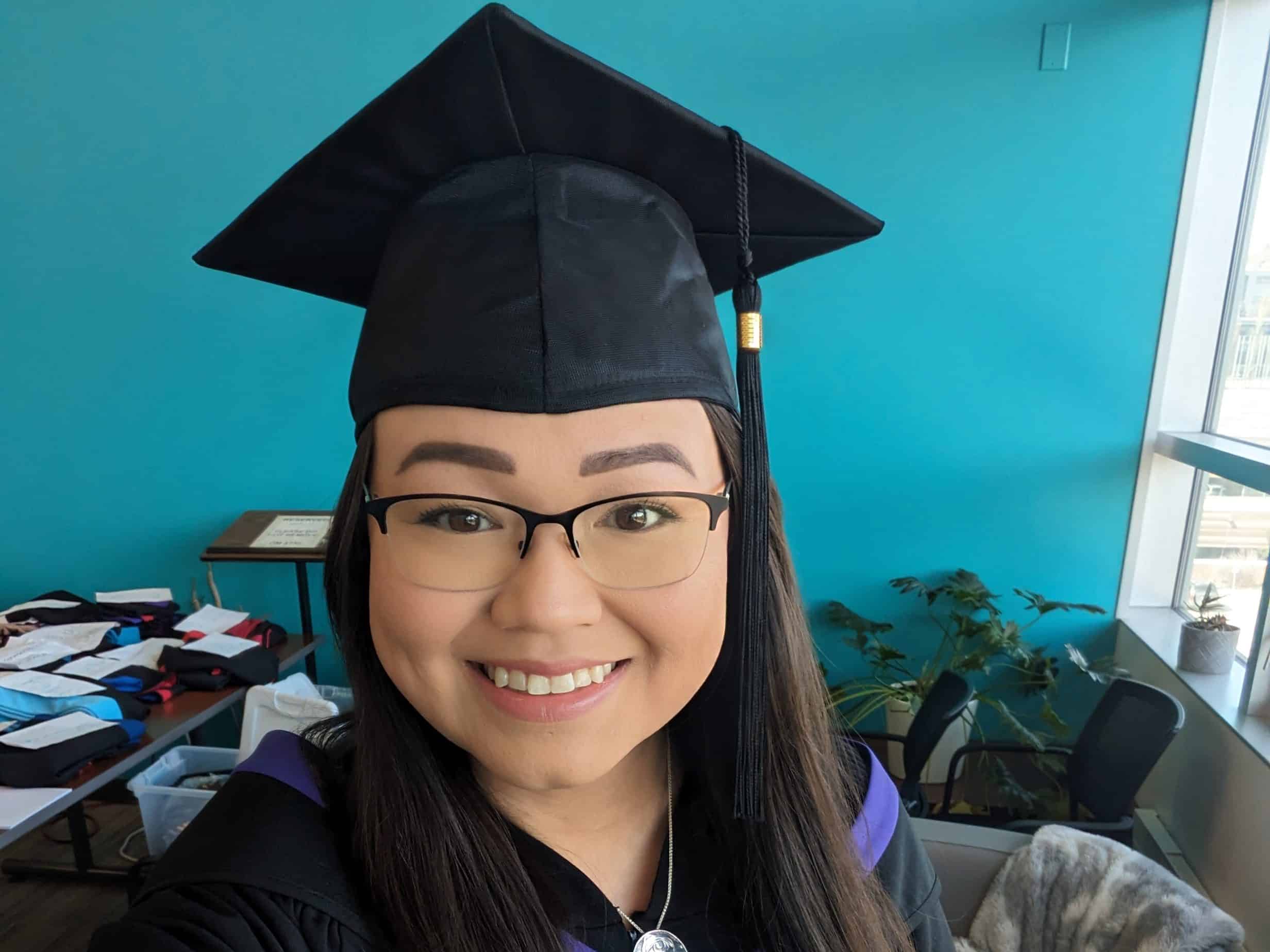
Last year, Thompson Rivers University (TRU) Law student Tara-Lynn Wilson (Toé Qwalax) sat at a negotiation table representing Coastal Gaslink, the company responsible for installing a pipeline through several Indigenous territories from Dawson Creek to Kitimat, B.C.
Wilson was participating in the Kawaskimhon National Aboriginal Moot Court, a non-adversarial simulated court proceeding that incorporates Indigenous legal traditions and concepts of dispute resolution alongside federal, provincial and international law.
Teams represent a variety of parties, depending on the nature of the moot problem, such as First Nations, band councils, hereditary chiefs, organizations, government agencies and industry.
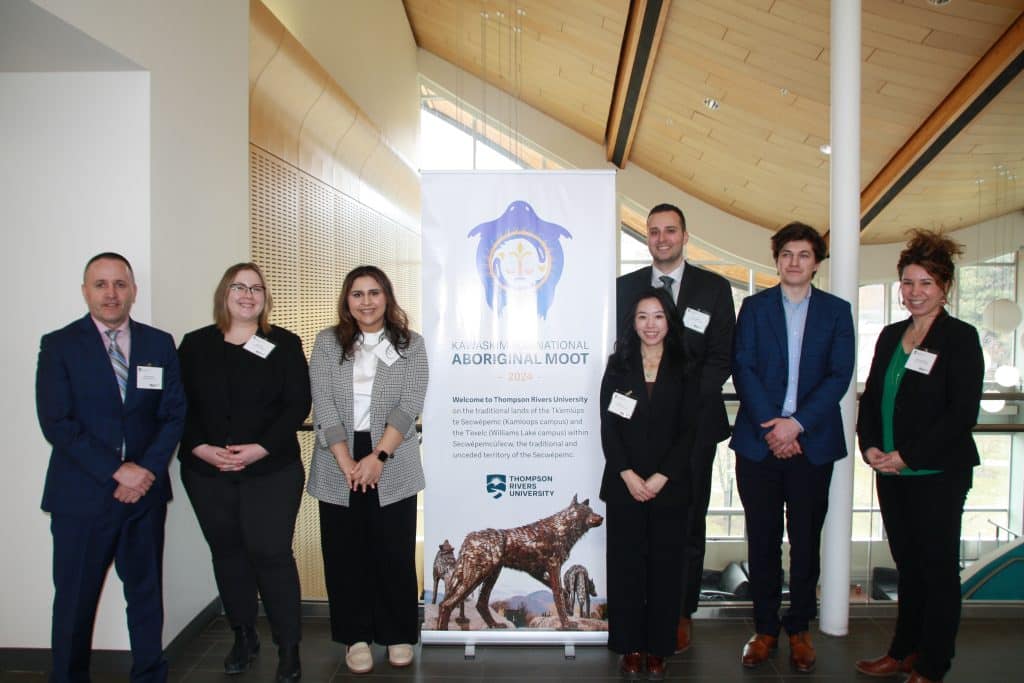
TRU hosted the moot for the very first time in March, where law students from across Canada negotiated an agreement for another pipeline project, this time the Canadian government-owned Trans Mountain (TMX), which cuts through a sacred site called Pípsell in Secwepemcúl’ecw. Open to both Indigenous and non-Indigenous students, the moot is intended to deepen their understanding of Indigenous legal issues and Aboriginal law.
The problem was that Wilson, who is Xen’ak’siala from Kitamaat Village within Haisla Nation, was strongly against the pipeline projects set to run through her community. But as a lawyer, she was there to advocate for her client.
“I don’t necessarily have to agree with them, but I need to make sure the law is being followed,” she says.
As an Indigenous person, Wilson was able to look at Aboriginal law and environmental Aboriginal law aspects and work to get the best deal for the Aboriginal parties involved in the discussion. In the end, the group was able to reach a consensus.
Now a third-year law student, Wilson aspires to become a judge and bring awareness to Indigenous issues and improve Indigenous rights. Most notably she is continuing the historic legacy of her father and uncle, who fought for the inclusion of Indigenous rights in the Canadian constitution — and won.
Barry and the late Derek Wilson were artists and activists who carved coins to raise money for the Constitution Express: a protest movement against the patriation of the Canadian Constitution proposed by the previous Trudeau government.
On Nov. 24 1980, activists led by George Manuel, leader of the Union of BC Indian Chiefs, boarded two trains in Vancouver and headed for parliament in Ottawa to lobby for changes to the constitution. When they received little response, the movement continued on to New York, then Europe.

“My dad and my uncle did that activism as best as they could with the education that they were allowed to have, and that they were permitted under these laws to have,” says Wilson, who only knows of one other person in her community with a law degree.
“I’m driven by exactly the same thing, but using the tools that I was permitted to have in this day and age. So I’m kind of continuing the work they were doing from inside the colonial system that knocked them down.”
As president of the Indigenous Law Students Association (ILSA) at TRU, Wilson is determined to help other Indigenous students succeed and change their communities. She connects people to law firms in Tk’emlúps (Kamloops), provides learning opportunities on Aboriginal and Indigenous laws and ensures ILSA is a safe space for its members.
She initially wanted to pursue criminal law, “because my people are so over represented in the criminal justice system,” she explains. But that soon changed.
“I did have this whole idea where I didn’t want to get into Aboriginal law, because I felt like that was where everyone was expecting me to go. But then as I thought more about it, the reason why I got into law was to help my people. So why would I try to steer away from that?”
The re-emergence of Indigenous law
Aboriginal law is a body of law made by the courts and legislatures handling the relationship between Aboriginal peoples and the Crown, such as Delgamuukw v British Columbia. It recognizes Indigenous laws covered by the Canadian constitution or other laws such as the Indian Act.
Indigenous laws, on the other hand, are the legal orders rooted in Indigenous societies themselves, pre-dating European contact. Today, judges are expected to have a firm understanding of both, and make judgements based on their knowledge.
“The way that I always thought of [Aboriginal law] is just thinking of it as a colonial construct,” Wilson says. “It’s something that was originally created to oppress Indigenous people.”
Chief Justice Leonard Marchand, British Columbia’s first Indigenous Chief Justice, says although Indigenous law is becoming more recognized under Canadian law, it’s important to note that it’s been present much longer.
“Sometimes I hear people talking about this ‘emerging area’ of Indigenous law,” Marchand explains. “It’s something that was here before Europeans arrived. So you can’t really talk about it as emerging. I think it’s fair to talk about it as re-emerging.”
Federal and provincial governments have historically refused to govern alongside Indigenous governments, leaving it to the courts to decide when and how to recognize and implement Indigenous laws within the Canadian legal system.
The problem, according to TRU law professor Bradford Morse, is there is a lack of clarity coming from the Supreme Court of Canada to properly distinguish between Aboriginal and Indigenous laws.
“If it came from the Supreme Court of Canada then it would, if not embraced, at least be accepted by all other courts in Canada,” Morse explains. “Now, that doesn’t mean that Indigenous peoples will accept how it’s framed, they may still oppose and argue that it should be different. And then we’ll again see more kinds of litigation.”
Varied opinions on the application of Indigenous law have resulted in inconsistencies. In decisions like Pastion v. Dene Tha’ First Nation (2018) and Tsilqot’in Nation v. British Columbia (2014), the Court acknowledged Indigenous law regarding elections and custom leadership and the right to decide how lands are to be used or managed, respectively.
But in Coastal GasLink Pipeline Ltd. v. Huson (2019), the Court ruled that the Indigenous laws of Wet’suwet’en Nation had to be recognized through treaties, court declarations or statutory provisions to be effective under Canadian common law.
Marchand, the keynote speaker at this year’s Kawaskimhon Aboriginal Moot at TRU, agrees that Indigenous legal orders will have to work together with Canadian domestic law in the future to deal with these sorts of issues.
He points to Gladue principles as an example. To better recognize the impacts of colonization on Indigenous communities, Gladue principles were introduced into the Canadian criminal justice system in 1999, whereby judges must take into consideration a person’s individual circumstances before determining a sentencing.
Still today, racism and intergenerational trauma associated with colonization means about 35 per cent of people in custody are Indigenous, despite making up about six per cent of the population.

As an Indigenous judge who grew up in Kamloops, Marchand has always been aware of the over-representation of Indigenous people in the criminal justice system.
Like Wilson, he started out in one area and had a change of heart: Marchand initially became an engineer before attending the University of Victoria’s Faculty of Law (TRU law opened its doors in 2011) with a mission of helping his community. Becoming a lawyer seemed to be the right fit.
Marchand moved to Kamloops to work as a lawyer for Fulton and Co., and had a significant role in negotiating the Indian Residential Schools Settlement Agreement.
He too, is continuing a family legacy: his father, Leonard Marchand Sr., became the first Indigenous member of parliament. A former Liberal MP and senator from Kamloops, Marchand Sr. was active in the North American Indian Brotherhood, which lobbied for Indigenous rights like voting in federal elections.
“[My dad] really believed in the idea that Indigenous people should have meaningful roles everywhere in Canadian society, and demonstrated what’s possible,” Marchand shared while addressing law students at TRU. “He was a major inspiration to me.”
When he became a judge, Marchand says he hoped he “could more than make up for” his lack of subject area experience through his understanding of how Indigenous people who have experienced trauma come into conflict with the law, how they should be treated through the legal process and how the legal process at its best, can really help turn lives around.
As a judge, he has to balance patience and empathy.
“Judges are supposed to exercise superior judgment, not be superior and judgmental,” he tells The Wren.

He strongly believes other justices should recognize the need to have two tracks in the legal system, as outlined by the BC First Nations Justice Strategy: the first is making improvements to the system that we already have by ensuring people are treated the right way in the judicial system and “where people feel they will be heard, will be respected and can see that justice is done.” The second is looking for alternatives to our existing system.
For several years, Marchand presided over court proceedings at the Kamloops Cknucwentn First Nations Sentencing Court, created by another prominent legal mind from Kamloops, the Honourable Judge Linda Thomas, a member of Tk’emlups te Secwepemc.
Before the sentencing court opened at the Kamloops courthouse on Columbia Street in March 2013, local judges were “frustrated by their inability to effectively address the root causes of offending,” the provincial court website explains. It was Thomas who urged the provincial court to set up a specialized court for Indigenous offenders, which she went ahead and did with no funding or a dedicated space.
There are currently nine Indigenous sentencing courts in B.C. for those charged with criminal offences. The court includes a traditional ceremony where offenders sit in a circle composed of a judge, First Nations Elders, and often the victim. Local First Nations are encouraged to contribute to the proceedings. Offenders are often given a sentence that doesn’t include jail time, in addition to a healing plan and instructions to report back to court every three to six months.
Marchand has witnessed some incredible healing through this process: for the offender, as well as the victim(s) and community.
“It was one of the most important experiences I had as a trial judge,” Marchand says. “I learned so much working with the Elders. They had their own ideas, were aware of the resources in their communities and had their own way of bringing home to clients the harms that were associated with the thing they had done.
“They also had a special way of expressing their support for clients and providing them with a pathway to being better. I didn’t only get to take those ideas with me and apply them in relation to Indigenous offenders, some of the ideas apply universally. I carry the lessons I learned from the Elders with me everywhere.”
Indigenous Justice Centres a way forward

Other alternatives to the existing system of law include organizations like the BC First Nations Justice Council (BCFNJC), the only Indigenous justice council of its kind in the world. They provide wraparound services in child protection and criminal defense free of charge at Indigenous Justice Centres, creating a safe place for people to turn for help.
After piloting a few of them, five new centres were announced last year for Kelowna, Surrey, Vancouver, Victoria and Nanaimo, and the Justice Council has other Indigenous communities from across the country reaching out wanting to start something similar.
While the BCFNJC describes sentencing courts as a “important initiative,” they have been working toward the implementation of Indigenous courts where First Nations laws and jurisdictions are applied.
BCFNJC has also set up a clinical supervisory model allowing them to have younger lawyers they could train to practice in a way “that isn’t complicit in the continued genocide of Indigenous people,” says the organization’s CEO, Amanda Carling.
Historically, the Law Society of B.C. required all lawyers to be on the provincial voters list to practice — a right some Indigenous people weren’t granted until 1960. When Carling, who is Métis from Red River, Treaty One, attended law school, she realized that lawyers helped facilitate the genocide against Indigenous peoples.
“Lawyers created residential schools, lawyers created the government that took up the land, and lawyers wrote the Indian Act,” she says. “There’s a section in the Indian Act, where they’re like, ‘they’re making too much gain with the land claim, so we’re going to make it illegal for them to hire lawyers.’ The whole structure and precedent have been set with the exclusion of Indigenous people. So we’re now just trying to catch up and also, at the same time, tear down the systems that were created without us.”
After launching three pilot Indigenous Justice Centres, last year, BCFNJC created an operational protocol to scale up the program.
“We want to pay lawyers to not just care about the sentencing that’s coming up, but to actually be able to spend that additional time with a client and talk to them, especially if they’re an individual who speaks English as an additional language and doesn’t understand the legal system,” Carling shares. “And figure out what are the other issues that brought them so that we don’t see them again.”
Some of those restorative rehabilitative principles apply in other areas of the law, according to Marchand.
“Often the ideas come into play, for example in child protection cases or certain kinds of family cases, and even other kinds of civil litigation where you’d really like to give people a different path forward than conflict and litigation.”

When it comes to civil litigation, TRU alumna Chrystie Stewart is implementing Aboriginal principles as the founder and president of the Indigenous Mediation and Negotiation Centre (IMNC).
Stewart, a graduate of the first law class from TRU and an Indigenous legal advisor for Indigenous students at TRU, also participated in the law school’s first Kawaskimhon Moot Court at Western University. She now owns her own law firm in Kamloops. Stewart noticed that despite mediation being a central part of Indigenous culture, she hasn’t seen a single Indigenous lawyer on the roster for the organization Mediate BC
IMNC gives people the chance to participate in the system rather than just be bystanders in court. Through mediation, she has resolved several land disputes that could have ended up in a court proceeding, and says not only is it more accessible and saves on legal fees, but it also gives people a better outcome. Anyone can access the IMNC, which handles dispute resolution, including land claim issues and workplace conflicts.
The idea for IMNC was born out of her experience practicing law. Stewart accompanied two Elders who went to court over a land dispute with a developer who began building a mobile home park on property their father had left them.
“Nobody would help them,” Stewart says. “They cobbled together some money, got a lawyer, went to court and the judges didn’t understand…[they] weren’t looking at it like a fairly simple legal issue, which was did he have the right to do it in the first place? So the process that is set up before them isn’t made for them.”
During the two-week trial, Stewart says her clients had no idea what was going on while they sat at the back of the courtroom. Meanwhile, her firm at the time had sunk millions of dollars into the trial. Legal opinion is usually that you have the right to a certain amount of land, but this gets expensive and complicated, whereas mediation can get to a solution specific to the needs of the client.
“The flexibility that mediation offers, is that you can say, well, I don’t really care about the bare land because I’m older, and I’m really more interested in just having some revenue…Ultimately, people have the opportunity to express what their specific needs areand then we [can try] to accommodate it.”
Stewart, the first named partner from TRU law who identifies as a woman, is hopeful that as more young people and Indigenous lawyers start their careers, and continue to be educated about Indigenous issues and practices, the legal system will change for the better.
“When I think about reconciliation, I would like to go into a courtroom where the judges are like, no problem, we can deal with this issue; that it just becomes commonplace for them. Change is slow and long, but when it happens, it is significant. So am I hopeful about that? Yes, absolutely.”
Young Indigenous lawyers leading change
What excites Wilson the most about being one of those young Indigenous people pursuing Aboriginal law is the fact that it isn’t staying stagnant.
“This legal concept that was meant to keep Indigenous people where they were, is no longer there. So the implementation of Indigenous laws into Aboriginal law makes me happy, knowing that we’re moving from that one, kind of prison of Aboriginal law, moving forward to something that will give us our actual rights as human beings.”
TRU law students take a required course on Indigenous legal relations to learn about Indigenous Laws, Crown – Aboriginal relations, Treaties and Aboriginal Rights. The course includes skill-based training in intercultural competence, anti-racism, human rights and conflict resolution. Wilson’s wish is that one day Aboriginal law won’t be such an elusive thing that people are scared to step close to.
As the first recipient of Fulton & Co’s Future Indigenous Lawyers (FIL) scholarship for TRU law students and a recipient of the Aboriginal Lawyers Forum Student Appreciation Award from the Canadian Bar Association of B.C., Wilson is excited to have such prestigious role models to look up to. She and Marchand have spoken several times and she hopes to model her career after his by making headwaves in B.C.’s legal system.
On his part, Marchand says while he appreciates the significance of having an Indigenous person in his role, he aspires to a time when it is normal to have an Indigenous person, or a person from other equity-deserving groups to serve in any capacity within the justice system. Just three per cent of people working in law in B.C. identify as Indigenous.
As he shared with future lawyers on campus, he still thinks of himself as a “small-town lawyer from Kamloops.”
“I’d never aspired to serve as Chief Justice, I’d quietly done some things in my legal career that I was proud of, but only because I thought that they were good things to do,” he told the audience.
“I don’t consider myself to be a particularly inspirational person. But I do hope from time to time, to inspire others to be their best, and to make a difference. We can and should all aspire to play a meaningful role in maintaining a justice system that delivers on its promise, where everyone feels welcomed, respected and heard.”
Editor’s Note April 10, 2024: This is a corrected story. A previous version incorrectly stated Marchand grew up on reserve near Vernon. In fact, his father grew up on reserve and Marchand was raised off-reserve in Kamloops.
So do we. That’s why we spend more time, more money and place more care into reporting each story. Your financial contributions, big and small, make these stories possible. Will you become a monthly supporter today?
If you've read this far, you value in-depth community news