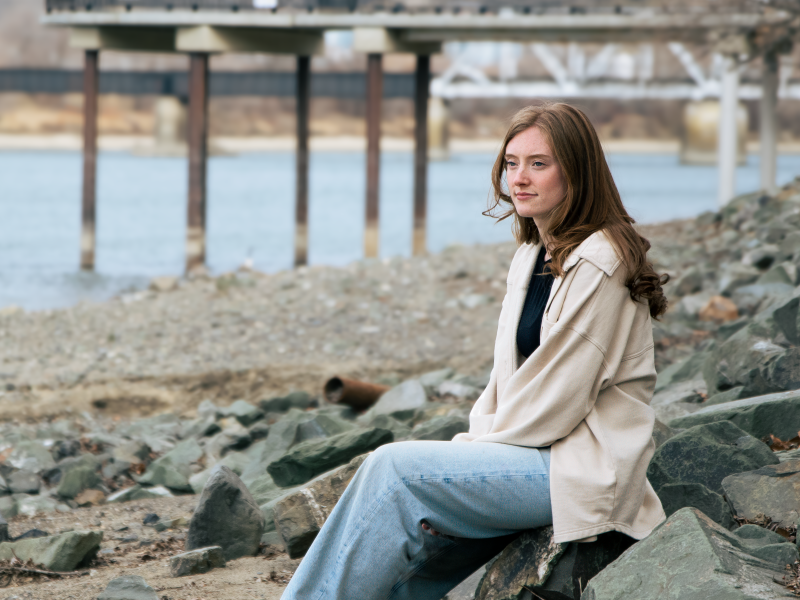
When Reagan first heard the warnings about Hurricanes Helene and Milton, it felt like any other storm season alert. Growing up in Nassau, Bahamas, she was accustomed to the rhythmic response to such alerts: boarding up windows, securing sandbags, and stocking up on emergency supplies. Storms were routine, even predictable, until these two struck. Now 27-years-old and pursuing a degree in communication and digital media at Thompson Rivers University in Kamloops, British Columbia, Reagan lives far from the Bahamas. But her relatives, who live just outside Tampa, found themselves in the path of two hurricanes that hit Florida back-to-back.
I’m not from Florida, but I do have family members that live in that area. The Bahamas itself is pretty close to Florida. We always get mistaken for being a part of Florida because of how close we are to it. The community that my family lives in is an hour outside of Tampa and it’s a pretty quiet suburban community. It’s close by the beach and it’s close by the water so already they’re at a big disadvantage, being so coastal.
My relatives are elderly and there are a lot of preparation steps like boarding up our windows, getting sandbags, and getting food. They’re not able to do that because of their ailments. They’re slow and they can’t lift things. So the biggest thing my cousins and I had to do was trying to figure out who their neighbours are, calling around the community, and finding out who can put up the shutters, who can put up sandbags, who can get them food, and who can take them to evacuate.
With older people, they’re not very technologically savvy. For example, I asked my uncle to send me a person’s number so I can have them make sure you guys are okay. And they’re like, “How do you send a contact? Or how do you do this? Or how do you do that?” So having to sit with them on video call and telling them how to do it, it’s still not the same. They don’t understand it. So that was a very long process for sure.
Family members were calling hotels, calling shelters, and trying to figure out what would be the best place for them. They were organising aid in terms of money for food and gas, in the event that we couldn’t get them to a shelter. Could we find somebody that we can pay to drive them to this hotel?
For me the moment of fear was hearing how the hurricane broke the barometer in terms of its strength. It’s scary to have your relatives in a position like that and you’re not physically there to help or be some sort of comfort. Even though I can call and text, those two weeks showed me that I’m a lot more helpless than I think I am. All I have is a phone. All I can do is call and talk, call and talk, and call and talk. But I can’t physically do anything. You’re just staring at a phone all day, every day. Hoping for a call that’s not bad news.
I will say that where my relatives were staying, the community was so together. Once we were able to overcome the barrier of finding people to talk to, it ended up being like, “Can you take the phone next door and let me talk to your neighbour?” Once we were able to do that and actually speak to people who understood technology, it became much easier. The moment of hope was being able to get my relatives somewhere safe and hearing from them throughout the storm being like, “We’re okay, we’re safe. We have food. Everything’s okay.”
There was a physical toll not knowing what the future held and what they would be going back to. It affected me quite a bit. When I was growing up, we expected two or three hurricanes during the entire season from June to November. Having two major hurricanes two weeks back to back is unheard of. I remember the mayor getting on the news and telling people that “If you don’t evacuate, you’re going to die. You need to evacuate because once the storm hits, we can’t come back out and get you until it’s passed. There will be no help for you if you don’t evacuate.” It was crazy to see the damage and the devastation.
My family ended up being okay. They’re currently back home. Their house is still standing. There were a lot of fallen trees and a lot of random objects and trash coming in from the water and the high winds. Part of the roof is missing, some doors and windows, but the house is still standing on its feet.
I felt a lot calmer. I also felt a sense of sadness for everybody that lost their house or lost their pets, or lost something or someone that was very close to them. All of the election-time-politics affected how far the government could go in helping people. They weren’t able to clean up before another one hit. So there’s trees down, poles down. Some places don’t even have electricity. Some places in Florida that the hurricane has hit are just dead zones.
Despite what happened, I think what brings me hope for the future is that a lot of people are now demanding aid from their government. It’s what they pay taxes for. They’re demanding aid. They’re demanding relief, they’re going to put their vote behind that. I think that gives me hope for the future, knowing that I’m not the only one who sees this, who understands this, and knows how dire it is.
When my relatives call me now, I do get a little tense. I get a little tense in the neck. I feel it in my neck and my shoulders. I squeeze my hands together involuntarily. Having your phone ring at 2:03 a.m. I feel I have to pick it up because that could be super important. I am very sensitive to my phone ringing or hearing a lot of notifications. So now I’ve had to turn my notifications off, sleep with my ringer off, and be in complete silence at a certain point at night.
I think that when you live with the idea that at some point a hurricane could just come and wipe you out at any moment, there’s really nothing you can do about it beyond just a small evacuation bag, you appreciate each day a lot more. You laugh louder. You eat the food you want to. In the context of those two weeks, I did a lot of sleeping. I did a lot of praying. I read books. I listened to music, and I went for walks. There’s nothing like a giant hurricane that’s hitting off the barometer to remind you that life is fragile, comes at you fast, and if there’s someone in your life that you’re not speaking to, and you’re standing in your pride because you feel like you’re right, let it go.
This story is a part of a series created by Thompson Rivers University students and led by instructor Jennifer Chrumka as part of the Climate Disaster Project.
The Wren is a community driven local news outlet. Your questions and ideas help guide what we dig into. Your feedback after we publish a story helps ensure we're always improving our reporting to better serve you
What do think about this story?