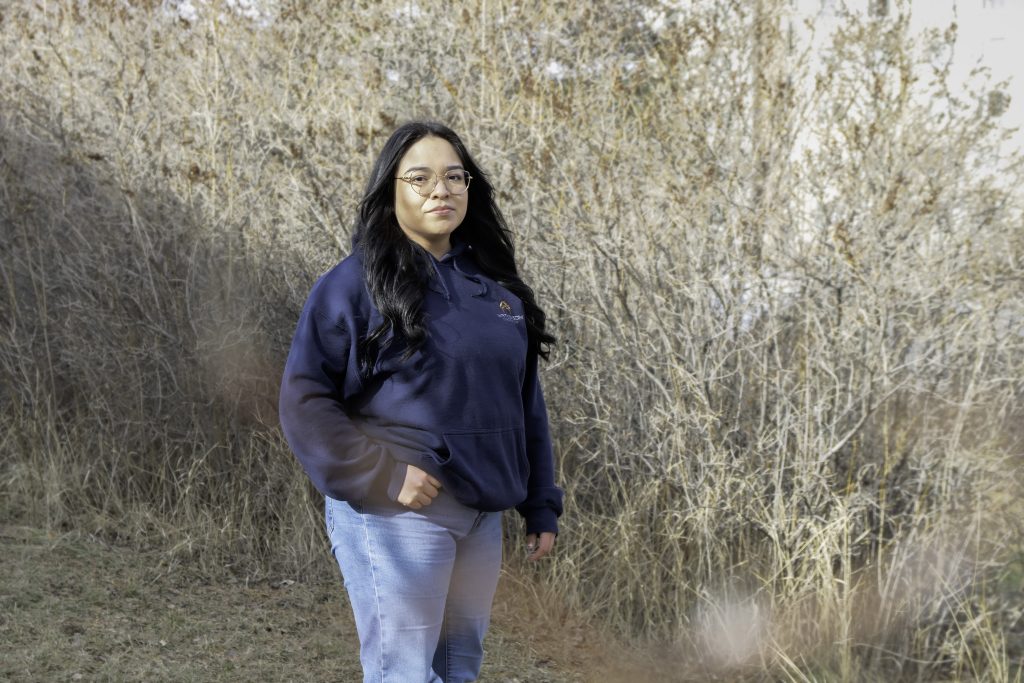
Cheyanne, a communications student at Thompson Rivers University, has had life that’s been shaped by playing on the ice and fighting fires. She loves to play matches and organise fundraisers within the community. Cheyanne is also interested in audio storytelling and wants to record the oral histories and knowledge from the St’át’imc culture and her family. Cheyanne lived in Lillooet, British Columbia with her parents and two older brothers until she was a teenager. It was her family who encouraged her to consider firefighting. In 2017, at the age of 18, she was a rookie with the BC Wildfire Service, fresh out of boot camp.
It felt like firefighting was in my blood. Many of my family members were firefighters. Growing up, I watched my uncles work fires and felt inspired by their efforts to protect the community. BC Wildfire gave me the opportunity to work alongside my brothers and uncles. I chose firefighting over hockey, even though I had been scouted by five universities for the sport. I wanted to do something meaningful and work alongside my brothers and uncles. I was very motivated to give back to the community.
The first day of the Elephant Hill fire stands out vividly in my memory. It began when we received the call to Ashcroft. My crew was from the Lillooet region, under the Kamloops Fire Centre. I recall a sense of excitement mixed with nervousness. This was my first fire. As we approached the scene, I saw a massive wall of flames sweeping across fields, moving faster than anyone could have anticipated. My crew’s first task was to protect houses in the fire’s path. We tried everything, setting up sprinklers, and looking for car keys to save vehicles. I felt this was the right place to be, until I saw the flames. I remember seeing a beautiful red 2017 Jeep Wrangler, one I desperately wanted to save, but the fire forced us to retreat before we could do anything. The fire consumed entire homes within minutes.
While retreating, our whole team was driving through the flames, which was terrifying. I couldn’t see anything except the taillights of the truck in front of us. The fire closed in on both sides of our vehicle, and the heat was so intense that it felt like I was cooking inside the truck. One of my crewmates had to push me down to avoid the flames licking the windows. I thought, “This is it; I might not make it out.” Moments like these became all too familiar that summer.
The dangers were relentless. At one point, we crossed a bridge that was on fire. We couldn’t afford to slow down, even as the flames roared around us. During another operation, I encountered dense black smoke leaving me disoriented and gasping for air. I had to crouch behind a rock, using a hose to spray water against my visor, creating a small pocket of breathable air.
One of the most terrifying close calls was when my brothers and I were nearly crushed by a massive boulder. It landed right between us while we were walking in a line. If any of us had been a few steps to the side, the outcome could have been devastating. Another time, we were sent to work near live power lines despite the clear danger. When the dry grass around us ignited, we barely escaped. It was clear that firefighting methods hadn’t evolved to match the intensity of modern fires.
Firefighting also came with emotional challenges. I missed significant family events, including my uncle and aunt’s wedding. I remember sitting in my tent, crying because I couldn’t be with them on their special day. My family, however, did their best to stay connected. My parents would drive for hours just to bring us food and remind us that we were loved. They even arranged a surprise video call during the wedding, projecting us onto a screen for everyone to see.
As a woman, I faced bullying and harassment. Some male firefighters treated me as if I didn’t belong, criticising my every move. I wasn’t even allowed to take a bathroom break without being scolded. Jokes often crossed into inappropriate territory, with sexual comments disguised as humour. I never expected them to treat me this way.
For a long time, I couldn’t talk to my family about what I had gone through. My mom worried about me constantly, and I didn’t want to burden her with the details. When I returned home between shifts, I tried to forget everything by drinking and partying. Over time, I realised that avoiding my feelings wasn’t sustainable. I sought counselling and began to confront the trauma. It hasn’t been easy, but I’ve learned that talking about my experiences helps. Although the memories of that fire season will always stay with me, I’ve found a way to move forward and make peace with my past.
I hope that sharing my story will encourage others to do the same. I hope that this helps another firefighter, especially a lady firefighter. There’s stuff that goes on behind the scenes for ladies in the wildfire service. There’s some unfortunate circumstances that you can be put into. Just know that you’re not alone. There’s a bunch of us who are out there, and there is a support system for you.
Looking back, I do have regrets. There are moments when I wonder if I should have pursued hockey instead of firefighting. The memories of that fire season will always stay with me. But I’m proud of what I’ve accomplished. I’ve found a way to move forward and make peace with my past. I now play on a senior women’s hockey team and host an annual charity tournament in Lillooet, combining my passion for the sport with community service.
But, to be honest, I feel like we’ve been stuck trying to fight fire in the same ways for so long. It doesn’t work anymore. The fires are more severe. They’re more intense. They’re faster. They’re unpredictable. You hear people say, “Oh, you just see firefighters sitting on the side of the road.” They’re trying to figure it out. That’s why it’s nice to see Thompson Rivers University has a wildfire program. I’m excited to see if they can provide more innovative responses to these wildfires.
When I think about all these things that are happening, not only with wildfires, but with all these climate disasters, it’s like “Crap. I want to have a family one day. Do I really want to bring them into this?” But that’s where hope comes into play. I keep riding on that. Because if you don’t have hope, then it really destroys you.
This story is a part of a series created by Thompson Rivers University students and led by instructor Jennifer Chrumka as part of the Climate Disaster Project.
So do we. That’s why we spend more time, more money and place more care into reporting each story. Your financial contributions, big and small, make these stories possible. Will you become a monthly supporter today?
If you've read this far, you value in-depth community news