
The Wren strives to ensure its reporting answers community questions and points to solutions. With this goal in mind, we created a series called Roadmap to Recovery focusing on Kamloops addictions recovery services, rooted in research and local voices.
Content warning: This story mentions overdose, substance use, the toxic drug crisis and death. Please read with care. To connect with your local mental health or substance use centre, call B.C.’s Mental Health and Substance Use line at 310-MHSU (6478), or visit HelpStartsHere.gov.bc.ca.
Diana Lowley sits in a mostly empty Kamloops parking lot surrounded by bags and a half-opened suitcase as she gathers herself.
The 43-year-old mother is seeking a stable place to stay and to get her teeth fixed, so that she can find a job and access treatment for her substance use.
“As soon as I get housing, then at least I know I have a home,” she tells The Wren. “From there, I normally get a job, just like that.”
Nearly three decades earlier, as a young teen, she’d moved with her family from Prince George. At age 16 her mother died of cancer, and Lowley had her first child.
In the aftermath of her mom’s death, Lowley describes growing struggles with drinking.
Eventually, wanting better circumstances for her children, she gave up drinking, earned her adult high school diploma and went to college, training to work in the medical industry.
Meanwhile, the father of her children worked in construction, and like many men employed in the trades, a workplace injury had him placed on prescription medication — painkillers he would become addicted to.
Hiding his substance use from Lowley, he started taking crystal meth and heroin she recounts, spending the money she’d saved for her kids’ future.
Facing her own addiction to fentanyl, she went through treatment at Kamloops’ Phoenix Centre, now known as the Day One Society, and stopped using fentanyl, known as “down.” She continued using methamphetamines, but explains that it didn’t affect her job or her stability.
That was at least until the father of her kids and her ex-partner of 16 years died. After that loss, she relapsed.
Lowley’s experience is one of many stories of Kamloops residents’ struggles with substance use and addiction, which saw a startling 90 illicit drug deaths in 2024, according to B.C.’s Coroner Service — equivalent to a Kamloopsian killed every four days.
That year, the city accounted for nearly triple its share of the province’s illicit deaths.

Mental health advocacy organizations have called for the province to fund more rapid-access drug withdrawal and harm reduction services in communities across B.C., But as a person with lived experience of drug use, Lowley sees the problem in Kamloops as not necessarily a shortage of addiction treatment services; to her, the crisis comes down to the city’s shelters for unhoused people.
She says agencies like the Mustard Seed Wellness Centre and Out of the Cold Shelter Society do offer effective services and options for substance-use treatment, however she believes some other facilities in town aren’t up to their standard.
It leads many people like her to take their chances on the streets.
“Some shelters are worse than others,” she says. “I’ve been to them all, and rather than being in the shelter, I’d rather just be out here.”
Lowley recounts being kicked out of one shelter in the middle of winter, she says, without justification. But she alleges the same shelter ignored open drug-dealing to tenants.
Improving services for unhoused Kamloopsians, she and others argue, is key to effectively tackling substance use.
‘I was scared — I felt a lot of pressure from the world’
Hers is one perspective on the drug crisis facing Kamloops. For fellow Kamloopsians like Devon Smith, many have had very different experiences with substance abuse care.
Smith didn’t use hard drugs like opioids or meth found on the city’s streets.
Smith’s addictions were legal and common: gambling and alcohol.
What started fairly innocently, as he describes it, became more and more serious, and he was kicked out of his family home in his late teens due to his worsening addictions.
“I was feeling very betrayed,” Smith tells The Wren. “I wasn’t sure what I was going to do and I was scared.
“I felt a lot of pressure from the world and outside circumstances.”
In his early twenties, he tried to seek treatment in Kamloops.
“I literally showed up right on their doorstep and knocked on their door,” he recalls, “and told them they had to take me today or else I wouldn’t be able to go.”
But his plea for help was met with a waitlist, “probably take a couple months,” he says, so he reluctantly opted to postpone treatment.
Time passed and in fall 2023, thanks to the encouragement of family members, he finally made the leap; he started treatment at the Chilliwack Men’s Centre, a recovery program run by Adult & Teen Challenge of B.C.
Danica Fletcher, a family friend, drove Smith there so he could participate.
Fletcher used to volunteer at The Loop drop-in centre — whose North Shore facility was shuttered last summer — helping provide meals, showers, lockers, laundry and other essential services to unhoused people.
“We would be looking for places for them to live, just being advocates for them,” Fletcher says. “And then when we would get the ones that would say, ‘Look, I really want to get out of this life.’”
She says Smith was one of several people she helped access treatment outside of Kamloops.
Although Smith has stayed sober for more than a year, that hasn’t been the case for everyone she’s helped access treatment over the years — others have since relapsed.
“We would try and guide them, to get them into detox and help them,” Fletcher says, describing how she’d often contact agencies outside the city because “it’s important to get them away from their regular folk that they’re hanging with.”
“It’s just so infuriating how our society, particularly Kamloops, has undervalued all of these people,” she says.
Although she acknowledges she’s not aware of every treatment centre in Kamloops, Fletcher tried to redirect former clients of The Loop to the Adult & Teen Challenge facilities outside of town.
Adult & Teen Challenge is a chain of faith-based, year-long recovery centres located in various cities.

Fletcher advises people hoping to treat their substance use disorders to use those out-of-town centres because they separate them from friends in the city who may continue using drugs, and also because such facilities offer long-term treatment and programs.
Fletcher and The Loop’s former operator Glenn Hilke tried to fill the gap left behind when the facility closed.
On top of dishing out food and basic hygiene supplies, they would make daily calls to various local treatment facilities to make sure their clients waiting for help weren’t left in limbo.
“It depends on how long the waiting list is — it could be a few days, maybe, could be a few weeks,” Hilke says.
“But the onus is on that person who [could be dealing with] active, strong addictions, co-occurring disorders, brain injuries from using these drugs, all these things.”
With those challenges, Hilke says many clients have trouble keeping their place in line for urgently needed care. That’s why he and other volunteers offer help and encouragement to stay committed.
Sian Lewis, executive director of the Day One Society, says waitlists at her detox facility typically take around three to five days for one of its 25 beds across from the Royal Inland Hospital.
A more intensive six-month abstinence-based treatment program has longer waitlists, however.
“People come typically for a week,” Lewis explains, “and the sole purpose of that is for them to … be taken off whatever substances are problematic for them, and do it in a way that’s medically safe and as comfortable as possible.”
Addictions services ‘where and when people need them’
On top of the non-profit treatment options offered in the city, the regional health authority also has its part to play in providing comprehensive substance use care.
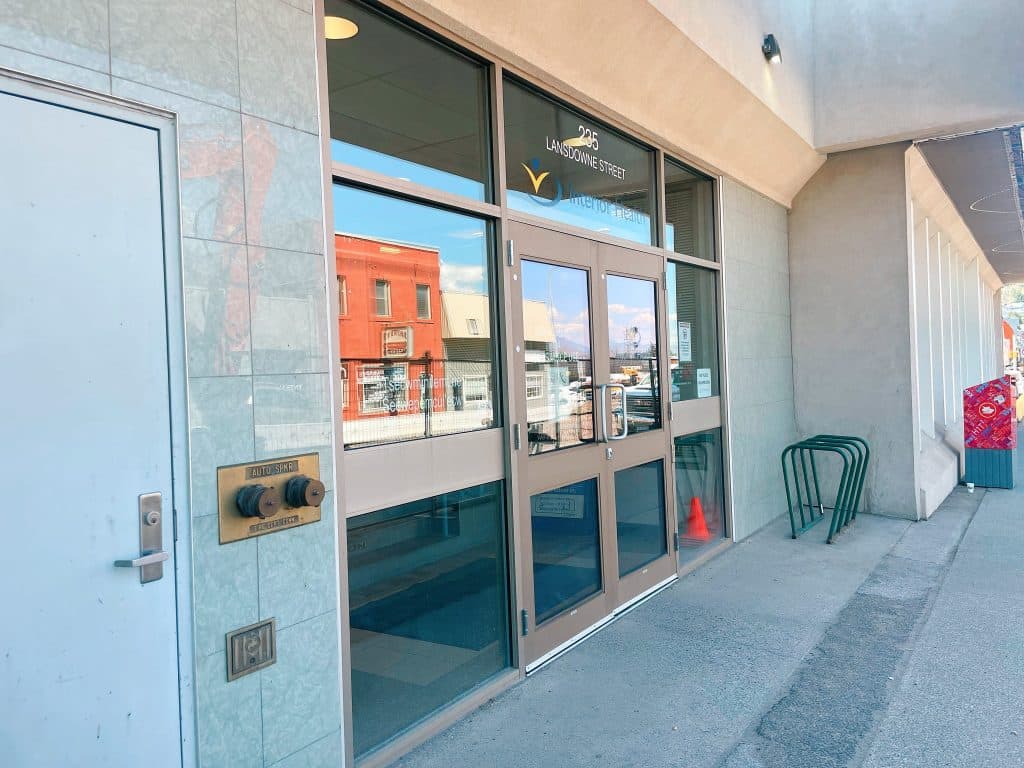
At Interior Health’s Mental Health and Substance Use Services facility at 235 Lansdowne St., visitors are greeted by a neutral-coloured entryway, wheelchair ramp and reception window.
The small foyer is dotted with sparse house plants and informational pamphlets leaning slightly out of their holders, both of which flutter lightly as the wind breaches the open door.
The unassuming and modest lobby doesn’t do justice to the size of the building, nor the extent of the operation inside.
To one side, people needing help meet with a triage worker — either a social worker or nurse — for an assessment lasting between 30 to 60 minutes.
A handful of people sit in back-to-back waiting-room chairs, representing a wide range of ethnicities and ages, from teens to seniors.
The centre offers same-day treatment for mental health or substance use issues, without patients needing a doctor’s note.
Opposite the 20-person waiting room for treatment is the facility’s overdose prevention site, run by Interior Health.
Previously housed in a retrofitted recreational vehicle, the official service is now n the same building as the agency’s other substance use services, in hopes of better connecting patients to the care they need.
“We’re bringing over doctors to do primary care, and then we’re going to have our other substance use services — like case management services, home detox and other substance use services — all in one location,” says Jessica Mensigner, Interior Health’s manager of Mental Health and Substance Use Services in Kamloops.
On the second floor of the building, the hallways twist and wind like a labyrinth, full of offices and tall white walls freckled with local art and photos.
Some offices and cubicles are decorated with personal mementos and photos, others with plants and cards.
This facility’s services include youth substance use programs, a seniors mental health team, individual and group counselling, a perinatal counsellor for new parents and an eating disorder program, on top of addiction care and substance use counselling.
Those are just a few of its offerings. To call it a comprehensive operation would be an understatement.
“Because of the investments over the last five years — because of the toxic drug crisis — we’ve been able to expand a lot of our substance use services,” Mensinger says.
“It’s a very busy team.”

According to Mensinger, Interior Health’s Mental Health and Substance Use location currently serves around 300 people directly receiving addiction-related care, in addition to nearly 500 people associated with its support groups.
Interior Health says its care policy for people struggling with mental health issues and substance use is determined on a case-by-case basis — individuals are given care catered to their goals around well-being and recovery, Mensinger notes.
“This is the spectrum of services that we have, and let’s find the best fit for you to support you with it,” she explains. “It’s all about recovery being different for different people, but services being accessible where and when people need them.”
One pillar of the health authority’s approach is the harm reduction model, which on its website Interior Health defines as “an evidence-based practice that aims to keep people safe and minimize death, disease, and injury from behaviour that involves risk, such as substance use.”
The public agency also offers a free drug-checking service in Kamloops, and runs peer-advisory groups for youth and adult substance users, touting the slogan, “Nothing about us without us.”
While many local private addiction clinics offer abstinence-based approaches, experts and advocates say a spectrum of options needs to be available for substance users — both for those who wish to stop or reduce their drug use, as well as those who wish to use substances more safely.
As the B.C. Centre on Substance Use puts it, it’s based on “respect for the rights of people who use drugs … to promote safer use and open a door into treatment as needed.”
The acting program co-ordinator of ASK Wellness Society — which operates in Kamloops and Merritt — told The Wren last year that offering harm reduction services for substance users is “something that’s going to keep them alive.”
“Harm reduction means we acknowledge that this might not be the safest thing to be doing,” Jessica Measseney, acting program coordinator at ASK Wellness, said in an interview for an earlier story in this Roadmap to Recovery series. “But how can we make it safer … It’s going to keep someone alive until they make it onto the next bed available at detox.”
‘We can’t let off the gas in terms of the supports’
Provincial health agencies have made numerous additions to services to accommodate the growing number of B.C. residents struggling with substance use disorders, according to Mensinger.
More changes will be made to adapt to the circumstances of the toxic drug crisis.
“There’s a lot of work being done to look at the next number of years,” she says. “How do we further enhance our services? How do we remove barriers, make access easier, and build out areas where we may see gaps?”
Mensinger mentions an Interior Health after-care position recently introduced in Kamloops, which the authority created in response to one such gap — which she calls a “what now?” job after someone completes treatment.
“Someone finishes a substance use treatment program, and then they are meant to go back into their life,” she explains. “But sometimes you just need a little bit of extra support to think through what that means for you.
“We can’t let off the gas in terms of the supports or the work that we’re doing around addressing the toxic drug crisis.”
While Interior Health says it has made strides towards improving rehabilitation programs, the public health emergency posed by toxic drugs continues to act like a domino effect, with interconnected challenges making the crisis tough to navigate.
Even with a growing number of investments in Kamloops services to save the lives of drug users, the “what about after?” debate is as persistent as ever.
Detoxing from substances is just the first step.
For those hoping to go through recovery from addictions, many new challenges rear their heads after the rehabilitation process is completed.
For some Kamloopsians like Lowley, finding a stable home is a vital step towards taking back their future.
For others, such as Smith, the hardest challenge was finding the right program available to support his recovery goals.
Even as advocates continue to step up to help raise awareness and save lives, a long road still lies ahead to overcome the devastating toll the poisoned drug supply has wrought in the community.
In Kamloops, substance use is now being taken more seriously by many community members, and services have become increasingly accessible. But barriers to fast and effective treatment continue.
As Kamloops tries a range of approaches to stop the toxic drug crisis from taking even more lives, many challenges remain — with little assurance people seeking help can actually receive it when it’s needed, and not slip through the cracks in the system.
“It’s crazy, I didn’t ever think I would have to save a lot of lives,” Lowley says. “I don’t like seeing people sick, because I know how it is to be really sick.
“You can’t save everybody. Well, I’m gonna save as many people as I can.’”
If you or someone you know is struggling, visit HelpStartsHere.gov.bc.ca or call 310-MHSU (6478). You can also visit the Interior Health Authority’s Mental Health and Substance Use Services
So do we. That’s why we spend more time, more money and place more care into reporting each story. Your financial contributions, big and small, make these stories possible. Will you become a monthly supporter today?
If you've read this far, you value in-depth community news


