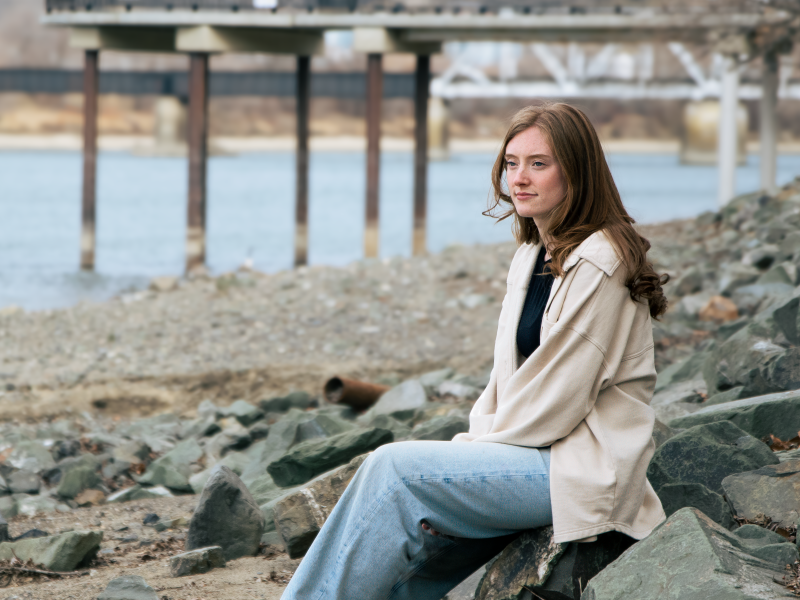
Lara is a fourth-year communication and digital journalism student at Thompson Rivers University in Kamloops, British Columbia. In her free time, she works at the university’s Wellness Centre where she supports students’ mental health. Lara was raised in La Paz, Bolivia, where she lived until she came to university. She believes growing up 3,650 meters above sea level left her with better lungs than most people. Her parents divorced when she was just three years old and she spent most of her childhood going back and forth between their homes across the city. Studying at Saint Andrew’s School, which offers an international baccalaureate program, Lara had more opportunities than many others living in her country. That also meant many of her peers were less impacted by the 2016 Bolivia drought, which was caused by wildfires and shrinking glaciers.
My parents are both from Villazón, which is in the city of Potosi. It’s a very small town that borders Argentina. They have always had water problems. I think my grandparents have water maybe four or five days a week at their house. They’re always very, very conscious about how to use water. I remember when I went to my grandpa’s house and I took a shower for more than ten minutes, he just got mad at me.
It was November. That’s around the time when school ends. We had exams. I was 14 turning 15 that year. We found out that I wouldn’t have water at my house the day before the water limits. My mom was panicking like, “What are you going to do? Because you didn’t shower yesterday, you have to shower today.” We went to a salon so I could get my head showered at least.
The fact that we wouldn’t have that normalcy for a while was just so confusing. There were days when certain neighbourhoods would have water in showers and the faucets. They would let you have, in your house, like five hours a day of water. We would play, “Where can I shower to go to school?” My mom was like, “Okay, you’re going to your aunt’s today because she’s going to have water that day. Then you’re going back to your dad’s place so that he can take you to school.”
There were these big white water trucks called Cisternas. They look like trash trucks. But they had this little song that sounded like an ice cream truck. We had our schedules for when the water was going to come. We had to go make a line and wait for them. We would have to go with buckets and bottles.
We competed in class with each other when we met, like, “I was standing in line for two hours.” Someone else would say, “Oh, well, I had to go to my house with three buckets.” It was us looking for a silver lining. We were trying to make fun of the situation, even though I know it stressed us a lot. If their parents had offices or stores, they could go there to shower. One of my peers, her dad had a car wash. So they would go there and all the workers would shower there.
When we did have water in our house, I was in charge of filling out bottles. There’s just a little faucet. I had to take a little container, fill that with water, and then fill the big blue container, and so on. I spent maybe an hour filling it. It was horrible. I had a little line of empty bottles ready to be filled with water. We would call it the water room. We also had different water bottles separated for the kitchen and for food.
The water shortage ended in February of the next year. It was kind of sudden. The rainy season starts in March so it could have been that. The government just said, “We are lifting restrictions.”
It made me more water-conscious. Here in Canada, I know it’s a prevalent problem in Indigenous communities. At least here in Kamloops, there hasn’t been this problem. Even then, I’m trying to be conscious of water. I have a friend that showers an hour every morning and every night. One hour with the water going on, and I’m like, “You do not know what it’s like to not have water every day.”
I know right now it’s not happening to you, but it doesn’t mean that it won’t. With everything that’s been going on with the wildfires, this is not something that’s only reserved for developing nations. This is probably going to happen. A month ago, when I was washing dishes, the water went off. I was like, “Whoa, no, no, no. It started again. It started again. We’re not going to have water. This is the end.” It was because the water heater broke.
I wish it wouldn’t have happened in the first place. I feel like it didn’t only have to do with climate change. I feel like there could have been preventative measures. It’s not like the government didn’t know. Right now in Bolivia, there are already so many climate change disasters happening, man-made and nature-made. I’m just a 22-year-old. I don’t know a lot. There are people who have power and knowledge. They have the resources to ask people who know about this, “Hey, what can we do?” I don’t think that they’re putting their energy into that.
This story is a part of a series created by Thompson Rivers University students and led by instructor Jennifer Chrumka as part of the Climate Disaster Project.
So do we. That’s why we spend more time, more money and place more care into reporting each story. Your financial contributions, big and small, make these stories possible. Will you become a monthly supporter today?
If you've read this far, you value in-depth community news