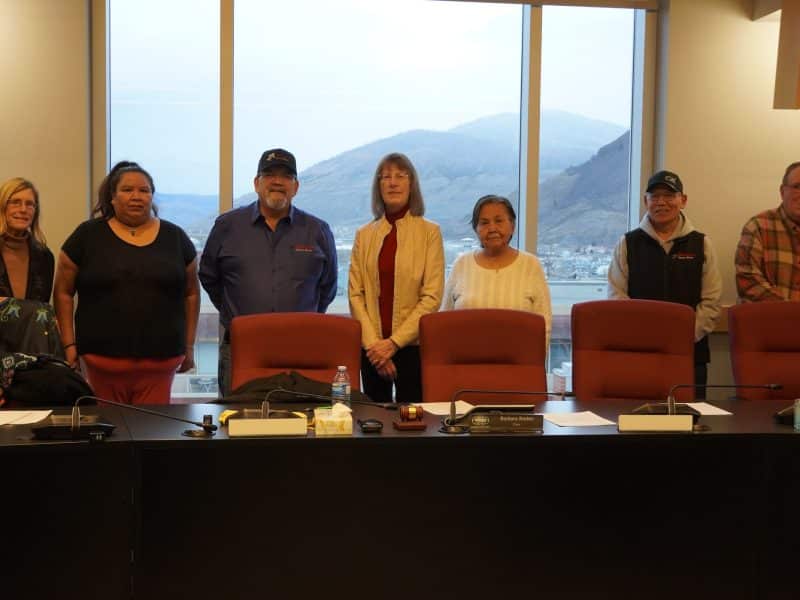
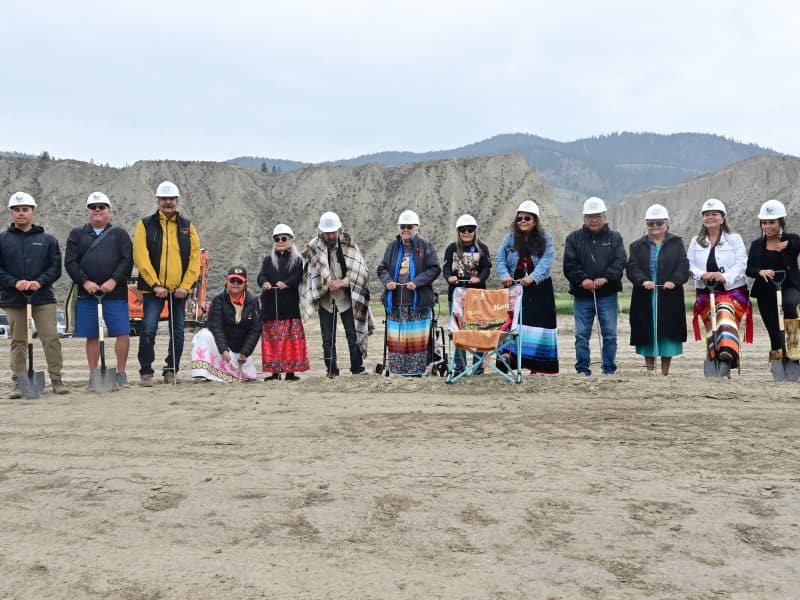
As the 19th century drew to a close, the growing accessibility of photography fueled the rise of a new kind of historical record. Little by little, an emerging global community of shutterbugs started a collective visual memory that fundamentally changed the way we conceptualize the past.
Kamloops was no exception, as attested by the thousands of photos contained in the Kamloops Museum and Archives (KMA) photo collection.
This unassuming beige filing cabinet — searchable using an authentic vintage card catalogue — is actually a window through time, transporting visitors into thousands of tiny moments that someone, at somewhen, deemed worthy of remembering.
There’s good, grassroots news in town! Your weekly dose of all things Kamloops (Tk’emlúps). Unsubscribe anytime.
Get The Wren’s latest stories
straight to your inbox
Thumbing through reveals moment after moment frozen in monochrome, accompanied by vague typewritten captions and penciled over with decades of corrections and notes.

In researching for the History at the Confluence series, I spent months immersing myself in these fascinating snapshots. As I explored these fragments of strangers’ memories, a somewhat benign observation grew into a personal obsession.
What is up with all these parade photos?
It is no exaggeration to say that anyone combing through these drawers inevitably comes across one or more photos from a parade.

This instance of preservation bias is more than just an interesting footnote; it provides a measuring stick to evaluate with one’s own eyes the colonial town of Kamloops changing over time. Not only the physical changes to the buildings and landscape but changes to what, why and how people celebrated.
Here are three of the earliest examples of Kamloops’ historical parade photos:
June 22, 1897: A diamond jubilee
The 60th year of Queen Victoria’s reign was celebrated across the British Empire and the young town of Kamloops was no exception.
The street shown in these three images is unrecognizable today, including its name. None of the buildings on this photo’s Main Street still stand on what we know today as West Victoria Street. Construction of the Old Federal building was still three years away.

To capture what was recorded as a “callithumpian parade” the photographer is facing southeast, standing on the Canadian Pacific Rail line which had yet to be moved off the road. Pedestrians, horses, carriages and bicycles, but no motor vehicles, are kicking up dust from the unpaved street. Spectators watch from the boardwalk, leaning against the picket fences lining the street.

Newspapers across the Dominion of Canada reported that the festivities brought people together across racial and class divides. And indeed, these images show folks of many ethnic backgrounds both in the parade and among the crowd.
However, details like the minstrel performer wearing blackface seen above show divides very much existed.
Feb. 13,1911: Flight of the dancing dragon
February of 1911 was an auspicious one for Kamloops’ Chinese community. Not only were they celebrating Lunar New Year, but also the opening of the new Chinese Freemasons Hall.
Also known as the Hongmen (洪門), the organization is not related to European Freemasons. Instead, their lodges mainly functioned as community centres and mutual aid societies for members, who were so often shunned and excluded by their white neighbours.
The history of Chinese immigration to Kamloops is long, with the first migrants arriving during the gold rush and later waves as labourers to build the Canadian Pacific Rail line.

Those marching in the procession wore their best and most colourful silk clothes for the occasion, despite the muddy winter roads. A small team thrilled the crowd by performing a dragon dance — or perhaps judging by the costume’s central horn it was the much rarer Qilin or unicorn dance. Either way the man walking immediately behind them (almost out of frame) is wearing a big smile, his feeling of joy preserved for over a century now.

Coverage in the Feb. 14 issue of the Kamloops Standard was patronizing to put it mildly, though the slur-laden blurb does reveal details of the day not captured by these photos.
Reportedly, the Rocky Mountain Ranger Band led the parade, followed by the Chinese Freemasons and finally, the Secwepemc formed the tail of the procession. A spectacular fireworks show in the evening thrilled onlookers, for whom the Chinese band played late into the night.
The evening’s final performance was provided by a local Scotsman and his trusty bag pipes, indicating that the realities of the racial divides between people were not as clear cut at the day’s newsmen would have you believe.
Sept. 17, 1912: Kamloops celebrates its “centenary”

Only 19 years after the municipality was incorporated, Kamloops threw a massive event to celebrate its 100th anniversary. How does that math work? They counted from the 1812 establishment of the first trading post near the Secwepemc Village at Tk’emlups.
The Hudson’s Bay Company in their full page ad on page 3 of that day’s Kamloops Standard spun a yarn full of historical inaccuracies to promote their sale prices.

Despite HBC’s claims, it was the Pacific Fur Company that built the first trading post here in 1812, a humble log cabin aspirationally called Fort She-waps which was abandoned a year later. Also in 1812, the North West Company cheekily built its own post alongside their competitors. This was Fort Thompson and it persisted, keeping that name even after the Hudson’s Bay Company took over operations in 1821.
Both local newspapers reinforced this historical revisionism with their front-page features that day. The Inland Sentinel stated that this is the “100th anniversary of the founding of the city,” while the Kamloops Standard went with the more ambiguous “centenary of the foundation of the capital of the Inland Empire.”
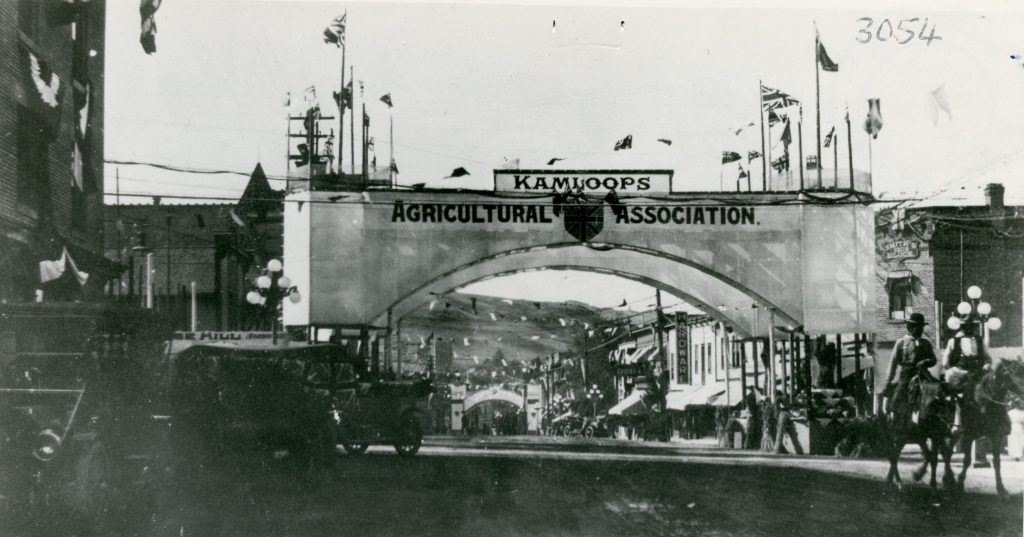
A series of grand arches, illuminated with electric lighting, were built along the parade route on Lansdown and Victoria streets. Flags and bunting were affixed to buildings, poles, vehicles or whatever else was convenient.
This extravagant effort was to impress the Governor General of Canada who also happened to be Prince Authur Duke Connaught, son of the late Queen Victoria and uncle of the reigning monarch King George V.

The royal party arrived by train at 3 p.m., kicking off a packed itinerary.
First up was the inspection of the troops and of the Tk’emlups te Secwepemc, many of whom were veterans of the Boer War.
The papers remarked that Tk’emlúps Kukpi Clexlixqen, better known as Chief Louis, “the old warrior, sat on his horse like a rock.”
The regimented sameness of the soldiers’ uniforms contrasted starkly to the highly customized best dress of the Sewepemc, for whom the quality and unique character of their handmade clothing was a status symbol that communicated to the world that they were loved and cared for as individuals. The empire, on the other hand, prized conformity and uniformity among its ranks.
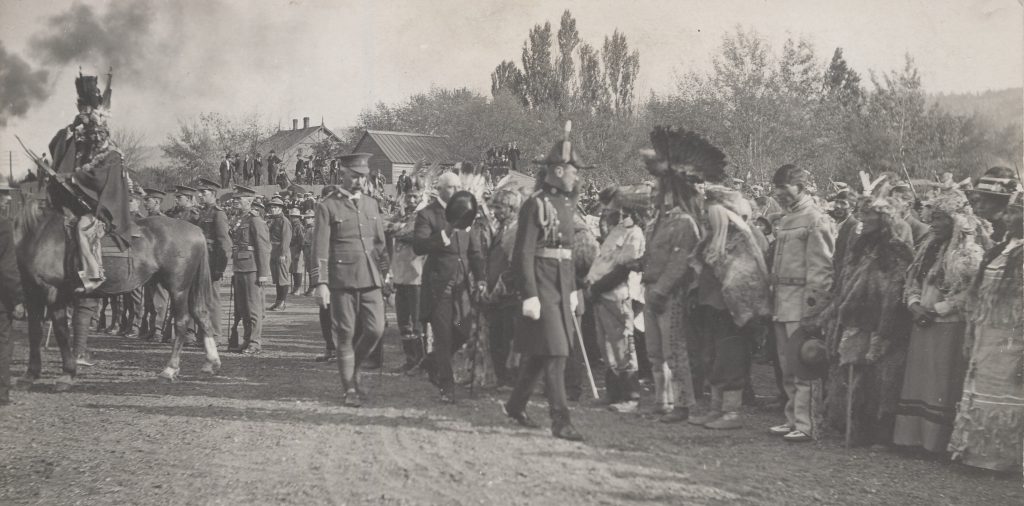
When moving between each stop, the duke was escorted by a procession of military personnel.
First was a speech at the courthouse, followed by the official opening of the new Royal Inland Hospital.
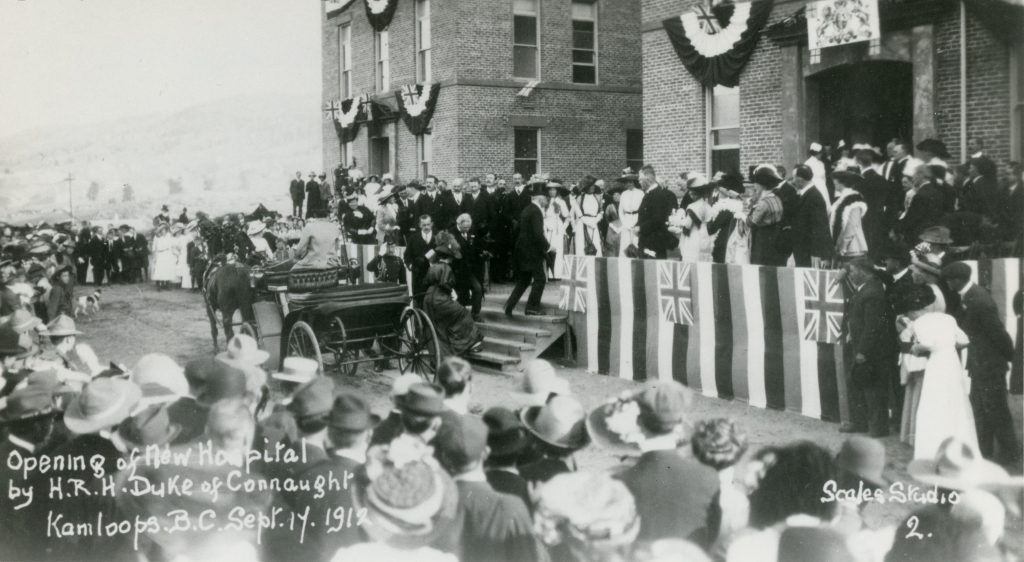
It was then time for the parade, the most pomp-and-circumstance the city had yet seen, after which the duke and his entourage boarded a train to Vancouver at 6 p.m.

This three-hour whirlwind tour did not end the party for Kamloops. According to the Kamloops Standard, there would be three days of festivities including “sports of every description, processions, music, military dance, first class baseball games, theatre performances, confetti carnival, the greatest display of fireworks ever held in the west, endless fun and amusement on the streets.”

Reevaluating the record
The photographic record reveals details of the past obscured by time, but it is not infallible.
Take the excellent candid shot below (KMA #5164), which captures a moment in exquisite detail: from the intricate regalia of those parading, to the deep marks carved by unseen carts into the dirt street.
This image was labelled in the KMA catalog as “The Indians on parade Dominion Day 1923,” but clues that contradict that identification can be found in the photo itself and others above.
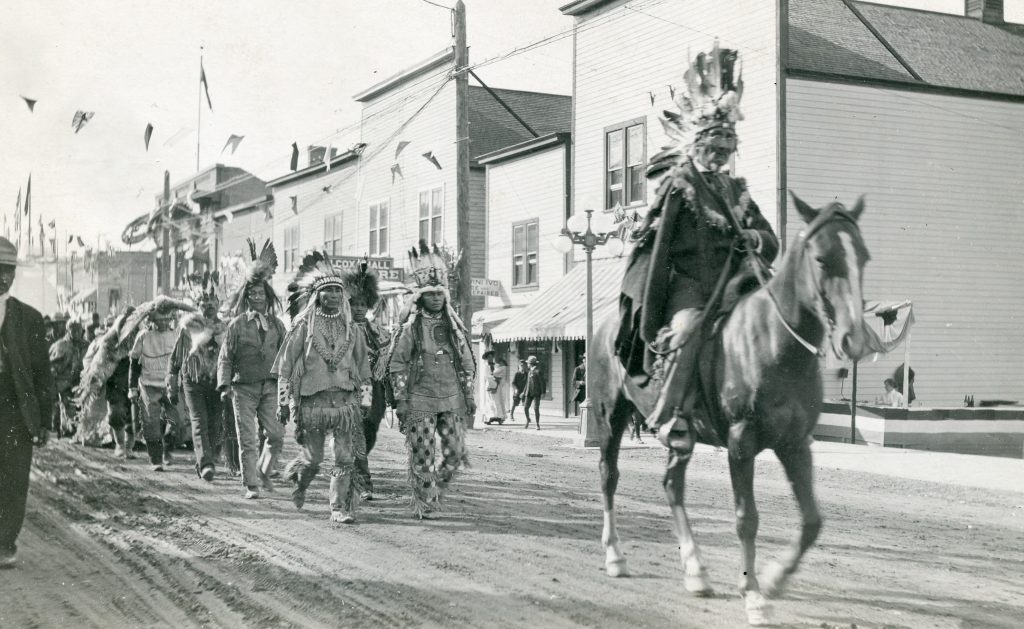
The most important clue is found in identifying the Elder leading on horseback. His facial features, headdress, round glasses, clothing, the blanket around his shoulders, and even the bow he is holding match closely with Chief Louis in the photo KMA #687. So do the markings on the horse, namely the white ‘socks’ of mismatched heights on its rear legs.
A man in a black suit and distinctive wide brimmed hat can be seen holding the reins of Chief Louis’ horse in KMA #3061, likewise a man in a black suit and that same hat can be seen in this photo walking alongside the procession, only partially in frame. Behind him is a centenary arch with its characteristic collection of flags visible in the background on the far left.
Despite much searching, I could find no mention in the historic newspapers or any other photographs in the collection that suggest arches were built for any celebration except the “centenary” in 1912. Even if I did miss such an event, a photo of Chief Louis can date to no later than 1915, the year he passed away, meaning this cannot be 1923.
You may be wondering if there was a reason this scene was mistaken for Dominion Day 1923 specifically. The answer is yes, but that is an interesting story for another time.
So do we. That’s why we spend more time, more money and place more care into reporting each story. Your financial contributions, big and small, make these stories possible. Will you become a monthly supporter today?
If you've read this far, you value in-depth community news