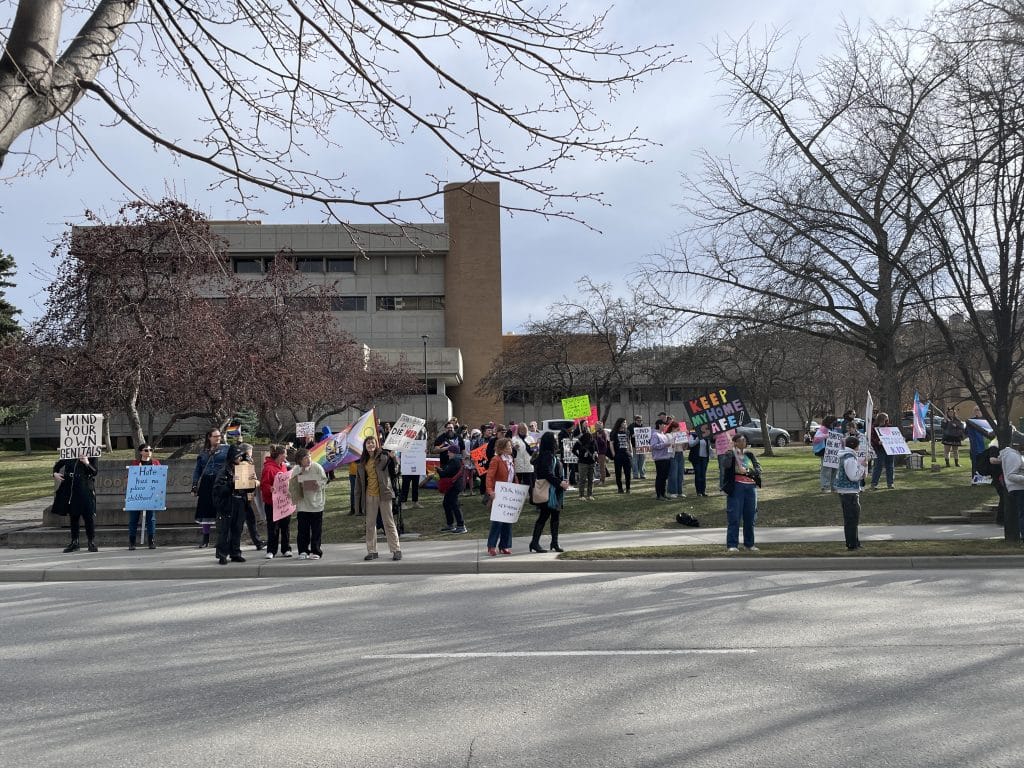
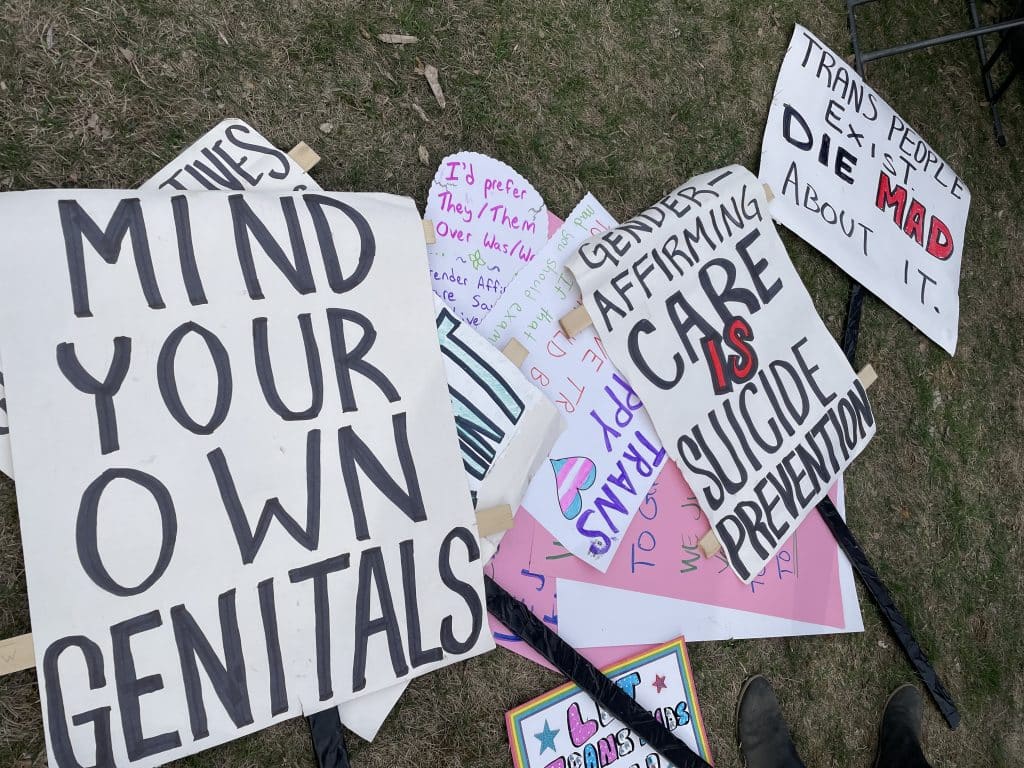
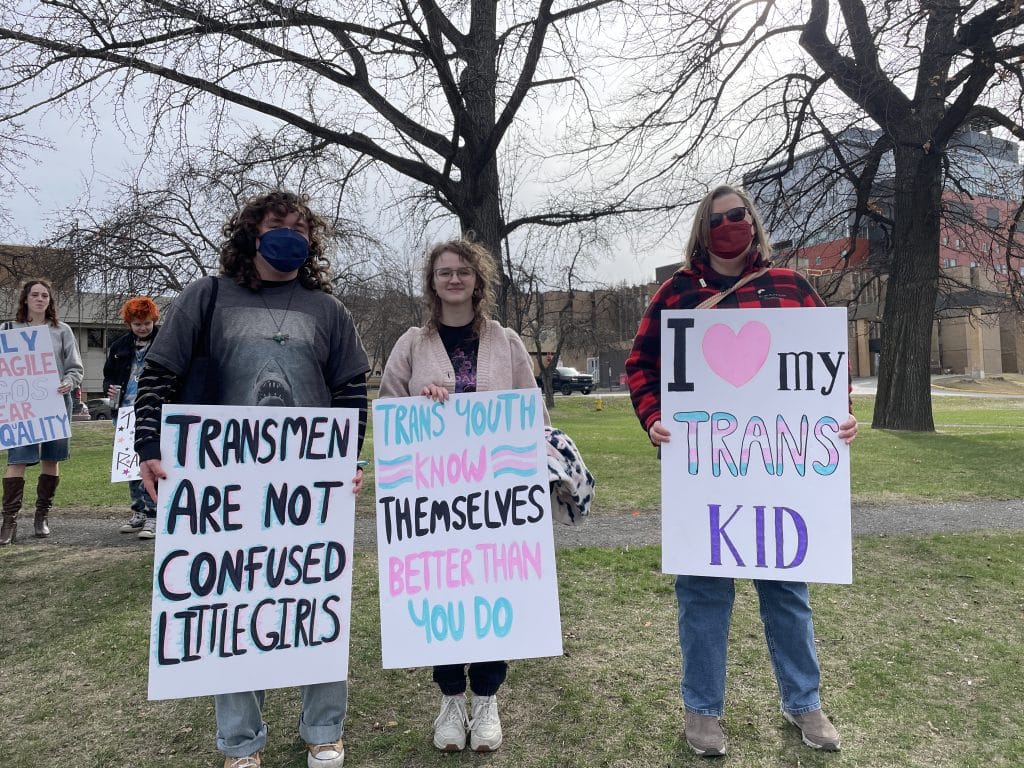
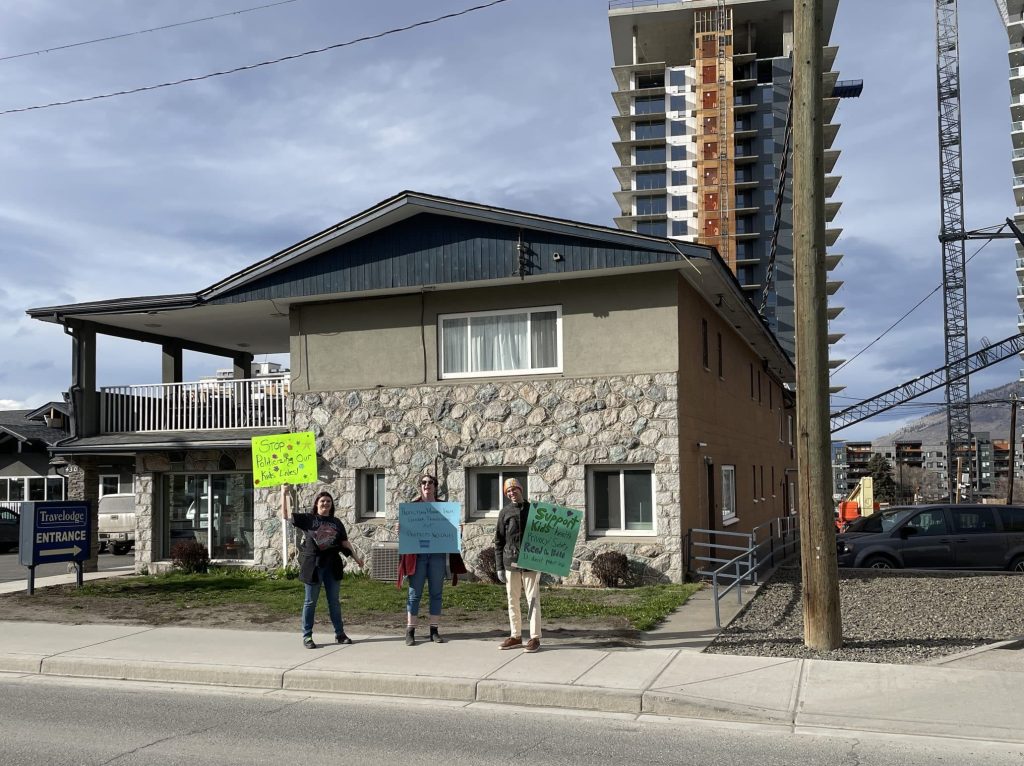
Advocates for transgender rights came together March 25 in front of the Kamloops Courthouse to support the community and call for more protections after two local MLAs voted in favour of debating a proposed anti-trans bill.
The protest was a response to an increase of transphobia in legislation, particularly focused on trans youth Alix Dolson, agency coordinator for the Kamloops Sexual Assault Counselling Centre (KSACC) tells The Wren.
“This legislated hatred is a problem, and it’s compromising people’s ability to live healthy and well,” Dolson explains.
Kelowna–Lake Country–Coldstream MLA Tara Armstrong has introduced several bills aimed at restricting support and rights for transgender youth including the Gender Ideology and Child Protection Act to address what she called the “greatest medical scandal in modern history,” and the Protecting Minors from Gender Transition Act.
The latter calls for limiting doctors’ ability to provide gender affirming care, such as hormone treatment, but also stretches into schools and social settings, where kids can receive support from friends, teachers and coaches.
“In our schools, [the bill] will stop them using the wrong pronouns, keep boys out of girls’ bathrooms and remove gender ideology from school libraries and curricula,” Armstrong said while she introduced the bill.
This proposed bill failed to pass first reading with 48 members opposed and 40 members in favour of discussing the legislation at second reading. Kamloops Centre MLA Peter Milobar and Kamloops-North Thompson MLA Ward Stamer were among those who voted in favour of moving the Protecting Minors from Gender Transition Act forward to debate.
While Stamer and Milobar did not respond to The Wren’s request for comment, Castanet reported that in a recent email from Milobar’s leadership campaign, he pledged he would “end the mandatory SOGI framework” if premier, referring to the optional resources that support schools and educators with grade-level appropriate materials related to gender and sexuality.
Milobar is positioned to lead the B.C. Conservative Party, and has been endorsed by Ward Stamer ahead of the May 30 leadership announcement.
“Allowing proposed legislation to be introduced, examined and debated is a cornerstone of our democratic system,” Stamer wrote in an emailed statement to The Wren about his recent vote related to proposed legislation – again introduced by Armstrong – seeking to repeal the BC Human Rights Code.
“While I understand that not everyone will agree with this approach, it is important that my first reading vote not be interpreted as opposition to human rights.”
It is rare for a bill to fail its first reading as it is considered a parliamentary courtesy to allow MLAs to place a bill on the order paper.
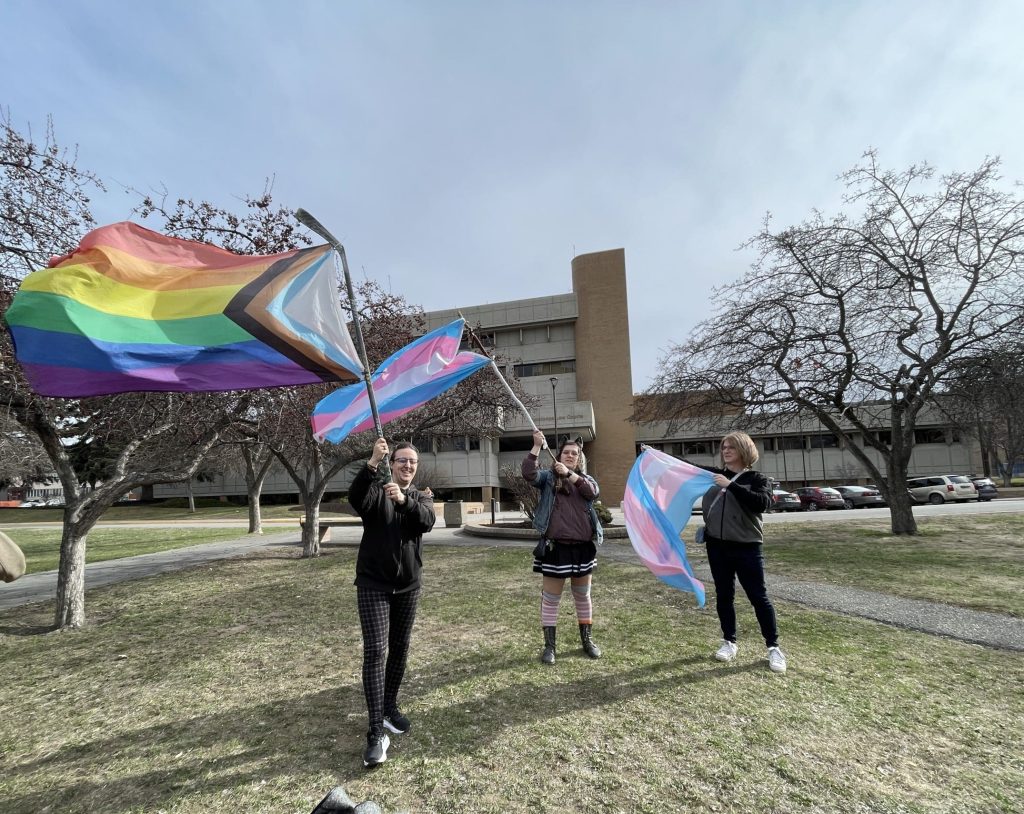
Regardless of legislative decorum, Dolson says it’s vital to hold elected officials accountable so they advocate for all the members in their constituency.
According to Statistics Canada 1.3 million Canadians aged 15 years and older are part of the 2SLGBTQ+ population. Out of those, roughly eight per cent identified as transgender or non-binary.
“I think for those of us who are advocates for human rights, while we appreciate the need to have open and transparent discussions in the legislature, there are pieces of legislation that do not deserve any sort of platforming, and that’s where our concern is,” Dolson says.
“The argument can be made that they’re just looking for open and honest discussion,” she continues. “This is the process, and they’re just following that process. Well, when processes are harmful, we need to call them out and change them.”
Sofiia Shmyhovska, the community liaison for a family violence prevention program at the Kamloops Aboriginal Friendship Society and organizer of the protest shares the same views as Dolson.
“I think the [Gender Ideology and Child Protection Act] itself not only treats gender diversity and heterosexuality, or the variety of sexuality, as something that can be used as a way of indoctrinating children but also something that is ultimately significantly inferior to the normal people,” Shmyhovska says.
In addition to posing an immediate threat to trans rights, Shymhovska is concerned that debating human rights through legislature may open a path to discussing protected rights, such as same sex marriage and abortion.
“We underestimate the interconnectedness of all those issues and how they do not exist in isolation.”
What does transition often look like for youth?
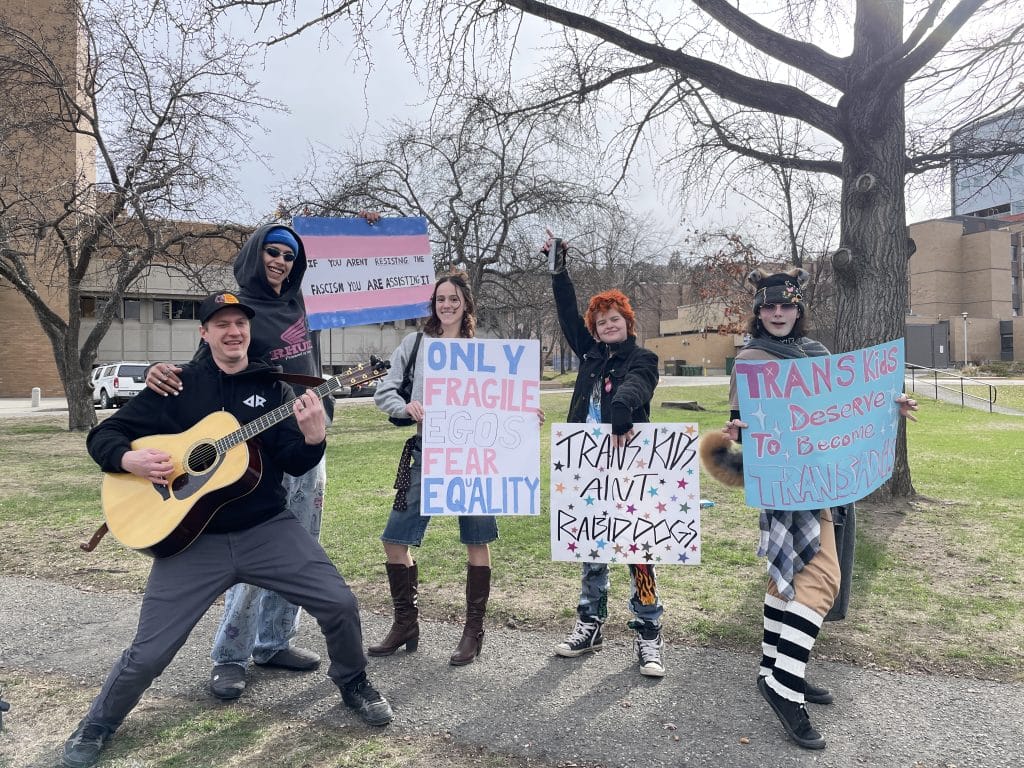
Attendee Fern Apeiron says they feel there is a misunderstanding among elected officials regarding what trans healthcare is and what it looks like for children.
“The rhetoric that’s been pushed by conservative media is that we’re giving children surgeries and that we’re pushing these unchangeable procedures,” Apeiron says. “Nobody is giving children surgery. It is incredibly difficult for an adult trans person to access surgery of any kind.”
In Canada gender-affirming surgery is generally limited to people 18 years or older. In some cases, top surgery or breast reductions are available to those under 18 with a referral and diagnosis process, readiness assessment and letter of recommendation.
Lower or bottom surgeries are only available for people 18 years of age or older. In B.C., hormone treatment may be accessed by young people if a series of criteria are met.
More commonly, transition for minors is less invasive, focusing on pronoun and name changes, or style and presentation shifts. It could also be simply sharing and having discussions around gender and gender identity, according to TransCare BC.
“If the feedback is good and if ultimately their need is met — a lot of them are not looking for automatically transitioning and a medical process,” Shmyhovska says.
‘Kids should be allowed to make decisions about who they are’
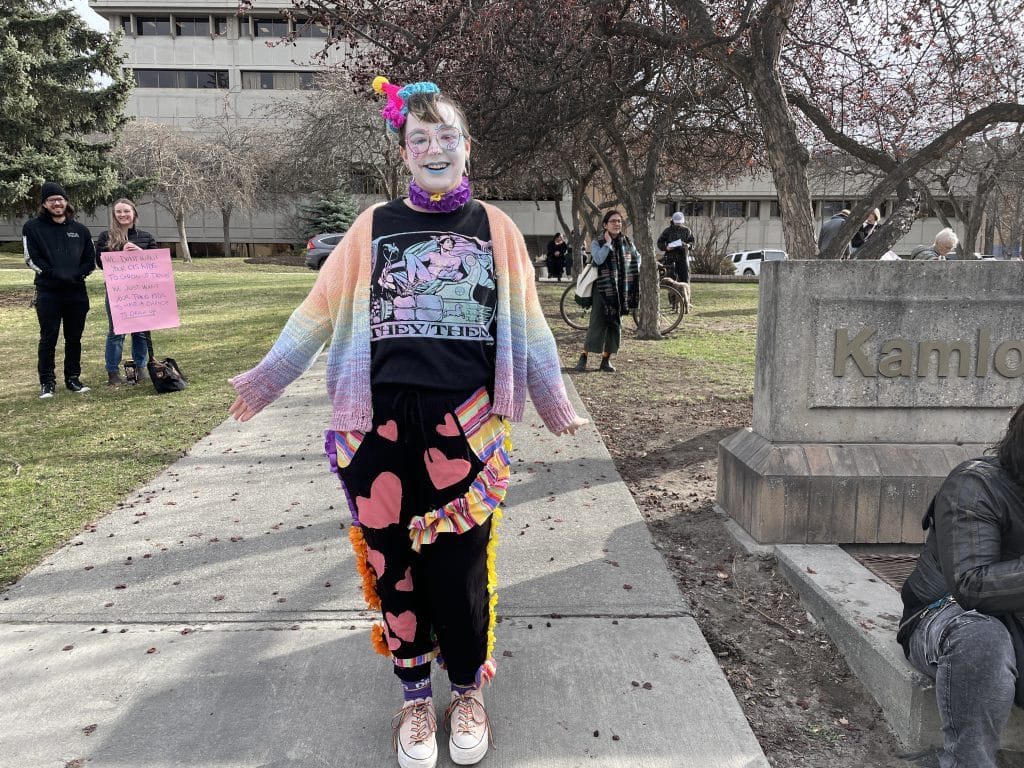
As a sex worker outreach coordinator for KSACC, Apeiron helps folks who have experienced gender-based violence, including transphobia.
Bills like the Protecting Minors from Gender Transition Act seek to take away key safe spaces and individuals, which folks like Apeiron found to be vital in their social transition.
“It removes school as the safe space to explore,” they say. “So even things like gay straight alliances, which are safe spaces that queer children can go during school to have safe queer adults to talk to, meet other kids who are like them and to ask questions when the broader world is not particularly safe for them.”
Li Karpuk started socially transitioning when they were 17 years old, and shares how these spaces played an important role personally.
“I was in high school, and my family is extremely religious. If I didn’t have the ability to socially transition at school… my parents would have kicked me out. I wouldn’t be where I am,” Karpuk tells the Wren.
They say their family has become more accepting as they have gotten older, but being able to socially transition at school was vital.
“Kids should be allowed to make decisions about who they are, because they’re the ones that know,” Karpuk added.
Interacting with elected officials
When it comes to chatting with MLAs, Dolson says her conversations have been limited.
“I don’t feel like it was taken terribly seriously, and I don’t know that they really heard or understood the concerns as we articulated them,” Dolson says.
This sentiment is shared by Apeiron, when asked whether MLAs have made some outreach to contact them.
“Not one word,” Apeiron says. “They’re not interested in discussing [trans rights] with trans people.”
Still, they encourage folks to reach out to MLAs and send their concerns via email or by calling them.
“I would most like to see [politicians] stop using the lives of marginalized people as an opportunity to play political games and to score partisan points,” Dolson says. “That’s how it feels for us, and I think that it’s really, really frustrating.”
Peter Milobar can be reached at Peter.Milobar.MLA@leg.bc.ca or via phone at 778-471-9371.
Ward Stamer can be reached at Ward.Stamer.MLA@leg.bc.ca or via phone at 250-554-5416.
The Wren is a community driven local news outlet. Your questions and ideas help guide what we dig into. Your feedback after we publish a story helps ensure we're always improving our reporting to better serve you
What do think about this story?