The year was 1929 and a new airfield in Grand Forks had other B.C. municipalities green with envy.
For years, political circles spoke of the need to develop a network of coast-to-coast air infrastructure, but the financial realities of the Depression era made progress slow.
In Kamloops, tough economic times didn’t hold back the air fever as leaders here and in other towns including Nelson, Cranbrook, Kelowna and Merrit worked to create their own airfields.
An editorial in the Sept. 20, 1929 issue of the Kamloops Sentinel by Erwin Greer, flight instructor and president of Greer College in the Kootenays, laid out the requirements for choosing an airport location after a flurry of letters and visits to his flight school.
“First of all the intended airport must be readily accessible by automobile, bus or streetcar,” he wrote, adding that being near a railroad is advisable because a spur track may become necessary.
The site must be an unobstructed “large, open tract of ground — the more level the better, of course.”
“The field itself must be of firm foundation, especially the runways, for in rainy weather there must be no mud to hinder take-offs or landings.”
“The airfield should be no less than 1800 ft in each direction and preferably 3000 ft or more.”
“Buildings and trees near the end of the runway should not interfere with a rise of 1 foot in 7.”
These constraints alongside the physical limitations imposed by the steep valley walls narrowed the potential sites significantly.
After Tk’emlups te Secwepemc declined to sell their reserve lands for the airport, and the city declined their offer to lease the land instead, the search for a new site was on.
For a brief window in 1930, McArthur Island was considered as the airport site, however, this plan was flawed from the start.
In an open letter to city council, Charles E. Thrupp estimated the cost to mitigate flooding, stabilize the ground and build a bridge would be at least $400,000, nearly $6.9 million today — a comically large sum for the cash-strapped council.
In 1933, the Dominion of Canada — now known as the federal government — authorized the development of a Kamloops airport, offering to finance the necessary infrastructure, but only if the city provided the location.
Now, deep in the Depression era, the city could not afford to take up this offer until 1938. That spring, 45 acres of land were leased for $200 per year from B.C. Fruitlands in what is now Brocklehurst was purchased later that year for $2,750, about $61,000 today.
The first official landing was by the “Yukon Queen” providing an airmail delivery on April 18, 1939.
An airshow to celebrate the opening was planned for August. Despite the poor weather, the event went ahead, though with fewer planes than planned.
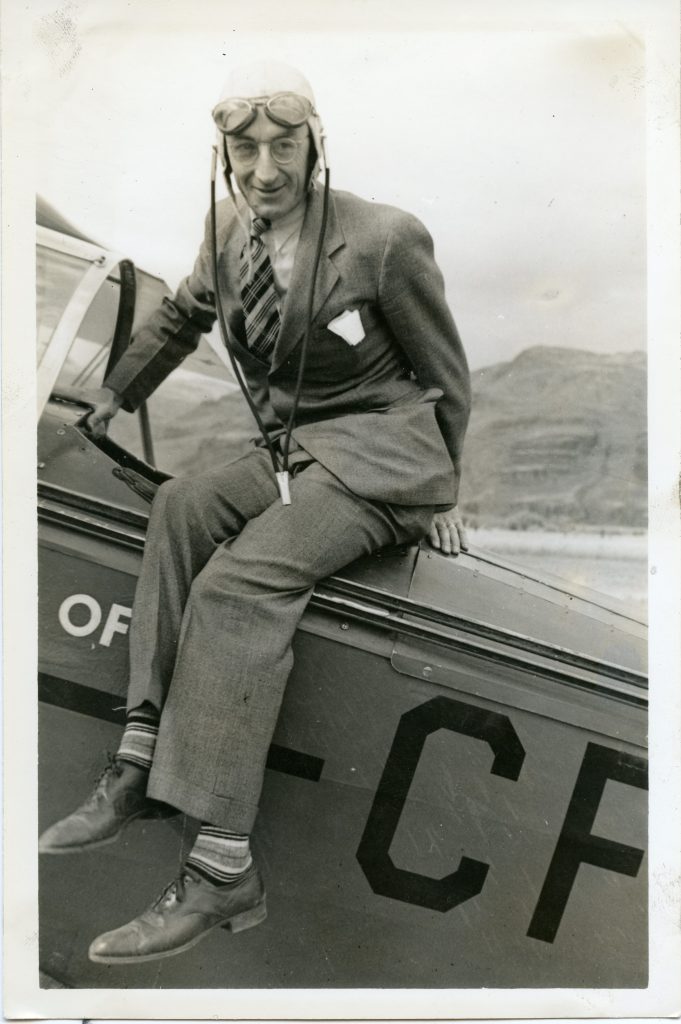
For Mayor Charles E. Scanlan, this event was the culmination of a decade of work and advocacy.
Scanlan, an engineer for Canadian National Railways, had been bitten by the flying bug. That obsession altered the course of his career and made him the driving force behind the Kamloops airport project.
In 1930, his commitment to the project saw him elected as an alderman and appointed as the head of the airport committee. He went on to serve as an alderman on and off until 1944, and served as mayor from 1936 to 1941.
In 1938, he became the first vice-president of the British Columbia aviation council.
In 1939, when the Kamloops Flying Club formed, he was its president. Despite his enthusiasm for airmanship, he seemingly never got his official pilot licence, though he reportedly looked great in a pair of goggles.
Less than a month later, the onset of the Second World War would mark a distinct shift in discourse in the media. For a decade the airport had been a nearly weekly news item, now suddenly all discussion went silent as the Royal Canadian Air Force (R.C.A.F.) took over the airport for the duration of the war.
The location was ideal, accessible by both the Canadian Pacific and Canadian National Railways, far enough inland to not be vulnerable to attacks by sea, while also being northerly enough to complete supply runs to Alaska and even the USSR.
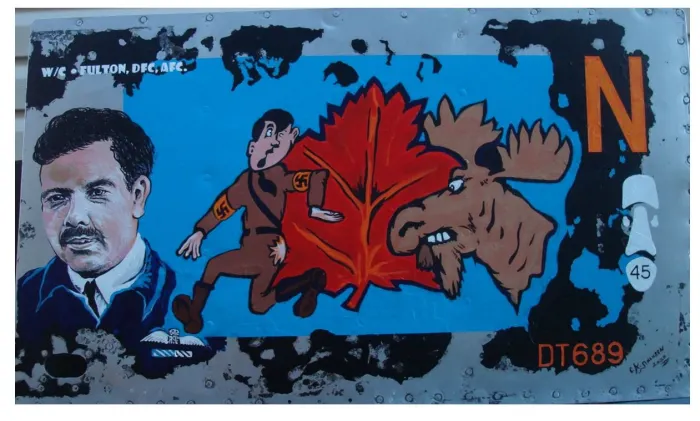
In 1945, control of the airport, now dubbed Fulton Field to honour the late Commander John “Moose” Fulton, was transferred to the Dominion’s department of transportation.
Fulton was raised in Kamloops and, much like Scanlan, had a passion for aviation. He left in 1928 to attend flight school in California. Afterwards, he enlisted with the Royal Air Force (R.A.F.) and became a distinguished pilot.
During the Second World War he was among the R.A.F. members who were “borrowed” by the R.C.A.F. to form the 419 squadron, of which he was the commander.
The nickname of their much-beloved leader was officially adopted by the squadron, who today still proudly refer to themselves as “Moosemen”. The squadron’s badge features an attacking moose and their motto is “Moosa Aswayita” a Cree phrase translating to “beware of the moose”.
Commander Fulton was killed in action in 1942 but his legacy lives on in the R.C.A.F. and here in his hometown of Kamloops.
So do we. That’s why we spend more time, more money and place more care into reporting each story. Your financial contributions, big and small, make these stories possible. Will you become a monthly supporter today?
If you've read this far, you value in-depth community news