Content warning: This article includes statistics of sexual abuse, violence, the topic of Missing and Murdered Indigenous Women, and the criminal system. Please read with care.
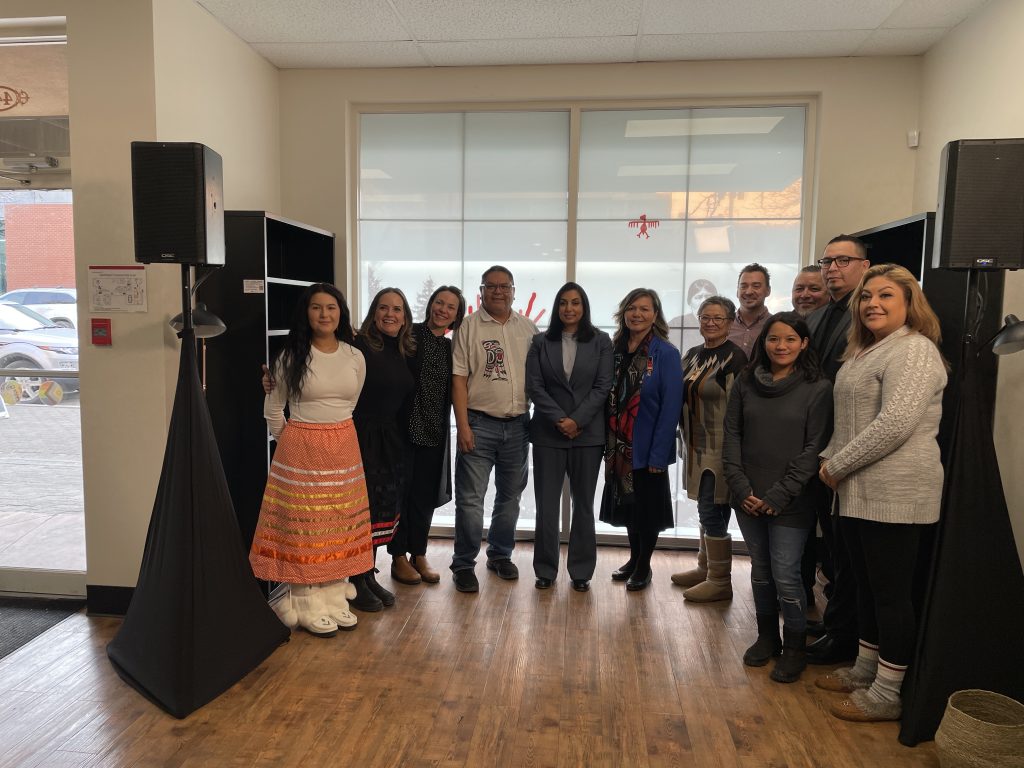
Boyd Peters (Xoyet thet), a member of the Sts’ailes Nation, is the vice-chair for the B.C. First Nations Justice Council (BCFNJC). Present at the press conference hosted to celebrate the opening of the new Indigenous Justice Centre (IJC) in Kamloops (Tk’emlúps), Peters shared his take on why these centres are vital for healthy communities.
“IJCs are meant to strengthen community safety and break cycles of repeat offending in meaningful ways,” he says. “They provide a way for people to step out of the criminal justice system and return to their true selves, grounded in the teachings of their communities. When our people are well, our communities are safe.”
Overrepresented in the criminal justice system, Indigenous peoples account for 36 per cent of folks in custody in B.C., despite comprising just six per cent of the population. IJCs address this disproportionality, and Peters has seen first-hand the power of community-based healing.
He recalls a time when two young spiritual dancers had an altercation. Peters facilitated a session with the two families and Elders using a healing circle. The two young women spoke about their experience for hours and they listened to each other. Once the healing circle finished the women sang their songs and all was well.
“That’s an instance of times when we’re able to do things on our own,” he says. “Like I said, those don’t belong in the justice system.”
What is an Indigenous Justice Centre?
With six new IJCs opened across B.C. including Kamloops and Williams Lake as of Feb. 6, more instances like this are possible. Specifically, these centres are designed to celebrate Indigenous protocols and laws, providing free culturally appropriate legal services and other outreach support.
Elders are available at the centres to provide guidance and healing, aunties support families and victims and support workers offer more connection to other services. Folks who access the centre can make sure they honour their cultural identity.
IJCs also have a network of collaborative partners, which have developed services and justice solutions for those who need them. Some of those partners are the Native Courtworker, the Counselling Association of BC, the local Indigenous Justice Program along with the province.
All of these supports are in place to prevent more overrepresentation of Indigenous Peoples in the criminal justice system, and the BCFNJC reports IJCs have assisted in 2,200 cases in criminal and child protection matters.
Some other services offered include advocacy and support for matters involving the RCMP, pre-trial support, housing and employment services and referrals for counselling, treatment programs, education, and other resources.
The cultural supports offered in the centres and wraparound services have a holistic approach.
“We strive for kinship, culture, diversion and healing at the heart of our service model,” Peters says.
What is the B.C. First Nations Justice Council?
The BCFNJC represents the 204 First Nations in the province on justice issues and is tasked with improving outcomes for Indigenous people.
Guided by a council of six directors, the BCFNJC is responsible for implementing the BC First Nations Justice Strategy, which focuses on reforming the current justice system and restoring First Nation legal traditions and structures at all levels.
At the local level, the opening of 15 IJCs in B.C. provides free access to legal aid and justice services.
In addition to these centres, the BC First Nations Justice Council and the province have virtual IJC that can be accessed by Indigenous community members who do not have access to a centre close to them.
Why is an Indigenous Justice Centre needed in Kamloops?
In the 2021 census for Kamloops, Statistics Canada identified 10.5 per cent of the population as being Indigenous, and 11.1 per cent reported Indigenous ancestry.
The overrepresentation of Indigenous peoples in the criminal justice system, both as offenders and as victims of crime, is an issue Canada-wide.
Research shows there is a link between violent victimization and colonial policies, such as residential “schools,” the child welfare system and other forms of institutionalized racism and socio-economic marginalization.
As a result, Indigenous women are four times more likely to be victims of violence compared to non-Indigenous women, leading the National Inquiry into Missing and Murdered Indigenous Women and Girls to use the term genocide to describe the ongoing intergenerational harms faced by Indigenous women, girls, and 2SLGBTQQIA people.
The impact of residential “schools” and other colonial policies have contributed to interference with family structures and intergenerational trauma, something pronounced and localized in Kamloops.
In addition to providing services to mitigate and respond to the harms of intergenerational trauma and the attempted erasure of Indigenous culture, the IJC in Kamloops will honour Indigenous art and heritage through custom pieces, according to Attorney General Niki Sharma during the press conference.
“Now that the centres are open, these are really places and spaces for the continuation of the building of relationships with rights and title holders in these nations,” Sharma says.
Providing a place where supports include legal and cultural facets in a region with a growing Indigenous population also contributes to more successful reintegration for those involved in the criminal justice system.
The Strategic Plan for Aboriginal Corrections showed that factors such as cultural activities, spirituality and support received directly from family and community contribute to successful reintegration into society.
During the press conference, Kúkpi7 Rosanne Casimir said the impacts of the centre in the community will have a positive ripple effect along the territory.
“This Indigenous Justice Centre is truly about reclaiming our connections to the land and to each other, and breaking down those barriers that keep our people isolated.”
The centre is open from 8:30 a.m. until 4:30 p.m. and can be accessed by all Indigenous people facing a criminal or child protection issue for free.
So do we. That’s why we spend more time, more money and place more care into reporting each story. Your financial contributions, big and small, make these stories possible. Will you become a monthly supporter today?
If you've read this far, you value in-depth community news