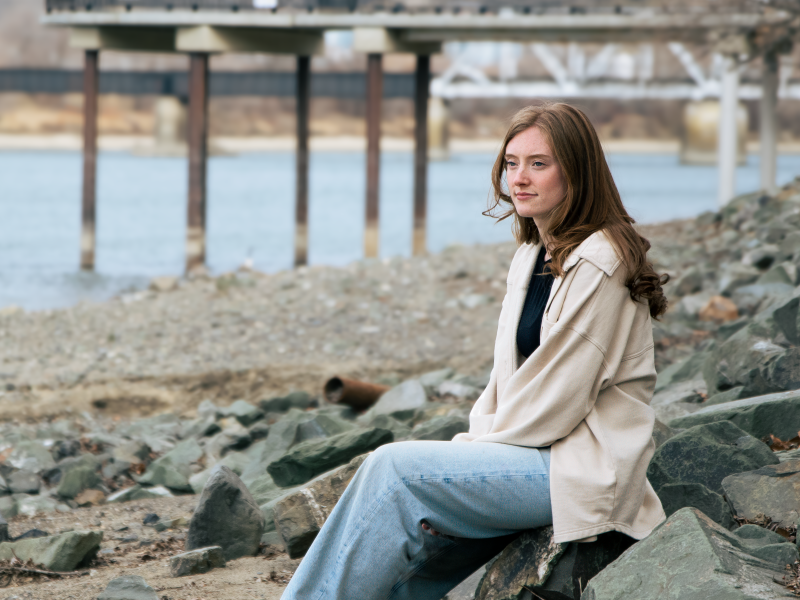
Sylvia was raised in Nairobi, Kenya’s capital city. She moved to Canada in 2021 to study journalism and communications at Thompson Rivers University in Kamloops, BC where she works at Ask Wellness Society, a non-profit organization that helps people in need. Sylvia enjoys reading books, cooking new dishes, and practising nail art. While she enjoys the quiet, slow life in Canada, Sylvia finds herself missing home from time to time. “Nairobi is a city that doesn’t sleep,” she said, “it could be midnight or eight in the morning but there’s definitely going to be traffic or a gathering somewhere.” Sylvia was in Kamloops preparing for her finals when she heard of flooding in her birth country.
The floods happened in May of 2024. It was quite sudden. People were not that informed. I wasn’t aware that this was about to happen. According to the government, it was supposed to be the normal rainy season. People just expected rain as usual.
At first, it seemed like the drainage system wasn’t working well. It was flooding in some parts. You expect that maybe the government would have informed people that it was getting serious, but there was no information whatsoever. They only addressed the situation once the flooding had really affected most of the country.
It was difficult to get information as it was happening because of the time difference. Kenya is twelve hours ahead of us. When they’re awake, I’m asleep, and when I’m asleep they’re awake. Being able to speak to family was challenging because of school. Also, because of these heavy rains, network lines were breaking. It would sometimes be a day where people weren’t able to communicate. I would try to use X. I also remember using a lot of TikTok. I was constantly refreshing my feed with new videos.
There’s this one specific video that I still remember today. We live in a 15-storey apartment. Our neighborhood, we have a shopping center and we have a very big university: United States International University. Close to our house there’s a roundabout and along the side there are vendors who sell different stuff. Out of nowhere, a big rush of water came and swept people away. As you’re watching the video you can see people fighting for their lives, and there’s nothing you can do. You can’t risk your own life to go save somebody. Especially with how harsh the water was.
Back home, we don’t have government-provided transport like buses, but we have privately owned buses. I remember seeing these massive, privately owned buses carrying people. As they’re driving on the road, the water becomes too heavy, and you see buses being swept away with people struggling and screaming through the buses. It was quite traumatic. The fact that I saw something like this happening close to home made it more terrifying. I began to think, you never know who was there when the person was taking the video. It could have been a family member. It could have been anybody. So the fact that you’re not able to confirm right then and there just heightened the anxiety around the flooding.
In the less developed areas, you would not find high-rise buildings. It’s mostly built of iron sheets to make walls and a roof. The only thing built with concrete would be the slab at the bottom to hold and support the sheets. Because the infrastructure is not done properly and sometimes the city council doesn’t maintain the road and the drainage system, there’s a very high risk that such homes would be affected more in a flood. I remember buildings like these were collapsing. All iron sheets are carried away. You tend to find that a single area is completely displaced after floods. You can’t even tell where your home was before.
My grandparents stay in the countryside. Most of the countryside is hills and valleys. Where we’re from, it’s quite popular to grow tea. There’s a lot of tea farms grown on sloping hills, and the homes are usually at the top of the hill. Homes were sliding off.
Close to my grandparents’ home there’s a river called the Chania River. And of course it did flood, so that just made the flooding in the area worse. Fortunately, my grandparents’ home was built properly with concrete so the home itself did not get damaged. However, because the water was seeping in, the ceiling had to be replaced. Some of the walls were starting to mould because of how high the water had gone. Furniture was totally destroyed.
I remember my grandparents telling me that in their farm, the water was so bad there was a crack in the ground at the bottom of the tea farm. That crack was so deep that till this day, there’s a certain section of the tea farm that cannot be used anymore. That specific part of the land is almost inaccessible because if you cross over you’re not able to come back. The crack almost separated the farm in half. So it did leave some long-lasting effects.
The floods made me feel more aware that climate change could happen to just anybody. Most times you hear about climate change on the Internet, and you hear about people experiencing climate change disasters very far from where you are. And it sounds real, but not as real, because it’s not impacted you. The fact that it came and it impacted all of us, made it more real. We need to start taking a look at how we’re treating the world because it really is affecting our day-to-day lives.
We need education on climate change. People need to learn what climate change means. They need to learn how they actually impact climate change. The fact that people might learn this gives me hope. But I don’t know how long this is going to go on for, and I don’t know if it’s fixable. I’m a bit two-sided on that. This idea that I’m literally just one person out of billions of people in the world is the reason why nothing is being done. People need to understand that even though you’re just one person out of the billions, the one thing you do actually does have a significant impact.
This story is a part of a series created by Thompson Rivers University students and led by instructor Jennifer Chrumka as part of the Climate Disaster Project.
So do we. That’s why we spend more time, more money and place more care into reporting each story. Your financial contributions, big and small, make these stories possible. Will you become a monthly supporter today?
If you've read this far, you value in-depth community news