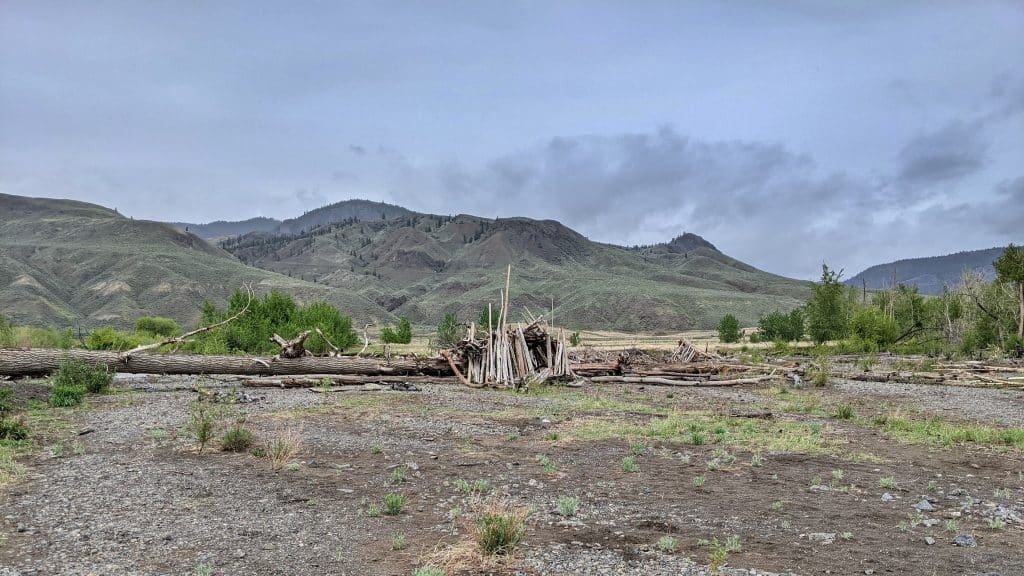
At the bottom of the project website for the proposed subdivision Tranquille on the Lake is a banner stating “respecting the land.”
There, the developer acknowledges “the Tranquille lands, located within the City of Kamloops, like all the land in and around Kamloops, is on the unceded territory of the Stk’emlupsemc te Secwepemc Nation.”
How can a large-scale waterfront subdivision be proposed on unceded territory? What does unceded really mean?
When European settlers colonized what’s been briefly known as British Columbia, only two treaties were signed, leaving the rest of the land unceded.
“When land has been unceded, there’s been no agreement with the Crown to address the underlying Indigenous title to that land,” says Alan Hanna, assistant professor at the University of Victoria’s Faculty of Law, adding this underlying Aboriginal title has been recognized in colonial law as far back as the 1763 Royal Proclamation.
As a result, many decades-long rights and title lawsuits have been brought forward by several First Nations, including monumental Supreme Court of Canada rulings Delgamuukw v. British Columbia (1997) and Tsilhqot’in Nation v. British Columbia (2014).
In the landmark 2014 decision, the Supreme Court of Canada affirmed the Tsilhqot’in Nation’s title to 175,000 hectares of its traditional territory — but Tsilhqot’in Nation excluded private and underwater lands from that determination.
“We’ve never had a definitive answer about this from the courts. They’ve really kind of shied away from this,” says Estair Van Wagner, associate professor at Osgoode Hall Law School. “But it’s a really important underlying question in terms of not just the future of kind of land ownership, but in terms of the future of decision making.”
Stk’emlúpsemc te Secwepemc Nation (SSN), a governance division of the Secwepemc Nation, launched its title case in 2015, claiming title to approximately 1.25 million hectares of its territory in Kamloops (Tk’emlúps) and surrounding areas, including private property.
“We have never ceded, surrendered or given up any of our lands or interests. We have a sacred responsibility to protect and assert jurisdiction over our territory and it is imperative that we stand up and protect our natural resources for the next generations,” said former Kukpi7 Shane Gottfriedson of Tk’emlúps te Secwepemc in a statement at the time.
In its 2017 response, the Government of Canada argued First Nations should name the landowners in their lawsuit if they are claiming title to these properties.
Terry Lake, the MLA for Kamloops-North Thompson at the time, called the government’s response to the case a “vigorous defence of private property rights, particularly because it involves homeowners in Kamloops,” as reported in Kamloops This Week.
What does this mean for private property owners in Kamloops?
“One of the biggest fears we see consistently is that when Indigenous nations get large redress (or) claims, it’s going to fundamentally shift non-Indigenous peoples’ lives in those areas,” says Darcy Lindberg, an assistant professor at the University of Victoria, who practices in the areas of Aboriginal law and human rights.
“And so we saw that in Delgamuukw, that first trial, where there wasn’t even awarding of title, [some] headlines in British Columbia were, ‘The Supreme Court is interrupting all of British Columbia’s private property and the Crown land,’” he recalls.
“Supreme Court ruling sure to increase racial tensions,” was the headline of one Times Colonist opinion piece authored by Martyn Brown, then-executive director of the Citizens’ Voice on Native Claims, in December 1997.
“The province’s unfettered title to virtually all Crown land in B.C. is now in question,” Brown wrote. “Even fee-simple land, or private property, may be subject to claims for compensation of infringements against aboriginal title.”
The Vancouver Sun’s Stephen Hume had a different take in an op-ed published a few months later: “Since co-sovereignty is already a well-established principle in Canada’s existing political reality, Delgamuukw suggests that continuing aboriginal title simply restores one layer of interest. So everybody should calm down. Remember the Supreme Court’s observation that we’re all here to stay.”
Tensions were so high, then regional vice-chief of the Assembly of First Nations Herb George told a room full of people in Kamloops: “We’re not the ogres you think we are.”
He was directly responding to fears from some conference attendees that the Delgamuukw decision could lead to the breakup of Canada, as described by the Vancouver Sun in a 1998 article. “Change has to be managed if we’re going to remove those fears,” he told the audience. ”Those fears that they’re going to lose their land, fears that there will be social chaos.”
Many legal experts agree these interests aren’t necessarily incompatible.
“We also have to understand that there’s another [First Nations] legal order in play here that has its own conception of that land and the title that exists on it,” Hanna says. “If we’re going to talk about law and justice, there’s law and justice that applies to and protects fee simple landholders and that same law and justice applies to and protects First Nations on their unceded lands.”
While fee simple property rights are seen as “peak rights — some of the strongest rights that we have in the common law system,” Van Wagner explains, “they don’t exclude and they don’t extinguish that underlying Indigenous right.”
In other words, both can exist. “Because, of course, Indigenous legal systems, just like other legal systems, have ways of dealing with different relationships with land, different use rights and different kinds of decision-making structures,” Van Wagner says.
While private property carries significant protection under Canadian law, these rights are not absolute, Van Wagner adds. “We are regulating people’s private property rights in a whole range of ways, all the time. Everything from whether you can have backyard chickens, to what kind of tax you pay, and what kind of structures you can build, what kind of trees you can cut down.”
“So one of the questions here is, well, who should be doing that regulating? And which kind of legal systems and values and principles should those be based on?” she adds.
“And in the context of Aboriginal title, I think there’s a very strong argument that that responsibility could then potentially — for that jurisdiction — be undertaken by an Indigenous nation and worked on from a foundation of an Indigenous legal order.”
“We don’t necessarily have a lot of examples of that happening in practice, so it feels kind of scary and unknown,” she says. “But that certainly doesn’t mean it’s something we can’t do or that we shouldn’t do. It’s just a new challenge as part of this larger project of grappling with colonialism and reconciliation and trying to figure out ways to move forward.”
Why are First Nations turning to the courts to resolve this question?
In the treaty-making process, First Nations are told to negotiate on a nation-to-nation basis, outside of courts. But private property is off the table except on a “willing seller, willing buyer basis.”
“Some nations have a lot of so-called Crown land in their territory. And so that can be a major part of a settlement,” Van Wagner says. “But some nations who are in territory that has been much more settled and much more significantly converted into fee- simple private property, those options aren’t available.”
This creates “an enormous roadblock” to the treaty process, she adds.
“So, is the government trying to resolve this? I would say No, there isn’t a lot of movement,” Van Wagner says.
Addressing Aboriginal title on private property doesn’t necessarily have to involve returning land, she adds. It can involve shared decision-making, revenue sharing or other negotiations to address the “enormous historical injustice” of what’s been described in some cases as a land grab.
As a result of the inaction on the part of the province and federal government, SSN and other nations have little other option than to push the courts to affirm their title to private lands.
“And so we do see some nations bringing these questions to the courts, even though that’s, in my view, a pretty uncertain path,” says Van Wagner. “In some ways, I think it’s a pretty uphill battle, given the protection that courts give to the simple private interests overall in our legal system.”
Recently, the Supreme Court of BC heard closing arguments on a Cowichan Nation Alliance case, claiming Aboriginal title to about 750 hectares of land in what’s now known as Richmond, B.C., including the Tl’uqtinus village site. It was the longest trial in Canadian history. The court has not yet made a judgment on the case.
In a pre-trial application, the Government of Canada asked the court to demand that the plaintiffs notify more than 200 property owners who might be impacted by the outcome of the case.
But the Cowichan Nation Alliance argued that the government’s application was misconceived — their claim does not seek to invalidate private land interests or assert the right to dispossess those lands. In a pretrial decision, a judge dismissed Canada’s application and declined to demand that any party notify the private landowners.
So what is the way forward with overlapping claims to land?
“For the parties involved, it’s far more beneficial to negotiate some kind of agreement and understanding,” Hanna says. “It’s far cheaper, it takes a heck of a lot less time. And you don’t end up with a winner-loser.”
Van Wagner agrees. “There’s no requirement for there to be a court decision for the provincial government or other actors — developers, other local governments — to acknowledge the title and to create processes to say, ‘Okay, we know that there’s all these entangled interests and we’re going to negotiate based on that acknowledgement,’ Van Wagner says. “They don’t have to wait for a court decision to do that.”
Lindberg points to the province’s reconciliation protocol with the Haida Nation as an example of what this could look like. “We are seeing a lot more partnerships between the provincial government in British Columbia and Indigenous nations, and setting up co-management schemes,” he says.
“[In this case] the Haida are not stepping down from their declaration of title of their territory, and the province, similarly — it’s asserted sovereignty over the territory as well… but then they agree on how they’re going to manage lands together in the agreement.”
Locally, Stk’emlúpsemc te Secwépemc Nation (SSN) conducted its own impact assessment of the proposed Ajax mining project and determined in 2017 that the open pit copper and gold mine would do irreversible damage to their cultural heritage. SSN also designated Pípsell as a cultural keystone area.
Both the province and Canada then denied the permits for the proposed mine, though existing permits remain because it is a historic mine site.
In 2019, B.C. signed a Letter of Commitment with SSN to work towards a long-term reconciliation agreement “with the shared goal to reconcile their respective jurisdictions, governance, laws, values and responsibilities.”
The agreement acknowledges B.C.’s commitment to full implementation of UNDRIP, which calls on governments to consult with Indigenous peoples “in order to obtain their free and informed consent” before approving any project affecting their territories.
One of the reconciliation agreement’s objectives is to make progress towards “reduced conflict over lands and resources by collaboratively developing structures and processes that can facilitate consensus seeking outcomes reflecting the principle of free, prior and informed consent under UNDRIP, the Truth and Reconciliation Commission’s Calls to Action, and the Supreme Court of Canada’s Tsilhqot’in decision and other case law.”
What about B.C’s commitments to implement UNDRIP?
In 2019 British Columbia passed into law the Declaration on the Rights of Indigenous Peoples Act (DRIPA) where it committed to bring its laws into alignment with UNDRIP and to implement an action plan to that end, while reporting regularly on progress.
“DRIPA itself, I really don’t think it does a lot without the impetus of the provincial government behind it to actually effect changes in the legislation,” says Hanna. “It’s more of an aspirational tool to guide the provincial government to make changes to its legislation.
Many First Nations leaders have argued the province is moving too slowly on these commitments.
And huge questions remain, such as: How will DRIPA affect the Land Title Act, which sets out the rights of private landowners?
“I think there will be some anxiety and fear about the implications for something like the Land Title Act system,” Van Wagner says. “But I think that shouldn’t overshadow the real purpose of DRIPA, which is to uphold and further Indigenous self-determination, and that includes relationships with land.
“We’re not going to get very far if we don’t grapple with the kind of core statutes and regulatory frameworks that we deal with land through.”
What can individual landowners and community members do as they wait for First Nations and Canadian governments to negotiate these complex questions?
“My advice is to recognize nations as decision makers, to recognize the jurisdiction and then operate on a basis of that … because it’s the foundation for good relations.”
“Good relationships are, I think, really the way that things get done properly, and maybe even sometimes more quickly.”
With files from Jacqueline Ronson and Kallan Lyons
So do we. That’s why we spend more time, more money and place more care into reporting each story. Your financial contributions, big and small, make these stories possible. Will you become a monthly supporter today?
If you've read this far, you value in-depth community news