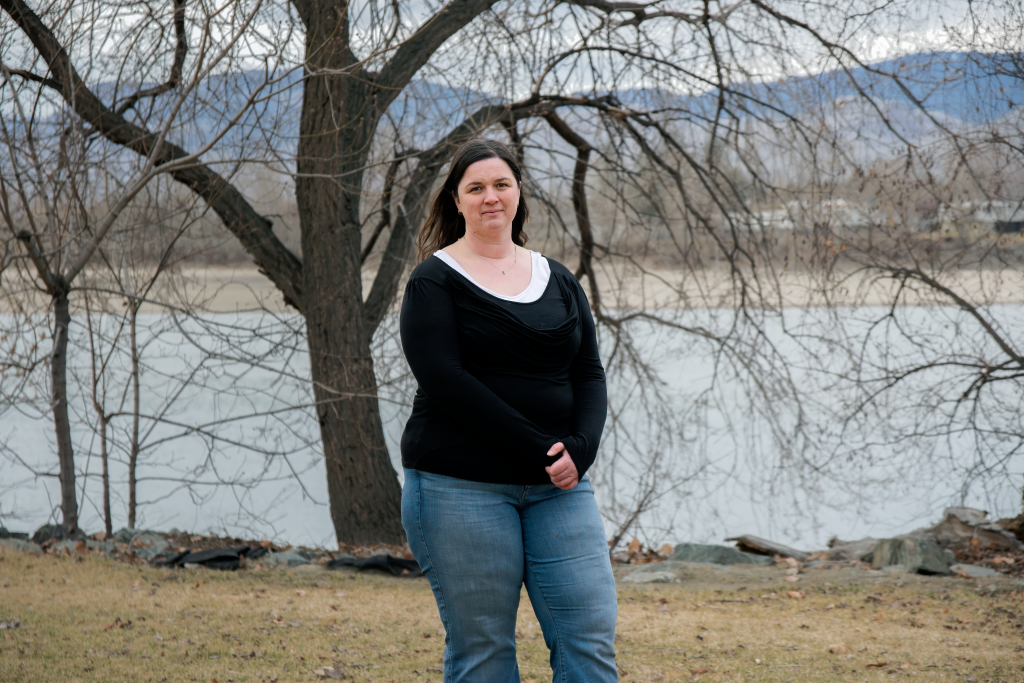
Melanie is the emergency services coordinator for Simpcw First Nation and is in charge of its Indigenous Initial Attack Crew. She also volunteers as the community’s deputy fire chief, and is the author of a fire safety-themed children’s book, Shawn and Flash. Born on the Sunshine Coast, her family moved to the small Interior town of Barriere, British Columbia when she was eight. “I guess my dad was having a midlife crisis in his mid-30s and said, ‘I want to buy a cattle ranch and become a farmer,’” said Melanie. In 2003, when the nearby McLure fire erupted near her community, the 20-year-old had no idea the battle to protect it would shape her future career.
Barierre was a mill town. There was the Tolko Mill and the Gilbert-Smith Mill. A lot of the parents worked at the mill, for the mill, or in the forest industry. There were these yellow plywood signs stenciled with black letters. They’d say, “This family is supported by timber dollars.” Every second driveway had one of those. It was a little tree-covered valley community that was self-sufficient and had everything that you needed.
There’s good, grassroots news in town! Your weekly dose of all things Kamloops (Tk’emlúps). Unsubscribe anytime.
Get The Wren’s latest stories
straight to your inbox
I was eight years old in ‘91 when my dad sold his logging company, and we were thrown into cattle ranching. Him and my mom had a herd of cows. They did a lot of the farming with a team of horses and they’d harness them every day. Minus thirty, didn’t matter. We’d ride those horses all summer, working the cows, riding up in the hills with our friends. Come the next spring, he would sell the horses and we’d start over again. So I grew up driving teams of horses, and I didn’t think that was odd. I thought that everybody could drive horses.
All through high school, I was a straight-A student. Top of my class. Class valedictorian. When the world asked me what I wanted to be when I grew up, I would say happy. I went to university because I was told it was a waste of talent if I didn’t, but it wasn’t my thing. I didn’t want to be going to school anymore. I wanted to be out doing things, experiencing life and learning that way.
In August 2003, I wasn’t really sure of where I wanted to go in life. I was living in my own house on the farm. We called it the Little House but it was more like an extended bedroom. It had its own kitchen and everything. But I’d just go over to my mom’s house for dinner because she still took care of us.
One day, when we were driving home to the ranch, there was a fire on the CN tracks. Crews were on it, putting it out. It was so dry and hot, we were lucky that somebody got on that fire. Then the next day the radio said there was another fire in McLure. This was before the days of social media. As this fire started moving, it took out the hydro poles. There was no power in the entire valley.
The fire was getting bigger and moving quickly. Farms and animals were in danger. So the president of the Fall Fair called my dad and said we need stock hauled out. My dad had a big stock trailer so we hopped in the truck. They stopped us at a staging area because they didn’t want to send everybody in with trucks and trailers and put them into more danger. When they knew exactly what they needed they would get someone to go in and take those animals.
I can remember sitting there in a lineup of trailers waiting to get stock out of the hot zone. It was dark. Police were stopping traffic We could see the fire coming but the police car’s lights were just flashing and flashing in the dark. I always remember those lights more than anything. We didn’t end up hauling stock out that night, but we went home knowing that this fire was burning and coming quickly.
Within two days of that fire, the Strawberry Hills wildfire in Kamloops, one in Falkland, one in Cache Creek, and a big one in Kelowna all started. They all blew up at the same time. We weren’t used to fires happening like that. A fire would start, and it would get put out. But these ones weren’t. They were just growing bigger and taking more and more resources.
One time we had to stop at the local fairgrounds. We were hauling horses out again. We’re facing south towards where the mill was. That’s when the Tolko Mill blew up. The whole sky just lit up in this big orange mushroom with black billowing towards us. A couple minutes later someone came racing in there. They’re like “The air’s on fire at the edge of town. You gotta get out of here.” We had to get the job done. We got the trailer unhooked and got the hell out of there — one foot in front of the other.
People started to get evacuated. Because cordless phones wouldn’t work with no power, we had my old stand-up Mickey Mouse phone from when I was 14. To ring, he would dance, his arms would move and he would sing the Mickey Mouse song. We lived north of Barriere so people would call us. They said, “Can we bring you our animals? Can we bring our horses?” We probably had 30 people that set up camp around our home with horses and dogs.
We had a few houses on the farm so people mostly stay in houses. Some were staying in RVs. We set up this common area in one corner. We put up tarps to create shade. There was chairs and picnic tables all laid out. Dad rerouted our gravity irrigation system so that we had water. We set up a shower house. The sun would heat the water in a metal container, so we had a semi-warm outdoor shower. We had barbecues set up. The women just cooked and cooked.
We live on Dunn Lake Road. That’s our one road in, one road out to Barriere. As you come down into the actual town, there was this spot where the road is quite steep. The fire was right up to the road. That road was acting as a barrier. If that fire crossed Dunn Lake road there, it would have continued north up into our community. We knew that if we didn’t do something, nothing was gonna happen. The fire was just advancing so quickly, and so many resources were tapped.
You make the decision: I am going to go out there and fight this fire. Without regulation, without being told that I can, just because I feel in my gut that this is the right thing to do and those people beside you are like, this is the right thing to do. So we went and fought fire with no firefighting experience.
One of the other farmers up past us, Darrell, had an old water truck and some old leaky hose. We drove into town. We parked. Four of us girls, GI Joe’d down the hill to where the trees were on fire. Dad’s up at the top running the pumps. We took these hoses and started spraying the trees at the top where the flame was. Dad’s like, “You gotta hit it at the base.” We had no idea. I was 20 years old. My sister was 23. Our friends were all the same age. We took the hoses, spray it at the base, and all the sparks came out at us. I didn’t know enough to be afraid. We just knew that this needed to be done. Fear was not allowed to be a part of the factor. When you’re 20-years-old, you think you’re invincible.
We didn’t ask for resources. We didn’t ask for help. We just went out and did what we needed to do. The crew was in close talks with the Ministry of Forestry. They needed to know we were out there. So they had to call us something. So they dubbed us The Derelicts.
We would work until it was dark, and then we would go home. It was pitch black, but mom would take the old coal oil lantern and sit it on the patio railing in the Little House. Me and my friends would wash ourselves up best we could, sleep till it was daylight, and then head back out again.
We would drive through town to bring supplies from our camp. There were pockets of people all over that weren’t leaving. They were out of gas for their pumps and generators. Some people thought the world was burning down. Everything was just scorched and smoky. Hydro lines were lying across the highway. There’d be bulldozers rolling through downtown and ashes falling. It was like a war zone.
All intertwined with this fire threatening our community was our daily life. Some people weren’t able to function. They thought the world was burning down. But we couldn’t just leave the daily ranch operations. Cows had to go up the mountain, so we pushed them up the mountain.
The days started getting shorter and the moisture started coming in at night. The explosiveness of the fire was gone.
The community as a whole was almost paralyzed. The Tolko Mill was a core employer for the community. There was also an industrial area of Barriere with mechanic shops and body shops that burnt. A large percentage of those did not get rebuilt. That was a big hit to the community. A lot of the employees got rerouted to other mills so they moved their families.
Employment was a real struggle for a long time because the amount of timber dollars in the community shifted. There became a struggle with youth and drug use.
When you’re 20 years old, you thought that you were going to break your leg or crash your car. You didn’t think that your world was going to burn.
When I found myself in a career of emergency management, that fire was able to help me. I’d been there and understood the importance of the organization of local responses and having the people who knew the community. Did we go there and put the fire out? Yes. Was it the best-case scenario? Definitely not.
I don’t know if we even talked about climate change back then, but this fire made me rethink who was out there protecting us. We don’t want our forests to burn the way that they did in 2003. With climate change, we’re going to have to manage our forests in a different way, because our forests aren’t living in the same world that they were previously
Since 2003, I’ve been on quite a few landscape fires, and the ones that are actioned the best are when we have the collaboration of fire departments, First Nations, BC Wildfire and the locals. In our area, it’s usually the farmers, ranchers or First Nations that know where they’re going. They have a vested interest in these fires.
Now, we have our Indigenous Initial Attack Crew in our community. We’re putting local knowledge, local boots on the ground and people with quick response times. By having that quick response with that local knowledge, we can get out there and preserve our environment and communities for the next generations.
This story is a part of a series created by Thompson Rivers University students and led by instructor Jennifer Chrumka as part of the Climate Disaster Project.
So do we. That’s why we spend more time, more money and place more care into reporting each story. Your financial contributions, big and small, make these stories possible. Will you become a monthly supporter today?
If you've read this far, you value in-depth community news