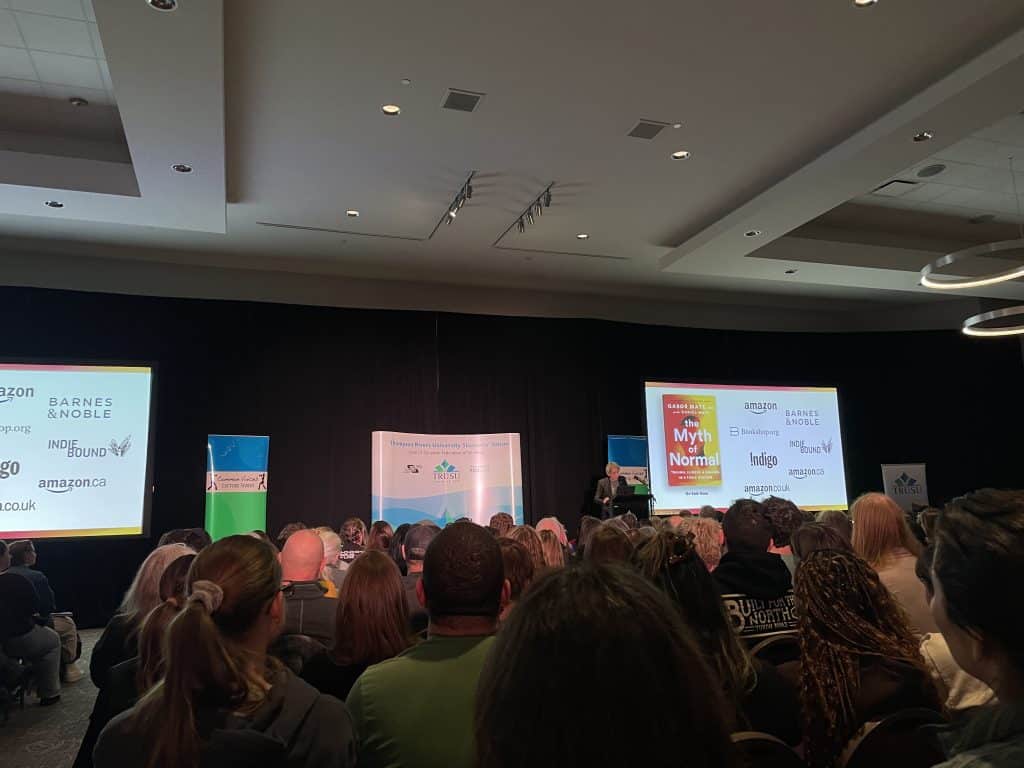
Last month, more than 600 people packed the Campus Activity Centre to hear a wide-ranging talk about mental health and addiction by Dr. Gabor Maté at Thompson Rivers University (TRU) in Kamloops. Maté is a physician and author of several books informed by his decades working in Vancouver’s Downtown Eastside.
The retired physician, who worked for more than a decade in Vancouver’s Downtown Eastside with people experiencing addiction and mental illness, challenged what he called common myths about substance use.
Paramedics responded to 1,086 overdoses in Kamloops last year, when 58 people in the city were killed by toxic drugs, according to newly released data by the B.C. Coroner’s Service. That’s equivalent to someone dying every six days, and in the last 10 years adds up to 662 Kamloopsians killed.
According to the Canadian Mental Health Association, roughly one-in-four British Columbians will experience a substance use disorder in their lifetime, well above the national average of 21 per cent.
Maté, the author of the best-selling book In the Realm of Hungry Ghosts: Close Encounters with Addiction spoke in Kamloops on Feb. 11.
As a Hungarian-born Holocaust survivor, he connects trauma and its intergenerational effects to early childhood experiences, and encourages people to take a compassionate approach to healing from addictive-behaviours, ADHD and other stressors.
His talk was part of the Common Voices Lecture Series. Maté, who was named to the Order of Canada in 2018, co-wrote his most recent book The Myth of Normal: Trauma, Illness, and Healing in a Toxic Culture with his son, Daniel Maté.
Here are some of the key takeaways from his lecture in Kamloops:
Addiction is complicated
“Drugs are not addictive,” Maté told the audience. “Even most people who try most drugs never get addicted.”
He posed several questions using alcohol as an example.
Asking how many people had ever tried alcohol, then when most folks raised their hands after he requested for folks to keep their hands up if they are alcoholics.
“If alcohol was addicting, you should all be alcoholics,” he said. “Nothing is addictive in itself, and everything is potentially addictive depending on the person’s relationship.”
Most people are addicted to something
Addiction is a complex psychological process Maté explained.
“But it’s manifested in any behavior which a person finds temporary pleasure or relief, and therefore craves — but then suffers negative consequences as a result of and doesn’t give it up, despite the negative consequences.”
Most addictions have characteristics such as pleasure, which offers short-term relief, but long-run harm, he added asking the audience if anyone had ever had an addictive pattern in their lives.
Addiction goes beyond just substances, he explained. People can be addicted to work, pornography, shopping and eating, among others.
Based on his definition of addiction, he then asked attendees to raise their hands if they had experienced addiction.
Almost the entire room did.
“Life is pretty tough,” he said. “Life is very painful, as you can witness or experience for yourself.”
Developing addictive behaviours goes back to the way the brain works, and how it can create certain emotions.
“Don’t ask, ‘Why the addiction?’” he said. “Ask, ‘Why the pain?’”
Trauma is the base for most addictions
“Trauma literally means a wound that remains,” Maté said. “Any addiction in my experience comes out of trauma.”
“Trauma is not what happens to you,” he added. “Trauma is what happens inside you as a result of what happens to you.”
An example he shared was if someone sustains a blow in the head. The trauma would be the result, perhaps a concussion. But barring a concussion, there is just pain left.
“You can have pain and stress without trauma,” he explained further. “Everything traumatic is painful and stressful, but not everything stressful and painful is traumatic.”
For those who experience addiction, highly stressful moments can trigger a relapse, since most people turn to addiction to regulate their stress.
“The addiction was your solution to a problem… of stress, the problem of loss of control, to the problem of loneliness, maybe to the problem of lack of meaning, to the problem of emotional pain.”
Bringing Gabor Maté to Kamloops
Abdus Samad Khan, elected entertainment representative of the Thompson Rivers University Students’ Union (TRUSU) board, told The Wren that bringing Maté to speak took roughly seven months of planning ahead.
“We’ve been trying to get Dr. Maté to come to Kamloops for a while,” Khan said.
The Common Voices Lecture series brings world-acclaimed speakers to address important and timely topics.
“We believe that learning does not stop at the classroom,” Khan explains. “It should go beyond that too.
The day of the event, there were around 700 people attending in person, plus an average 600 viewers of an online livestream.
“We had massive interest to the point that our phones were constantly ringing … our website crashed.”
Many thanked Khan for securing Maté for the talk.
Overall, he adds, feedback about the lecture was positive, including one of his friends who credited Maté’s teachings with helping turn his life around.
“Most of us were just there because Dr. Maté has had a positive impact on our lives,” Khan adds.
For him, it was Maté’s main mantra — “Don’t ask why the addiction, ask why the pain?” — which had the biggest personal impact.
“It just gives you a very compassionate way to look at people that are struggling instead of just sidelining them.”
Marie, a longtime Kamloopsian who attended the lecture but gave only her first name,said the substance use issues he discussed resonated personally.
“I’ve had loved ones who’ve also struggled with addiction,” she told The Wren after the event, saying his mantra about addiction and pain “just really sums up his work in reframing rather than seeing it as someone’s personal failure or deficit.”
The Wren is a community driven local news outlet. Your questions and ideas help guide what we dig into. Your feedback after we publish a story helps ensure we're always improving our reporting to better serve you
What do think about this story?