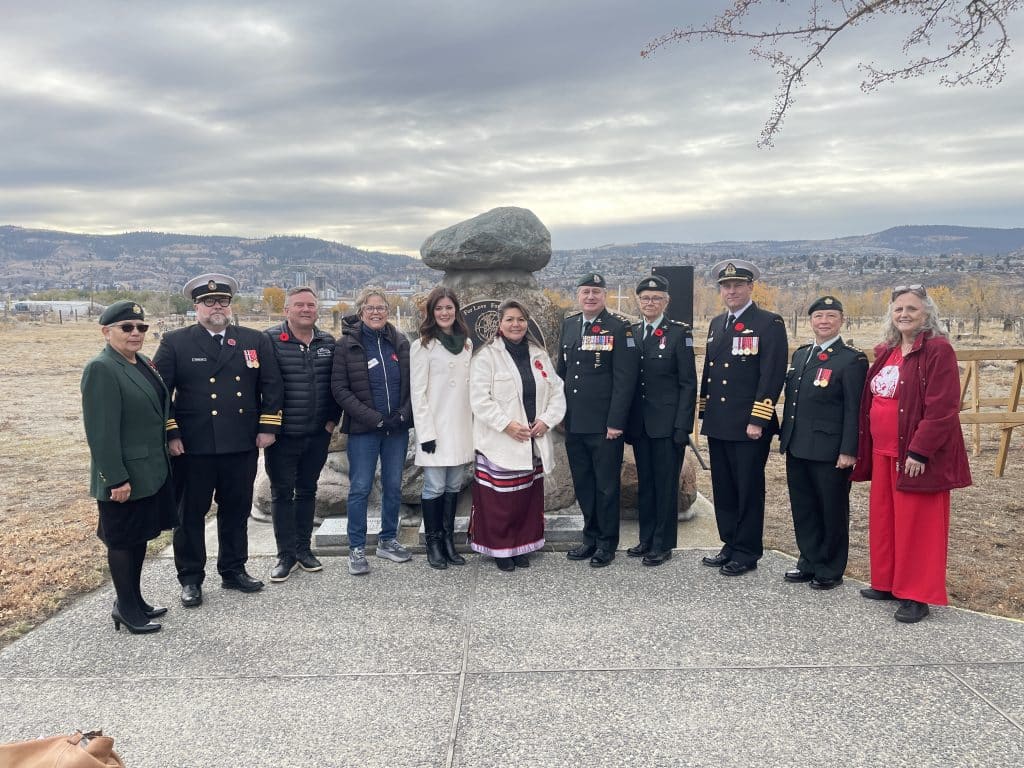
The sun was shining on the cenotaph at the Pen Pen Cemetery Saturday, Nov. 8 as folks gathered for Indigenous Veterans Day.
Hosted by Tkʼemlúps te Secwépemc, the ceremony was opened with a prayer, welcome song and honour song.
The ceremony was led by Kúkwpi7 Rosanne Casimir who welcomed attendees, speaking on the importance of Indigenous Veterans Day to recognize the many First Nations, Metis and Inuit peoples who have served Canada.
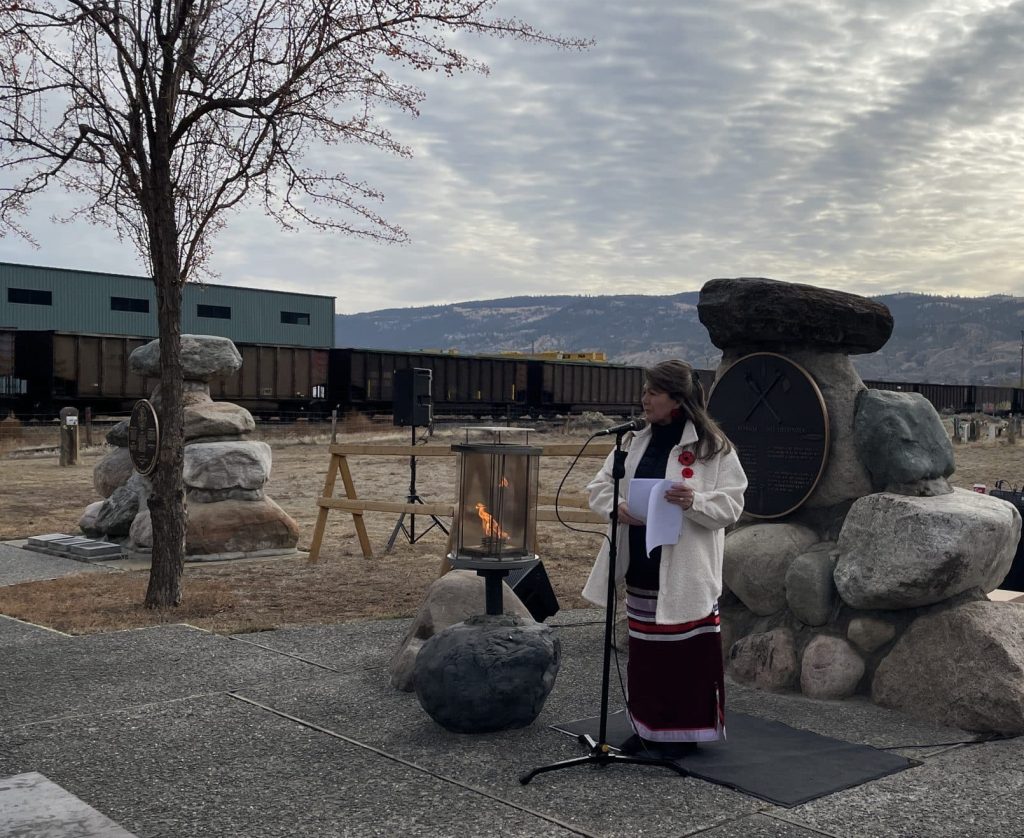
“Many volunteered at a time when they weren’t even recognized as citizens in our own homeland,” she told The Wren. “So for us today, November the eighth is about truth, it’s about respect and it is about remembrance.”
Tkʼemlúps has 42 members who have participated in various wars, three of whom “paid the ultimate sacrifice,” Casimir said.
Private Joseph Allen Jr. Leonard, private Robert Louise Larue, and private Ernest Thomas all served and died in World War II.
“Their stories remind us of the enduring power of courage and unity and selflessness in the face of adversity and their memory will also continue to inspire generations to come,” Casimir said.
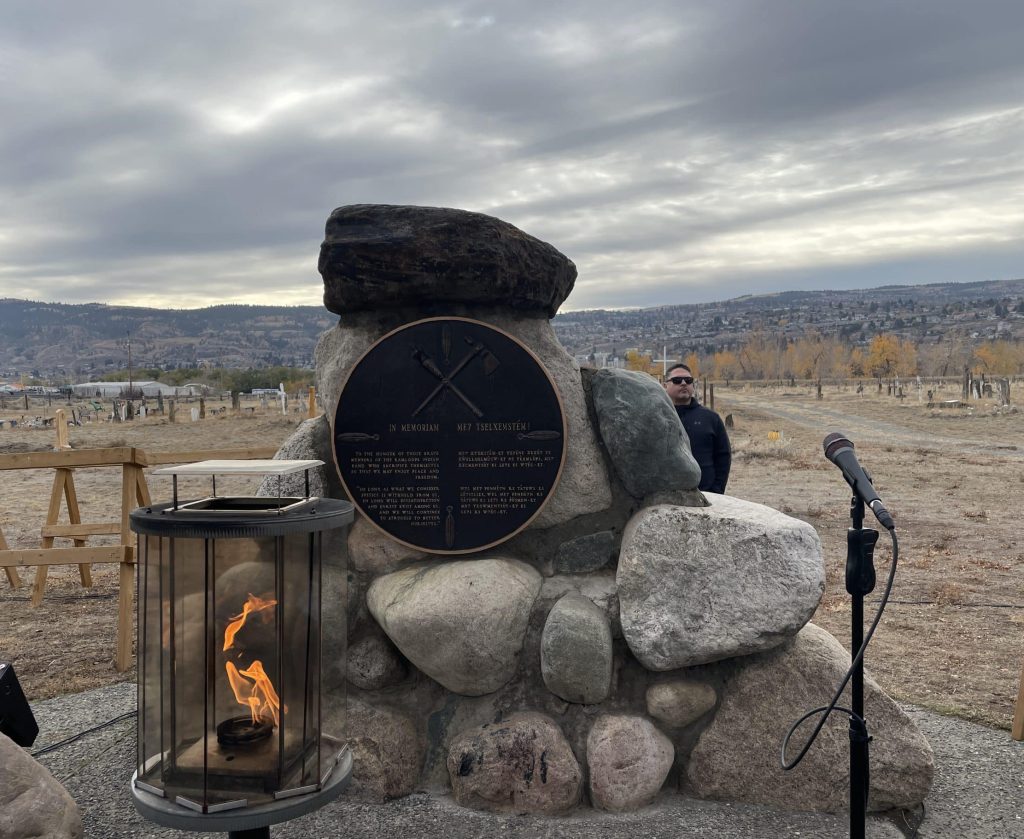
Two minutes of silence were held.
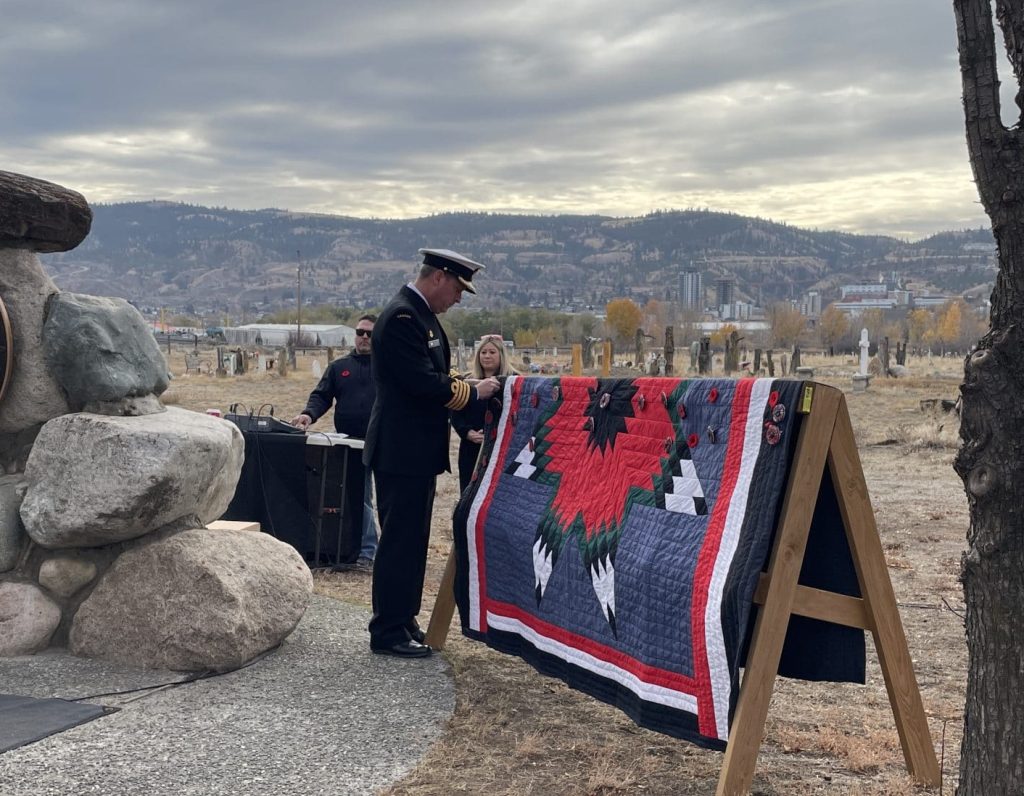
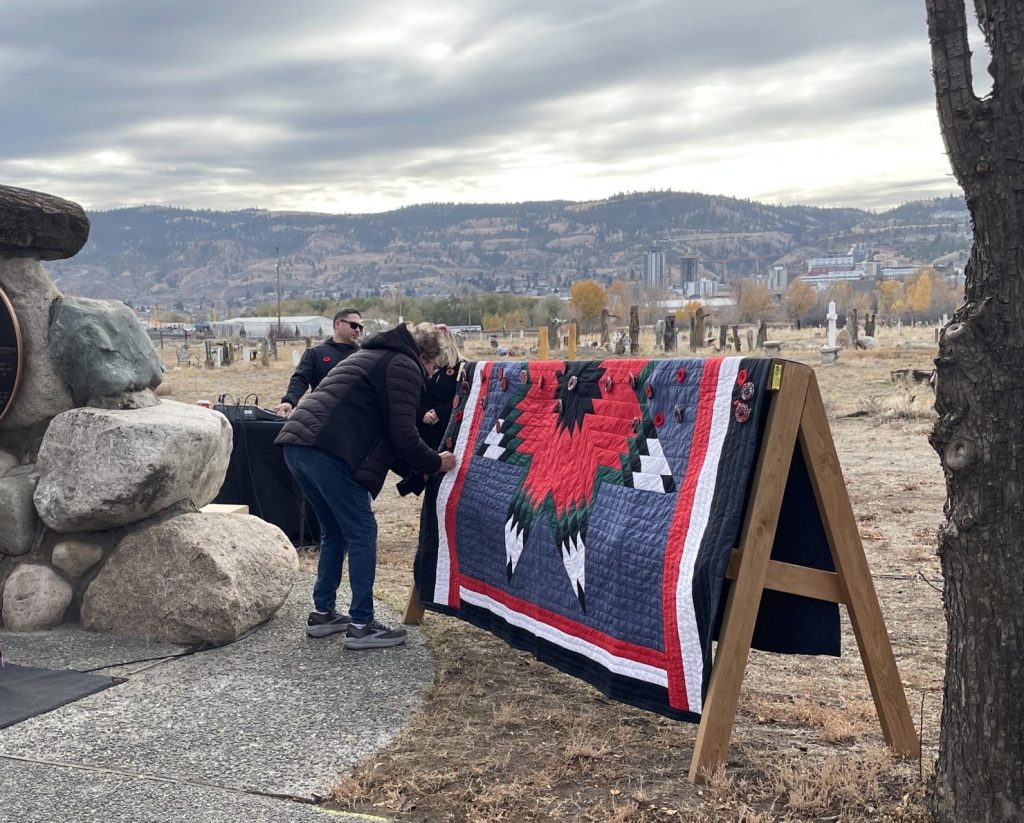
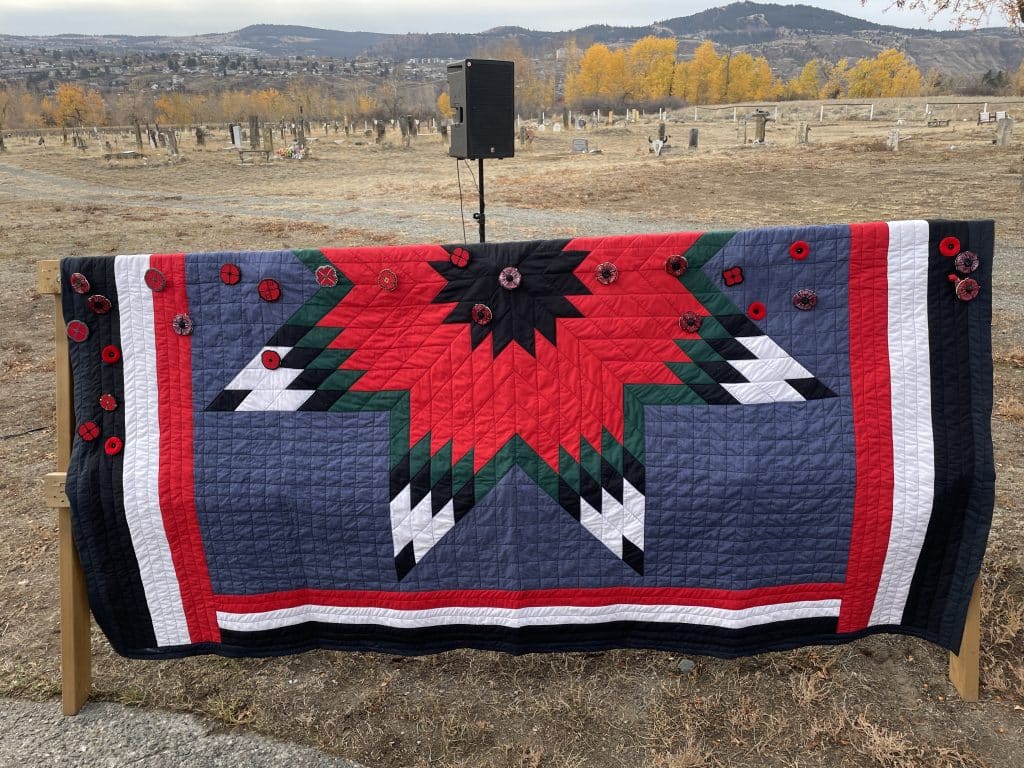
After reading the poem In Flanders Fields, Casimir called upon attendees to hang their poppies on a star blanket, offering a moment of remembrance.
One by one various attendees spoke into the microphone sharing names and families they were honouring. Veterans spoke the names of those who worked amongst them or were their close friends. Emotions bubbled up as folks recalled all those important to them, and one attendee saluted a poppy he put up in honour of a friend he lost.
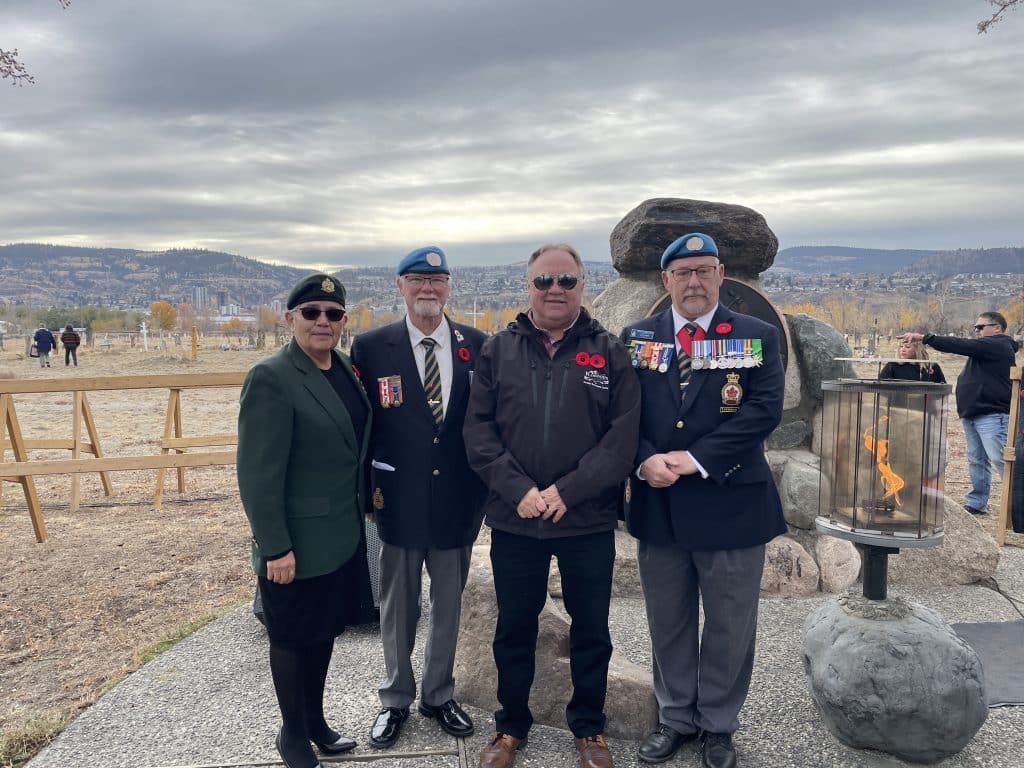
Kamloops city councillors Margot Middleton, Kelly Hall and Dale Bass were present at the ceremony, as well as Mayor Reid Hammer-Jackson and Deputy Mayor Katie Neustaeter.
“We say thank you for holding in your hearts those who have fallen, those who returned home but not whole, those who were never recognized in their service because of the colour of their skin, because of cultural background. We say we stand with you today. We recognize you. We see you. We see the pain in your families when we come alongside,” Neustaeter said.
‘We supported each other. That’s what it means to me, to think of Remembrance Day’
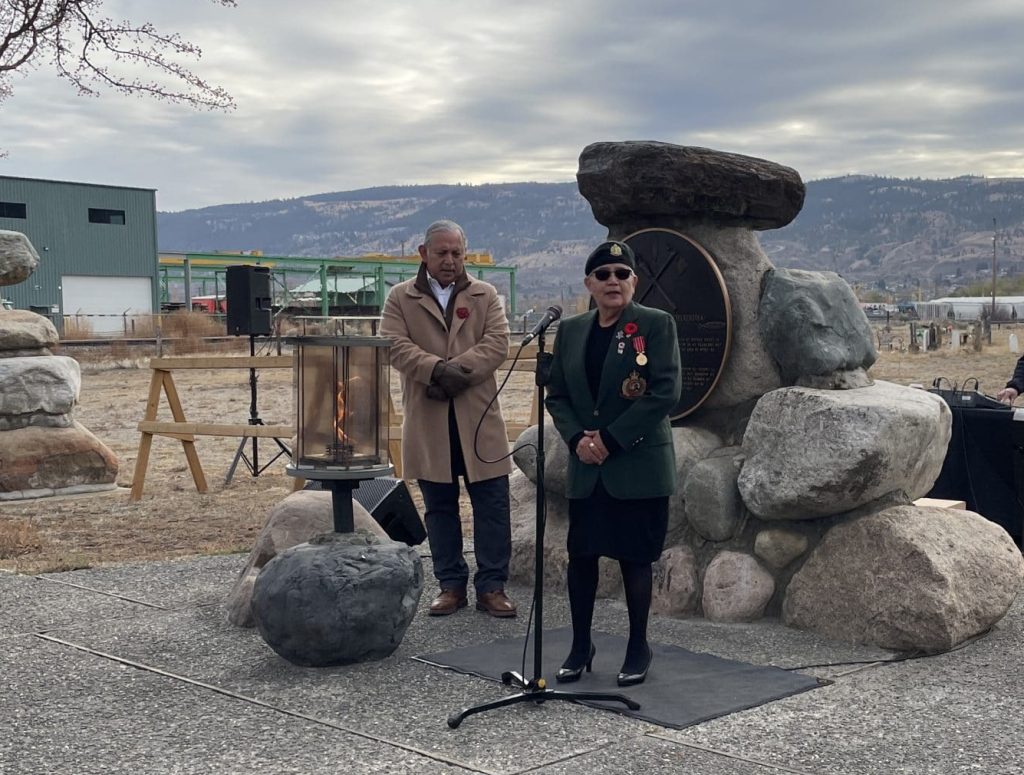
Master Corporal Lorna Shackelly, member of the Upper Nicola Band spoke as well, sharing her story of blazing a trail and making history.
“I was a juvenile delinquent,” she said in her speech. “I was still on probation at the time when I joined. My cousin told me I was signing up for summer camp and that I was going to get paid to go jogging, climbing, river, river, boat, rafting.”
After receiving her duffle bag, green clothes and combat boots she asked why everything was green and then someone told her she just joined the military. Shackelly ended up being part of the Summer Youth Employment Program with the Rocky Mountain Rangers.
“I went and I loved the challenges and proving them wrong. I am the first female…tank operator in Canada,” she said.
“I put First Nations women and the Okanagan on the map.”
Becoming Canada’s first woman Armoured Vehicle General Purpose tank operator came after she attended a course on armoured vehicle gunnery personnel.
In the back of the classrooms amongst mainly men Shackelly sat and carried on with her training. After attending the course she asked permission to write the test and passed. Scoring 20 per cent higher in the driving test, Shackelly passed.
“I was 18 years old. I didn’t know that I had made history,” she told The Wren. “It took a long time for me to be accepted and appreciated for what I had done. I was a female in a combat arms role; I was native, and I had two strikes against me. For the first two years, I had to put up with a lot of humiliation, a lot of degradation, a lot of disrespect from the guys. But I wanted to prove to them that if you can do it, so can I…”
After those two years she gained the respect of those men around her and found friends, family and comrades.
When asked what Indigenous Veterans day meant to her, Shackelly kept quiet for a couple of minutes and reflected with emotion in her eyes.
“I lost my military family,” she said.
Shackelly tells the experience she had after Warrant Officer Jimmy Claire passed away. He was part of Princess Patricia’s Canadian Light Infantry, he was also Indigenous and was one of those who voted so she could be part of the military. She recalled how hard he was on her and would always say ‘you can do better’ to her.
“On Remembrance Day, I go up to his grave here in Kamloops, and I stand at attention. I salute him, and I bend a knee for him,” Shackelly said.
The Rocky Mountain Rangers were Shackelly’s family.
“We supported each other. That’s what it means to me, to think of Remembrance Day, to think of the regiment, to think of the veterans. We never left anybody behind,” Shackelly said. “They stood beside me, in front of me, behind me, supporting me all the way.”
Me7 Tselxemstem! (In Memoriam)
In remembrance of Tkʼemlúps te Secwépemc members and veterans:
Edward Bennett, WWII
Wilfred Bennett, WWII
George Bob, WWII
Manuel Boney, WWII
Felix Camille, WWII
Irene Campbell, WWII
Thomas Charters, WWII
Alex William Eneas, WWII
Clarence Joseph Fortier, WWII
Joseph Fraser, WWII
Victor Fraser, WWII
Alexander George, WWI
Gus Sr Gottfriedson, WWII
Peter Harry, WWI and Boer War
Francis Jules, WWII and K-49341
I’sha Jules, Iraq
Leslie Jules, WWII
Willie Jules, WWII
Eli Jr LaRue, WWI
Gabriel LaRue, WWII
Robert Louise LaRue, WWII
William LaRue, WWII
Allen George Laviguer, WWII
Dave Leonard, WWII
Joseph Allen Jr Leonard, WWII
George Leonard, WWII
Jimmy Leonard, WWII
Jos A.S. Sr. Leonard, WWI
Allan A Manuel, WWII
Andy Manuel, WWII
Jim Manuel, WWI
Louis Manuel, WWII
George Mclean, WWII
Pete Paul, WWII
Francis Paul, WWII
Dave Seymour, WWI
Gerry Seymour, WWII
Alec Thomas, WWI
Edmund Thomas, WWI
Ernest Thomas, WWI
Ernest Thomas, WWII
Alex George Thomma, WWI
Isaax Willard, WWI
Kukwstsétsemc (Thank you)
The Wren is a community driven local news outlet. Your questions and ideas help guide what we dig into. Your feedback after we publish a story helps ensure we're always improving our reporting to better serve you
What do think about this story?