
City staff explore Kamloops-wide safer streets research after council rejects pilot program to reduce speeds
After a 30 kilometre per hour pilot program intended for two neighbourhoods was rejected in council, city staff work to create a practical, enforceable policy for high traffic areas.
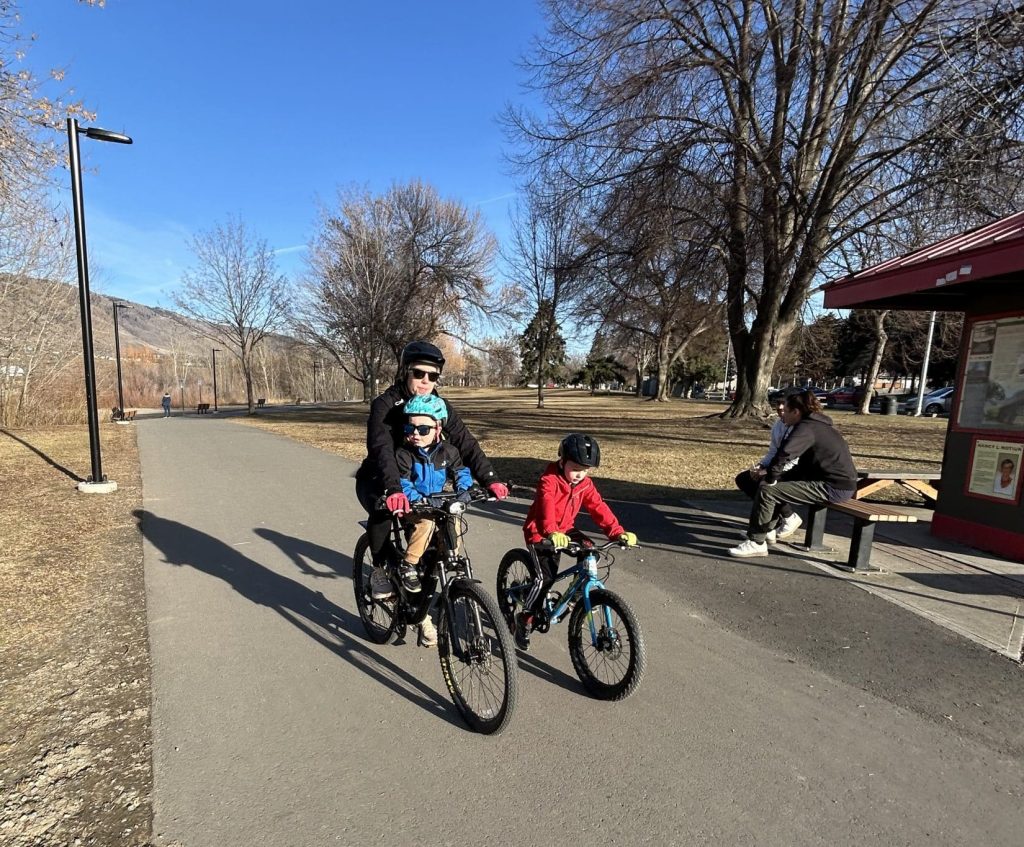
As someone who grew up biking, Andrea Burrows is used to managing its risks, including the lack of biking infrastructure and signs, and navigating cars and other obstacles.
A Kamloops resident for over 12 years, Burrows lives in the downtown core with her two kids who are now old enough to cycle with her, and she says teaching them to be safe on two wheels has added a complexity to her daily commute.
“Every morning, I put on my shields,” Burrows says. “I am acutely aware of when cars pass, and they pass you at this great speed, thinking that maybe they’re doing you a favour.”
Burrows says she is disappointed the city has not enacted policies or strategies to prioritize the safety of cyclists.
One step she says would have been helpful was the neighbourhood 30 km per hour pilot program recently brought before Kamloops City council that would have directly impacted her neighbourhood.
The pilot program came together after July 15, 2025 when council directed city staff to investigate the Sagebrush and McDonald Park neighbourhoods and reduce speed.
Following the audit, staff recommended reducing the speed in those neighbourhoods to 30 kilometres per hour, presenting the report in November 2025.
But once in front of council on Jan. 26, the pilot project was struck down, with staff instead directed to look at a city-wide traffic calming solution.
The need for a solution is clear and overdue, Burrows says.
“The perception of safety is what I often think about. When I talk to people about walking, biking, it always comes back to well, it’s not safe enough,” Burrows says.
She adds that the slower vehicles go the better, especially when she is cycling with her children, one of whom rides his own bike.
Whatever the case may be, speeding cars add extra stress to her daily commute.
“Speed is a big part that makes a difference for me as a cyclist and for my child,” Burrows adds.
Elwira Rosiak, a Kamloops parent of three, tells The Wren that prioritizing safer streets is valuable for the community as a whole.
Rosiak lives in Westsyde, and through her volunteer work has had conversations with other parents seeking to make changes.
She argues that research supports the permanent benefits of 30 kilometres per hour speed limits in residential areas with kids and schools.
According to the report by the city reducing traffic speeds helps improve reaction time, decreasing the stopping distance, and reducing the risk of serious injury and death.
“At this point, you should be putting money in the budget towards implementing Vision Zero,” she says, referencing the action plan adopted in late 2023 by city council which aims to reduce transportation fatalities and serious injuries by 2039.
“Why are we even debating if we’re going to do the pilot?”
How frequent are crashes in Kamloops?
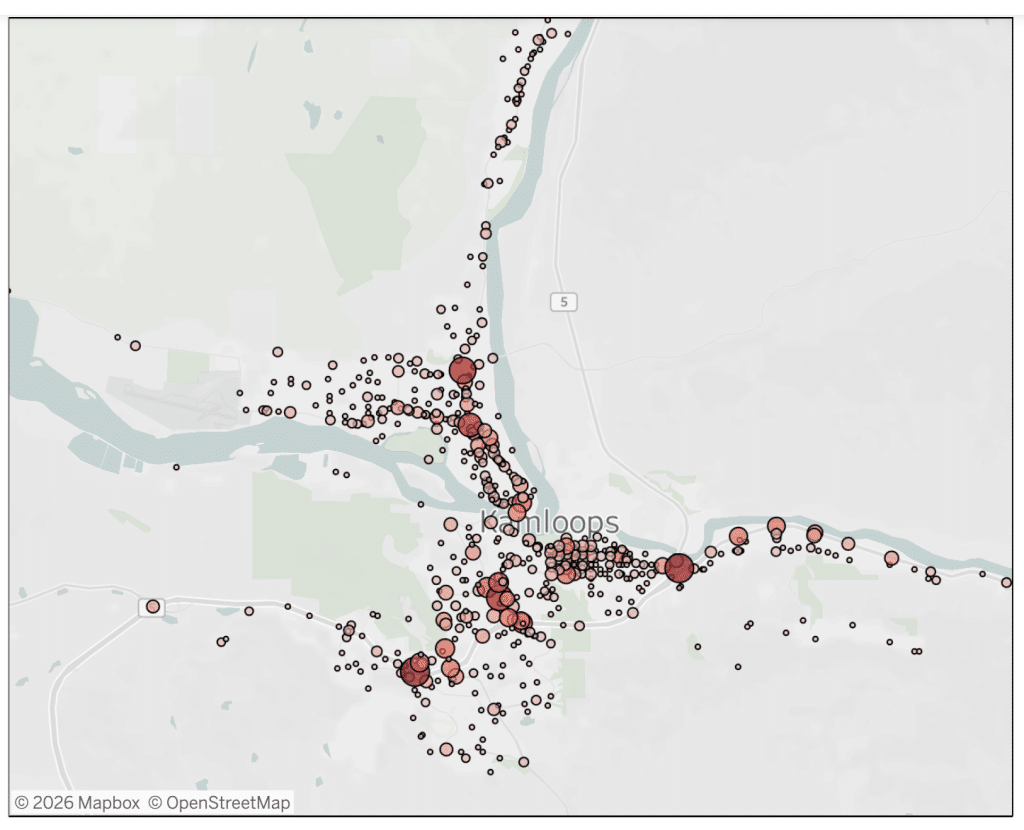
In 2024, the Southern Interior saw 41,608 crashes with 5,699 resulting in casualties, according to Insurance Corporation of British Columbia (ICBC).
Two-hundred and ninety one incidents involved pedestrians, resulting in 248 injuries.
Kamloops specifically saw several hundred crashes. One of the most frequent areas was the intersection of Hillside Way, Hugh Alan Drive and Pacific Way, where there were 60 crashes in 2024.
“We are a car-centric community,” Burrows says.
The KAMPLAN snapshot presented by the city showed a faster growth rate in passenger vehicles than population growth in 2021, and in 2024, Kamloops had 76,765 active drivers licenses, ICBC reports. During the same year 81,270 vehicles were insured in ICBC in Kamloops.
When the pilot program was proposed city staff also analyzed 26 neighbourhoods in Kamloops based on collision frequency, equity and vulnerable population. This resulted in them picking the Sagebrush and MacDonald Park neighbourhood for the pilot program.
“I don’t know why we haven’t incorporated speed bumps, this isn’t a new issue. There are places in the city that have major concerns…Why did it take us so long to get this policy?” Burrows says.
Rosiak says she feels parents should be party to conversations regarding further adoption of policies or effective solutions.
“We don’t have, as parents, a spot at the table,” she says, explaining her frustrations. “Parents are just treated as the public… I don’t know how to overcome that, but we’re not listed as a partner and a stakeholder.
Why was the pilot program rejected?
One of the reasons the pilot program did not pass was due to the kind of streets it was going to be applied to, Coun. Dale Bass tells The Wren.
“What council did instead is we asked staff to go back and take another look at Vision Zero and come up with an idea on how to deal with streets, not just the residential streets.”
The Kamloops Vision Zero Strategy and Action Plan focuses on human life as the main priority in improving the safety of roads, vehicles, speeds and post-crash care.
Most accidents happen on the streets that have the most traffic, Bass adds. The pilot program was not accomplishing what they wanted in a meaningful way, since it only focused on two neighbourhoods.
One solution is to add other traffic calming methods like roundabouts that force drivers to go slower.
“If you institute a 30 kilometres per hour, who’s going to police it?” Bass asks. “It won’t be our police. They don’t have the time.”
Driver behaviour was cited as another reason the pilot program was rejected.
“If you’ve ever tried driving at 30 kilometres an hour, I can see an awful lot of drivers getting very frustrated,” Bass adds.
Additionally, Bass says she feels slower speed limits won’t do enough to really make an impact.
“We need to do something to [physically] slow down traffic,” Bass adds.
With complaints coming in from high-traffic areas like Valleyview Drive, Bass says council needs to focus on practical solutions for all roads, not difficult-to-enforce policies for some.
“It is our responsibility to follow the Vision Zero policy that we put in place, it wants all roads considered and it wants practical solutions,” Bass says.
Speaking to the enforcement and participation in lowering the speed limit, Purvez Irani, transportation manager for the City of Kamloops says compliance is often “very limited” based on his research on other cities.
“Then they had to go ahead with implementing traffic calming, physical traffic calming measures,” he says. “By putting a physical traffic calming device there you have compliance 24 hours.”
The cost of the pilot program was another factor that was considered by city councillor Margot Middleton.
“For me, it was really what the cost of the study was going to be, and what the outcome of that study would actually generate for us to be able to [take] action,” Middleton says.
The study was estimated to run $130,000 per neighbourhood for a total of $260,000 for the pilot program.
This budget, Middleton says, could be better used on other measures to improve safety, and the information gleaned from the study would simply reiterate a problem already identified.
“If you’re not enforcing even the existing speed limits, then changing them isn’t likely to move the dial on anything,” Middleton says.
What’s next?
City staff will now focus on developing a city-wide traffic calming policy, Irani tells The Wren.
In line with the Vision Zero plan, the traffic calming policy would look at areas in the city where there are significant speeding concerns, Iriani adds. Those areas will be analyzed so the city can engage with the impacted neighbourhoods and recommend a traffic calming device, such as speed humps, raised crosswalks and intersections, roundabouts and traffic signals.
Currently there is a draft of the policy, but it still has to be finalized through internal engagement before it can be rolled out for council.
“I would think in the next six months, we should probably be able to take a policy to council,” Iriani says.
When the policy is presented to council there will be more details on what it will entail, including locations and cost. If the policy is approved by the city there will be a process before any traffic calming devices are installed.
Road safety and engaging the city
While residents wait on changes and solutions to road safety here are some things people can do to help.
Drivers should avoid getting distracted and be on the look out for pedestrians or cyclists on the road by doing shoulder checks when exiting the car.
Drivers should also yield the right-of-way in advance and keep a safe distance. ICBC recommends at least one metre of space in areas with a maximum speed limit of 50 kilometres per hour and at least 1.5 metres in areas with speed limits above 50 kilometres, or 0.5 metre in areas with a separated and protected cycling lane.
Cyclists will use standardized hand signals to indicate direction. For example, extending the right arm or bending the left arm upward means they will take a right turn. Then extending the left arm will lead them to take a left turn and pointing this same arm down means stopping.
Cyclists should always wear a helmet, and have a front white headlight and a rear red light reflector for inclement weather.
Riders should also follow the rules of the road like obeying traffic signs and try to use bike lanes if possible. It is also recommended to do shoulder checks if possible and be cautious of parked vehicles.
Safety recommendations for pedestrians include being visible, paying attention while walking and crossing at intersections. Avoid jaywalking, especially with low visibility and make eye contact, do not assume a driver has seen you.
If as a pedestrian or cyclist you are in an accident ICBC has details on the steps you should take moving forward.
To engage with city council, check the Let’s Talk Kamloops website. Often the city will post updates on projects and opportunities for residents to provide feedback. Residents can also contact city council and report issues described in the city’s website.
The Wren is a community driven local news outlet. Your questions and ideas help guide what we dig into. Your feedback after we publish a story helps ensure we're always improving our reporting to better serve you
What do think about this story?
Author

Related Articles
Here’s how general election candidates will support public transportation
Candidates for the 2026 municipal election have plans for transportation in Kamloops.
Here’s what candidates have to say about AI infrastructure in Kamloops
As Kamloops becomes a hub for AI data centres, candidates share their thoughts on regulation and support.
Here’s how general election candidates will tackle affordability in Kamloops
Kamloops’ 2026 general election candidates share what steps they’d take to improve affordability.
