
‘You can’t miss the sandwich boards’: Kamloops residents share feedback about emergency communications after water main break
The Wren spoke with local residents to learn what worked and what didn’t during the emergency water restrictions.
Like many residents of Kamloops, Twyla Jensen initially heard about the Kamloops water main issues affecting east end neighbourhoods on May 12 through Facebook.
“I didn’t really pay attention to it,” the Dallas-based real estate agent and mortgage broker told The Wren. “It didn’t set off an alarm bell.”
She went about her busy day using water as normal.
“Then I saw something on Facebook again that night, and I went, ‘What the heck, what is this about?’”
The post shared a city notice asking residents to sign up for emergency communications app Voyent Alert, to get updates on emergency water use restrictions affecting roughly 8,000 homes.
“I’d never even heard of [the app], and I honestly feel that I’m a fairly in touch person,” she said.
She downloaded Voyent Alert, and soon got a notice saying she was not supposed to be drinking or using her water.
“We had no clue at that point that this had been going on all day.”
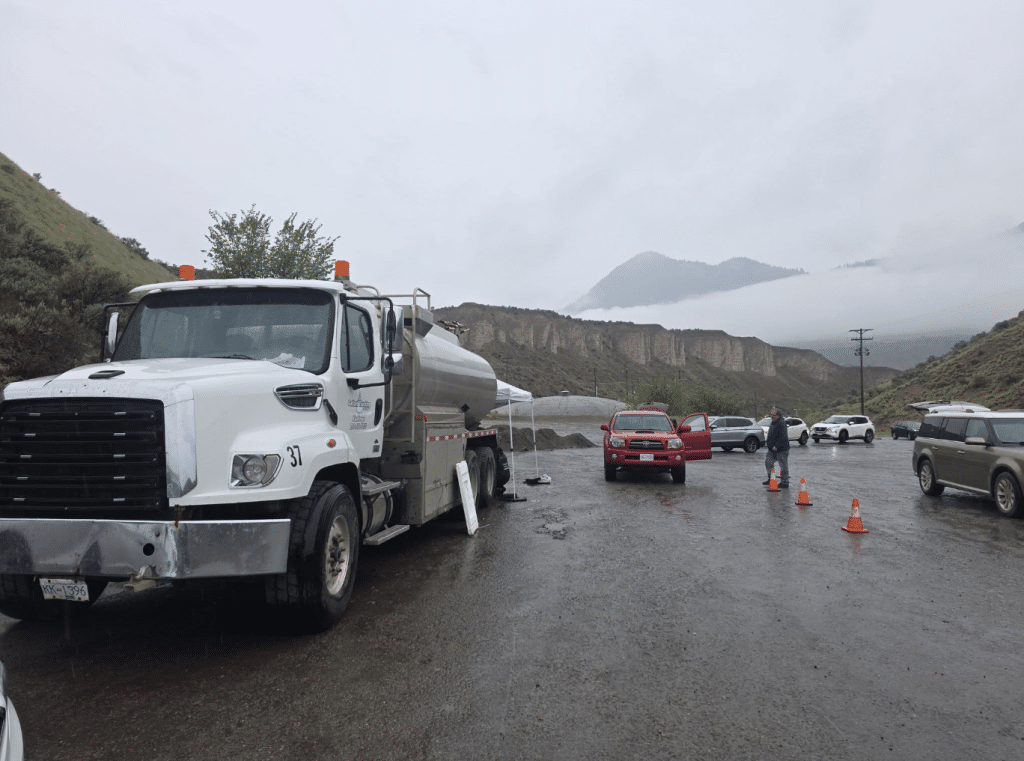
In addition to using Voyent Alert to share information, the city posted updates on social media and to a special information page titled East Kamloops Water Main Break.
The evening before, on May 11, the city posted to its Instagram stating that critical water main repairs were underway and “restricted water use will need to remain in place until further notice.” That post appears to have been removed.
For those subscribed to Voyent Alert, a message shared the morning of May 12 stated crews were “implementing a secondary plan that involves a more robust repair” to the critical water line supplying the east end of Kamloops and that impacted residents were to avoid using water to allow the reservoir to replenish.
Community groups quickly disseminated the information, posting screenshots of what appeared on Voyent Alert.
Many east end residents like Jensen were quick to point out that they didn’t hear about the restrictions until after they had used or consumed water.
While local news outlets such as Castanet posted updates, these stories can’t be shared on Facebook due to the Canadian news ban, so some residents opted to copy and paste the news story text to Facebook.

For those following the information on the city’s information page, they would come to learn that the water restrictions were due to the unexpected water main pipe break which affected pressure to the system.
When pressure drops, contaminants can impact water quality. The city needed time to test the water, which led to a Do Not Consume water advisory for some areas.
“If you are a senior that doesn’t go on social media, doesn’t leave your house a lot, you would have been drinking contaminated water all day, because how else would you know? So that was my concern,” Jensen said.
Anyone can quickly sign up for Voyent Alert and select notifications via phone call, landline, email or text. While Voyent Alert also has an app, this is not required.
On May 15, the city notified residents that water flow returned, although water quality restrictions remained in effect according to zones.
Then on May 18, the city posted an update stating Valleyview, Campbell Creek, Dallas, Juniper and Rose Hill’s water was safe to drink. As of May 20, only Barnhartvale is still on a Do Not Consume water order.
An electronic sign installed on the highway with three simple words: “water usage restored,” really got Jenson’s attention, she said.
The city confirmed these signs were rolled out on Tuesday afternoon when critical cease water use notices were live.
Jensen acknowledged that the region affected was large, making door-to-door communications and physical signs challenging, but said signs like these in more places could have made the urgent information known and visible to residents who may not have the Voyent Alert app or social media.
While she did see a sign that posted a map of affected areas, Jensen said this may be not clear enough for people driving by.
“Those signs are okay, kind of, if you know that there’s a problem. But if you don’t know there’s a problem, it just looked like a map.”
The city did not respond to The Wren’s question by publication but Deputy Mayor Katie Neustaeter, speaking as a member of council, said council would be reviewing communications to see what could be improved.
“The city has been issuing press releases, posting on social media channels, has placed signage (digital and physical) in impacted neighbourhoods, and has a dedicated landing page on Let’s Talk for this event,” Neustaeter stated via email.
“Any of these methods will have reliable information, but none will be as direct and expedient as Voyent’s leveraging of digital, real-time, direct updates.”
The question of how effective Voyent Alert was in this case “will be a key question in the review of this event as the city identifies communication gaps and confusion that impacted our residents,” Neustaeter stated.
“The city must listen to the community’s feedback and ask how communication systems can be improved in future events that require urgent, ongoing updates for those impacted.”
What can be done to improve communications?
Sun Rivers resident and artist Deb Fong is familiar with boil water advisories.
She was not affected by the water line break last week because Sun Rivers is on Tk’emlúps te Secwépemc reserve lands and has a different water system.
But she has faced water advisories before and had some insights on what works in terms of making residents aware.
“The last couple of times we had boil water advisories, they just had huge sandwich boards that they put out right when you come into Sun Rivers.”
While “old fashioned,” they do the trick, she said.
These signs clearly stated there is a boil advisory in effect, she recalled.
“I think it works really well here, because almost everybody here has to leave the community at some point,” she said, noting that this communications strategy is easier when the community is drive-access only and has one road in like Sun Rivers.
“You can’t miss the sandwich boards. It sounds silly, but they’re like at every stop sign.”
Fong has decided not to download the Voyent Alert app, expressing concerns about how it’s vetted.
“I do understand the benefit of the app to some extent,” she said, but she wonders about who controls it and how many third-party apps she’d have to use for other types of emergency, like wildfire.
Voyent Alert is anonymous by design, and does not require personal data to register. It is designed to provide geographic information related to floods, wildfires or other local emergencies.
According to a city FAQ about the service, “the only information required to register is a postal code or address and a phone number or email address. No other personal information such as your name, address or date of birth is required.”
It’s a cloud-based service that uses Canadian-based resources for operations and storage, the city also states. More information can be found on the Voyent Alert! Privacy Policy page.
“I have been using the Voyent App for years and would have much greater concerns with how social media, digital banking, cookies in web browsers and navigation apps tap my data than I do with Voyent,” Neustaeter stated.
“We give greater access to lesser tools every day in this digital age. The minimal risk isn’t comparable when a fire, flood or other critical event could impact the safety of my family.”
Some residents asked why something like Alert Ready — the national emergency broadcast infrastructure — couldn’t be used.
“Voyent allows for more detailed information to be sent out to a targeted audience; meaning the city can pinpoint areas that need to be alerted about a specific and contained matter as opposed to a blanket alert that runs the risk of creating indifference over time because it doesn’t necessarily apply to all recipients,” Neustaeter explained.
“For example, instead of 100 thousand people receiving blanket notifications about an issue that might or might not apply to their address, 30 thousand people are given applicable information customized to their neighbourhood impacts, as was the case in the East Kamloops water disruptions.”
Working together to get the word out
Juniper Ridge resident Shawn Thompson also got word of the water restrictions and advisories through Facebook, in his case the local Juniper Ridge community group.
The retired Thompson Rivers University professor did his best to keep informed as things developed.
“The best posts were people sharing posts from the city website, and then of course that led me to the city website,” he said.
“It’s an interesting communication issue. You know, the communication was faster when I went to the Facebook groups.”
As a journalist and non-fiction writer, Thompson posted updates himself when he had information that was more up to date.
Thompson declined to comment on the city’s response because he didn’t want to speculate.
“We’re not out there in the trench digging this up. [The city is] focusing their attention to solving the problem, and there’s not much to communicate if you haven’t solved the problem.”
But Thomspon said this brings up the importance of understanding where many residents go to get information, and what they expect.
“The city is using an old style of communication that actually goes back to the beginnings of the internet, when initially the internet was one-way communication,” he said. “There’s problems [with Facebook groups], because it’s so unfiltered and can sometimes be chaotic. But also it’s very quick, very interactive.”
The technology has changed the level of communication people expect, he said.
“I think the city needs to examine that, and see what it can do,” he added.
As a resident of Juniper Ridge, Thompson saw first-hand how emergencies require adaptations and responses from the city.
A single road into and out of the neighborhood when the 2021 wildfires flared left residents clogging up the only evacuation route. Their concerns, however, led to the installation of additional evacuation routes in 2023.
“[The city has] recognized that, they’ve fixed it, but you know here are these fragilities of our systems.”
Community groups and residents have been providing feedback in recent days, and the city seems to be taking notice.
The Barnhartvale Community Association highlighted some apparent discrepancies around communications between the city website and Voyent Alert.
Residents are encouraged to report any communications questions to the city.
What is the city doing to repair the water system?
For now, water use has resumed everywhere with Barnhartvale still on a do not drink or consume order.
So where does this leave the larger project of protecting Kamloops’ critical water infrastructure?
Inspections on the concrete water main are ongoing. A May 5 memo to council outlined the work ongoing to manage the risks associated with the city’s concrete cylinder pipe water mains.
“City staff are taking a proactive approach to managing and inspecting the concrete cylinder pipe water mains in the Kamloops water distribution system. Water main inspections are being prioritized based on risk and criticality factors.”
However, according to Neustaeter, this disruption was unrelated to the “broader and continual work of the city to ensure we are proactive in caring for the Kamloops water system.”
The Wren is a community driven local news outlet. Your questions and ideas help guide what we dig into. Your feedback after we publish a story helps ensure we're always improving our reporting to better serve you
What do think about this story?
Author

Related Articles
MLA candidates for Kamloops share plans to address affordability ahead of B.C. election
Here’s how Kamloops’ MLA candidates answered the question: What will you do to help with affordability?

How will Kamloops MLA candidates support healthcare?
Here’s how Kamloops MLA hopefuls will address the shortage of primary healthcare providers in small-urban and rural areas.

Here’s how MLA candidates will improve safety for all in Kamloops
Here’s how candidates answered the question: How would you create safety for everyone in Kamloops?
