
Municipal government explained: Here’s what Kamloops city council can (and can’t) do
From taxes to tap water, The Wren breaks down what you can expect from Kamloops’ municipal government.
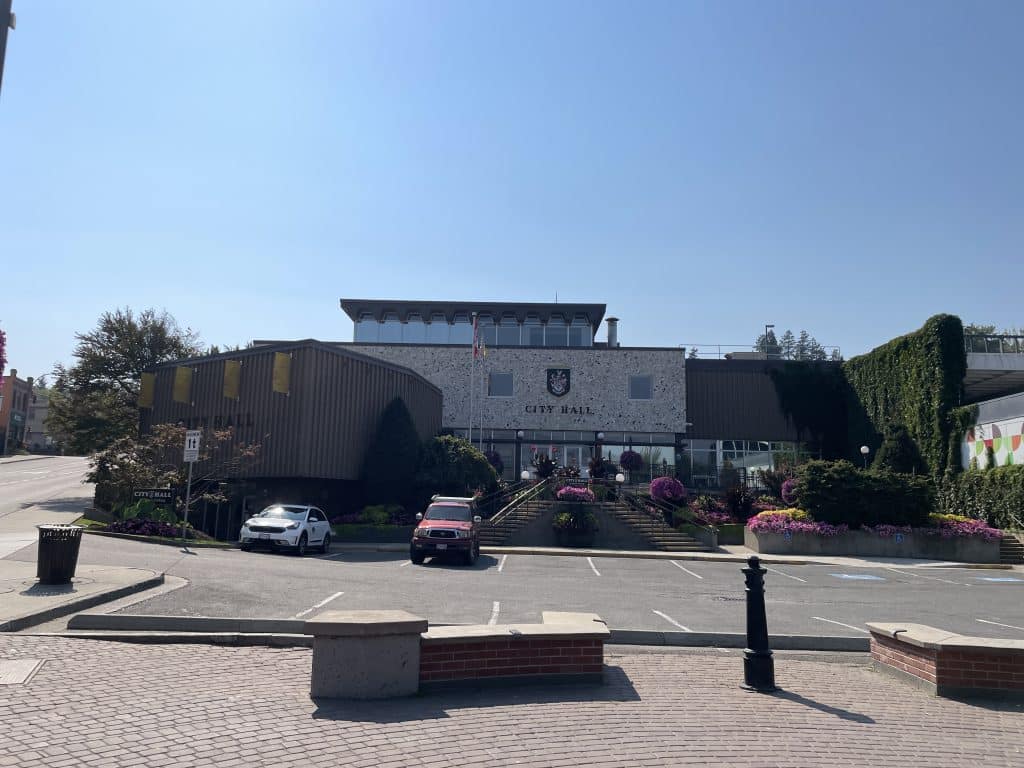
This is the first article of a four-part series which will focus on the differences between municipal government and regional, provincial and federal governments.
During the last few election cycles, readers shared many issues they wanted provincial and federal candidates to look into. At The Wren we believe it is important to hold politicians and members of the government accountable. To do that, it is vital to understand which level of government is responsible for what.
In B.C., there are several types of local governments, including regional districts, municipalities, special purpose districts and local boards and agencies. Local governments have been created to make bylaws and manage matters like parking, business regulations, zoning, construction permits, local transportation and fire protection, among other things.
“When you turn on your tap, does clean water come out? When you drive to school or work that day, that road – as long as it’s not a highway – is something that the city is responsible for,” Katie Neustaeter, Kamloops councillor tells The Wren. “Really, what it comes down to is community planning and land use. That is the core function of what a municipality provides for its residents.”
Four things the municipal government is responsible for
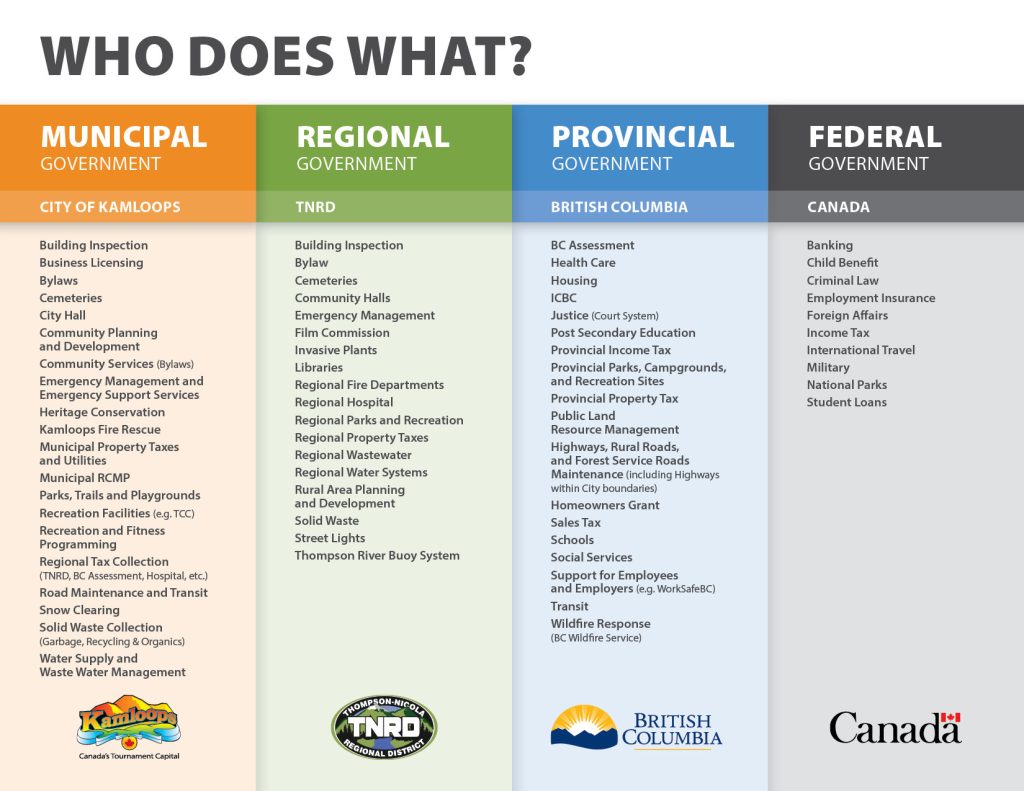
The City of Kamloops is one of 11 member municipalities in the Thompson-Nicola Regional District (TNRD). Members of Kamloops city council and the mayor depend on city staff to help make policies to manage services such as water, recreation and taxes. Residents help guide decisions through conversations and feedback, Neustaeter explains.
“Many residents engage with us around things like property taxes, which is an excellent use of conversation. Parks is one that is a regular occurrence, [and] garbage or snow clearing. These are the kinds of things that really matter to our residents that fall squarely under the canopy of municipal responsibility.”
Here are a few things that fall under municipal jurisdiction.
Water management and services
The city is responsible for the water Kamloopsians consume, as well as the drainage, sanitary sewer and flood protection systems managed by Utilities Services.
The Kamloops Centre for Water Quality is operated by the city and provides drinkable water to anyone in Kamloops, along with the Kamloops Sewage Treatment Centre which processes waste water or sewage.
Wildfire and flood mitigation
The city is in charge of how wildfire mitigation is addressed and managed. The city has designed programming for wildfires like the Community Wildfire Protection Plan, which educates people on wildfire risk and mitigation, and has partnered with FireSmart to help residents be more aware of the particular risks their properties face.
The city also manages evacuation plans in various communities and offers programming for residents so they can be prepared for a wildfire. An example is Juniper Ridge, where the city hosts tours showing evacuation routes.
Tk̓emlúps te Secwépemc and BC Wildfire Service work with the city to plan and implement prescribed fire projects.
Kamloops also has a high risk of flooding due to both North and South Thompson Rivers, and all programming relevant is managed by the city.

Property Taxes
The municipal government is in charge of collecting, increasing and controlling property taxes, and creates a five-year financial plan and tax bylaw, which show residents where the spending and revenue is going in the next five years. It will also indicate the total amount collected from all types of property owners for 2025.
Recreation
Recreation includes not only parks and fields but also cultural programming. The city is responsible for the way parks are maintained, along with any improvements made to them or any new building initiatives.
BuildKamloops has been an initiative supported by city councillors which seeks to foster the recognition of Kamloops as Canada’s Tournament Capital. Projects under the BuildKamloops initiative include the Kamloops Centre for the Arts, the Arena Multiplex and other improvements in McArthur Island Park. The city received funding to promote and have these projects on the go.
The city funds several programs which promote physical activities like sports and cultural events focused on the arts. There is more information on the city’s Recreation and Culture website.
Council’s limitations and overlapping responsibilities
As the lowest level of government, Neustaeter says council’s “scope is limited.”
“We do find that an increasing number of people are struggling to delineate between the responsibilities of different levels of government,“ she says. “We spend a lot of time directing people to speak to their MLAs or their MPs, depending on the issue, but it’s very challenging for people to understand why they should have to do that.”
Two of the most common issues brought to the municipality include healthcare and crime, neither of which Kamloops city council has much control over.
“A shortage in doctors is, of course, a significant issue for 40,000 people living in our city, but that responsibility falls under the province,” Neustaeter says.
While councillors can advocate for the needs of Kamloops residents, larger changes have to come from higher up.
“We are the most junior level of government and most big, bolder changes do require the province and the federal government,” she explains.
There are of course areas where the various levels of government overlap, due to procedure, communications requirements or local initiatives for provincial or federal issues.
“The federal government can give some money to the province to increase housing, but then the province tends to have to actually negotiate with each municipality as to meeting certain conditions,” Thompson Rivers University political science professor Terry Kading says.
At times this can lead to municipal partnerships for community needs that historically fall under provincial responsibility, Maria Mazzotta, a corporate officer for the City of Kamloops explains.
“Something that may sometimes get forgotten because it’s been something municipalities have worked on for so long, is housing and homelessness…that is not typically a municipal responsibility…but our community saw a need,” she says. “Leaders of the community wanted to do work to address that need, and so now it is part of what municipalities do, in partnership with provincial and federal funders.”
As a governing body made up of residents who are most accessible, Neustaeter says council and staff are often responsible for educating community members on what is under municipal control, and more awareness around each level’s responsibilities would be helpful.
“Educational opportunities are always something that we’re looking for…because we find it very burdensome on the city staff as well, as they try and explain to people what they can and cannot do, and deal with the frustration that comes out of that as well,” she explains.
How to engage with council
Members of council are democratically elected to make policy and pass bylaws, Mazzotta explains. As it is their responsibility to bring resident concerns to light and propose solutions, they may hold public information sessions or request community engagement.
“We do have opportunities for public input and lots of opportunities for public engagement, which are all available on our website,” she says.
Neustaeter recommends LetsTalk Kamloops, which allows residents to bring up any issue on their minds.
“We also take delegations at council where people can bring forward things that they’re working on, things they’re concerned about, things that they would like to see some support for from the city,” she adds.
City councillors are available via email, which are all public through the council access portal, and constituents can also reach out via phone.
The Wren is a community driven local news outlet. Your questions and ideas help guide what we dig into. Your feedback after we publish a story helps ensure we're always improving our reporting to better serve you
What do think about this story?
Author

Related Articles
‘It is about courage’: More students take up Secwepemctsín as language revitalization efforts grow
‘Without any new interest or passion for Secwepemctsín, there is no revitalization,’ student says.

Secwépemc actor William Belleau brings Hollywood to Alkali Lake
Days before the Leo Awards, Secwépemc actor William Belleau reflects on a career that’s come full circle with his role in the independent Secwépemc film W7éyle (Moon’s Wife).

Meet Eric Van Stone, the archaeologist who stopped digging and started carving
Once trained to uncover the past, Chipped Stone Tools artisan Eric Van Stone now reshapes stone into functional blades.
