
Regional government explained: The Thompson-Nicola Regional District
Solid waste management, emergency response and libraries all fall under the responsibility of the Thompson-Nicola Regional District (TNRD).
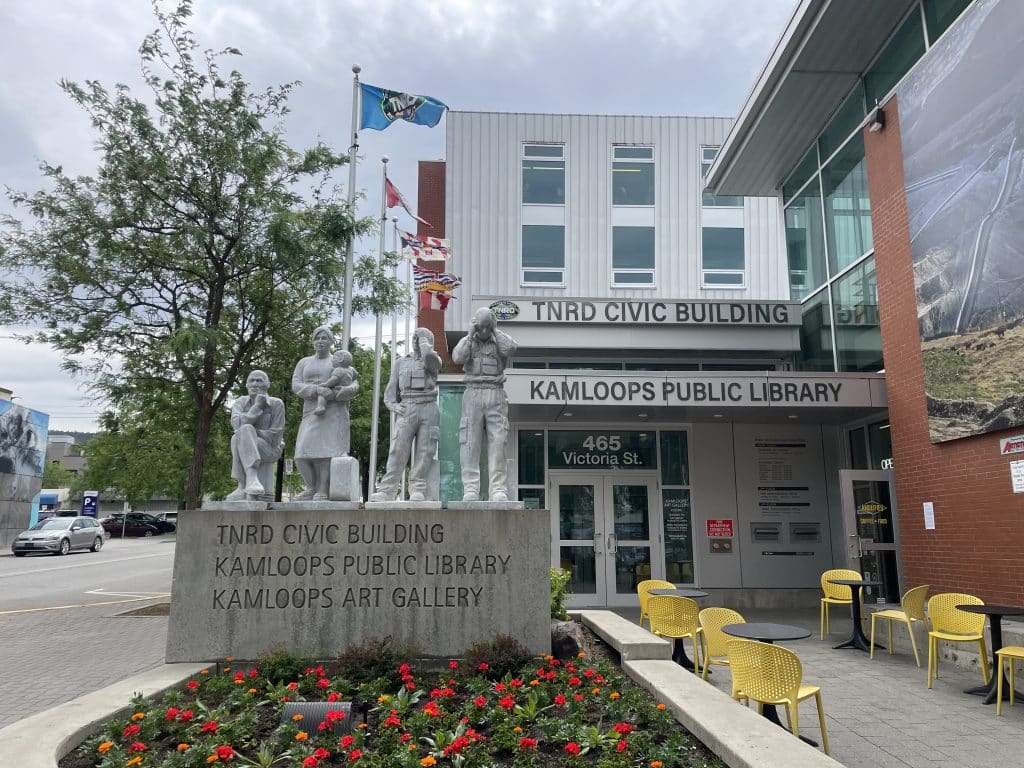
This is the second article of a four-part series which will focus on the differences between municipal, regional, provincial and federal governments.
During the last few election cycles, readers shared many issues they wanted provincial and federal candidates to look into. At The Wren we believe it is important to hold politicians and members of the government accountable. To do that, it is vital to understand which level of government is responsible for what.
In B.C., there are several types of local governments, including regional districts, municipalities, special purpose districts and local boards and agencies. There are 27 regional districts in B.C. composed of electoral areas and municipalities.
The history of regional districts starts after the 1950s when rapid urbanization increased demand for various services like water, sewage and zoning. In 1965, the province amended the Municipal Act creating regional districts, which originally had limited powers.
Over time, as districts became more established, the B.C. government granted more power. Today, regional districts focus on providing region-wide services like emergency telephone services and regional parks. Other responsibilities include sub-regional and inter-municipal services like recreation facilities.
Additionally, regional districts can act as a general local government for electoral areas, which are smaller rural areas or unincorporated communities, and provide services like fire protection and waterworks.

The Thompson-Nicola Regional District (TNRD)
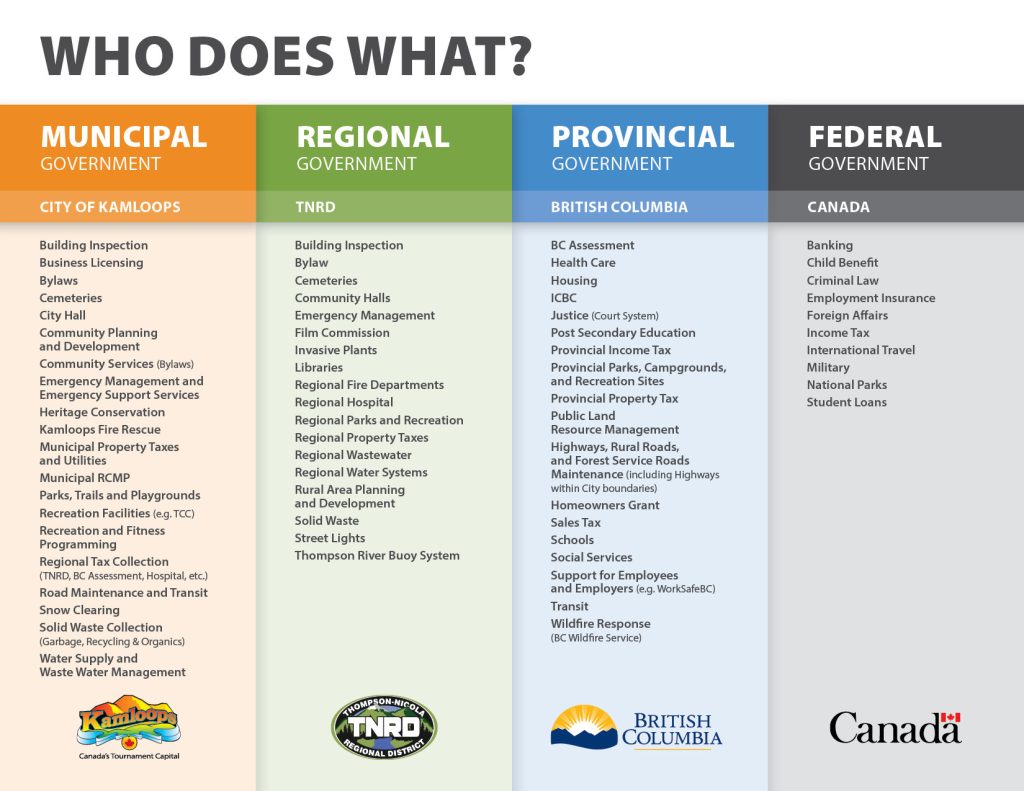
The Thompson-Nicola Regional District (TNRD) covers more than 65 unincorporated communities, 11 municipalities and 25 First Nations. The TNRD is governed by a board of directors, including 27 elected officials. The board of directors includes one director from each of the 10 electoral areas, one director from the ten smaller TNRD municipalities and seven directors from the City of Kamloops.
The city and regional governments work together on many things, Kamloops city councillor Margot Middleton tells The Wren. Middleton is one of the seven representatives from the City of Kamloops working on the TNRD board of directors.
“We don’t operate in isolation of each other, because the city of Kamloops is actually part of the regional district,” Middleton says. “We have a significant place at the table, because a lot of the distribution of areas and representation is based on population. Of course, the city [of Kamloops] has the largest population base of the TNRD.”
Colton Davies,communications manager for the TNRD, says folks often find it hard to differentiate the responsibilities of the City of Kamloops and the regional district.
“Within the city of Kamloops, the TNRD provides just a handful of services,” he explains. “In general, we provide probably fewer services within member municipalities compared to what we do in many rural areas in Kamloops.”
Here are a few things the TNRD looks after:
Regional bylaws
There are differences between municipal and regional bylaws. According to Davies, the bylaws from the regional district are completely separate from municipal bylaws.
“There might be some of our bylaws where there is overlap,” he says. “For example, the TNRD would have a noise bylaw but it doesn’t apply to the city. Most of our bylaws apply to just the areas where we provide the services.”
The process of passing a bylaw in the regional and municipal level is the same.
“The TNRD has a set of bylaws that have been instituted over time,” Middleton says. “The process is the same for the review, the changing, doing things like first, second and third readings on changes on bylaws.”
In certain cases, electoral areas might only have provincial regulations.
Regional taxes
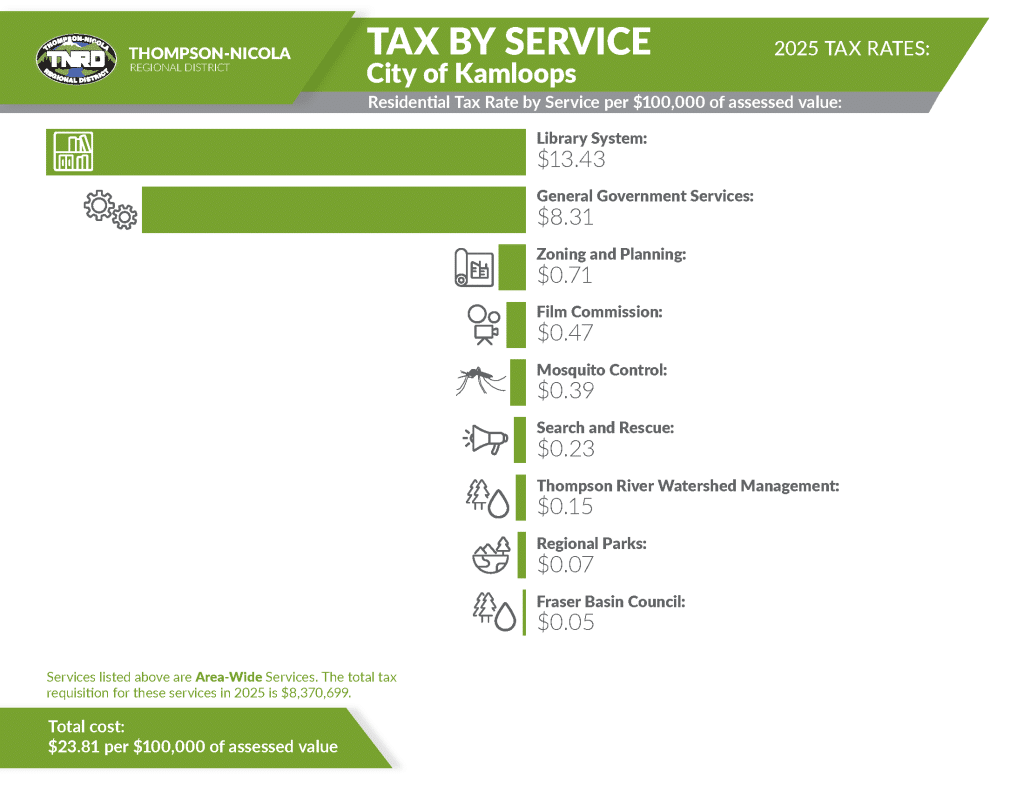
Through taxes, Kamloops residents contribute to the Thompson-Nicola Film Commission, mosquito control, libraries and more.
The TNRD has a page on its website noting all the details about the budget and how taxes are charged. There are infographics with the final 2025 tax rates for each TNRD service in each member municipality and electoral area.
Regional libraries
One of the largest services the TNRD offers is the library system.
“The North Kamloops library, downtown library and the fairly-new Aberdeen tiny library, are all part of the TNRD library system,” Davies says. “That’s a service that is region-wide, so every property in Kamloops contributes taxation funding to the TNRD for libraries on a smaller scale.”
The Thompson-Nicola Regional Library has several branches along the region, including a mobile and digital library.
Every property pays the same tax rate for the libraries according to Davies.
“When it comes to resource sharing, it’s looked at as a very equal level of service. It’s intended to be an equal opportunity for library service in all of our areas.”
Regional hospitals

Though the name might suggest it, regional hospitals are not managed by the TNRD, but by the Thompson Regional Hospital District. Healthcare at large is managed by the provincial government.
“Hospital districts basically exist to borrow funds, [to] help finance hospital construction projects and capital equipment purchases at healthcare facilities,” Davies explains.
In the TNRD, there are a limited number of facilities that are part of the regional hospital district. Some examples are the Royal Inland Hospital, the Ashcroft Community Health Centre and Barriere Health Centre.
“When there’s issues with things like rural emergency room closures, that’s far outside the scope of the hospital district. Hospital districts exist to be a shared funding partner,” Davies says.
Davies tells the Wren that there are no hospital district employees at the TNRD civic building, although some of the staff does prepare the budgets or if there are any board meetings for the hospital district.
Regional emergency management
Emergency management is a large part of the TNRD’s responsibilities, “particularly in rural areas with the wildfire situations and flooding,” Middleton says.
The TNRD’s emergency programs are similar to what the City of Kamloops does with the differences of the areas they look after, Davies adds.
“That’s a very busy department at different points of pretty much every year for the TNRD, because of the frequency of fires, and in many recent years catastrophic fires that have affected a lot of people in our rural areas,” Davies says. “We’ve obviously had many floods too, or even high water situations where it doesn’t always materialize into significant flooding.”
The TNRD tries to respond rapidly to the fires and relies on forecasting to prepare and activate. In addition, it manages evacuation orders, alerts and provides resources to the region.
Solid waste management
The TNRD is responsible for the solid waste management in the region, operating two landfills and various eco-depots and transfer stations. This includes garbage collection along with recycling.
Waste management in the TNRD is based on zoning, Middleton says.
The TNRD manages 29 sites for drop-off garbage and recycling, in addition to offering curbside collection in five rural communities. Most of the programming in the region is managed by the TNRD.
If there are concerns related to the services provided by the regional district, those are brought up to the electoral area directors rather than city councillors, Middleton tells the Wren.
The TNRD’s website can be used to report an issue where constituents can reach out to the appropriate department either by phone or email.
The Wren is a community driven local news outlet. Your questions and ideas help guide what we dig into. Your feedback after we publish a story helps ensure we're always improving our reporting to better serve you
What do think about this story?
Author

Related Articles
‘It is about courage’: More students take up Secwepemctsín as language revitalization efforts grow
‘Without any new interest or passion for Secwepemctsín, there is no revitalization,’ student says.

Secwépemc actor William Belleau brings Hollywood to Alkali Lake
Days before the Leo Awards, Secwépemc actor William Belleau reflects on a career that’s come full circle with his role in the independent Secwépemc film W7éyle (Moon’s Wife).

Meet Eric Van Stone, the archaeologist who stopped digging and started carving
Once trained to uncover the past, Chipped Stone Tools artisan Eric Van Stone now reshapes stone into functional blades.
