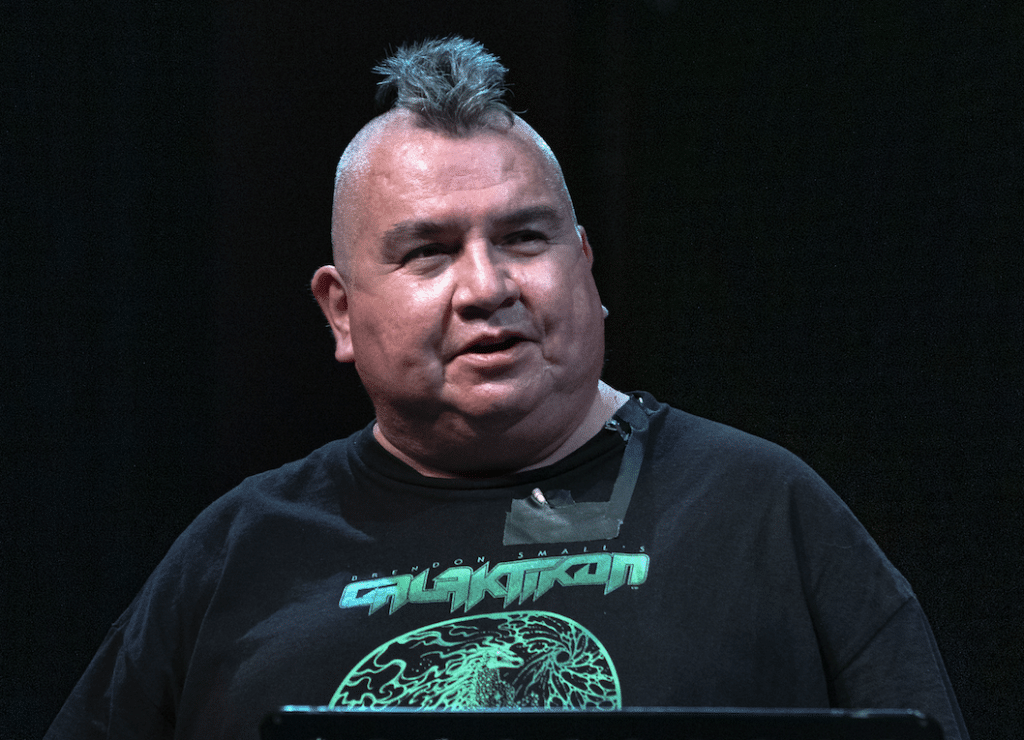
Chris Bose hands out shakers and drums, teaching Secwepemc words as the crowd joins in. Soon, the room becomes loud.
“I get them to be loud,” he says. “That’s how I help people find their voice, and it’s fun.”
That participatory energy defined Bose’s recent residency as Indigenous Storyteller at the Vancouver Public Library, where he organized 45 events across all 21 branches. From poetry readings and jam sessions to workshops and storytelling, the residency reflected his commitment to community and collaboration.
A multidisciplinary artist, musician, father and mentor, Bose is a proud member of the Secwepemc and Nlaka’pamux Nations. His work as an Indigenous storyteller bridges the past and the present, carrying both the weight of intergenerational trauma and the joy of cultural resurgence.
For Bose, the creative drive is rooted in the intergenerational trauma, passed down from his parents, both survivors of Canada’s residential “school” system.
“Home was violent and not perfect. It was a tough, tough home,” he says. Bose describes years of grief and anger, compounded by the absence of open dialogue.
The silence around their experiences left him searching for ways to process pain, and eventually, to transform it.
Through storytelling, music and visual art, he began to confront the legacy of trauma. Humour is just as essential, he adds.
“Indigenous people love to laugh. Laughter is part of what kept us alive, what kept us going.”
Bose blends cultural insight with the energy of stand-up comedy, ensuring his performances remain engaging even when addressing complex topics.
“I hope it just gives people and Indigenous people hope that you can be yourself and be a freak, be Indigenous and still have a voice and still be welcomed by society,” he tells The WrenElee Kraljii Gardiner, poet laureate at the Vancouver Public Library, calls Bose “a warm and dedicated voyager in the arts who is passionate about sharing resources and opening spaces to all, particularly youth. It was fascinating to hear how he moves through genres in transdisciplinary work, always foregrounding relationships and community.”
Lighting the way: A journey through storytelling, identity and community
Bose’s earliest lessons in storytelling came from his grandparents. Summers in the 1970s meant long hours in community halls and gymnasiums as they travelled across Canada and the U.S., sharing stories.
“My grandma sort of told the more morality-type stories, you know, be good,” he recalls. “And then my grandpa was more like coyote trickster stories.”
Sk’elép (Coyote) is a central figure in Secwépemc and Syilx storytelling who often travels through life imperfectly, learning lessons along the way.
These stories gave him more than entertainment; they gave him roots. Bose sees storytelling as a cultural inheritance, one that connects him to “place, language, and community.”
His journey hasn’t followed a straight line.
“When I was 16, I ran away from home to Vancouver. I haven’t really been back since,” he says. “I’ve been on my own since I was 16.”
That decision marked the beginning of a long and difficult chapter, one shaped by instability, addiction and homelessness.
“Who’d have thunk that, this kid from the hood or the troubled childhood would get to where I am now and all things I’ve seen and done.”
He used creativity as a lifeline, channeling pain into poetry, music and mentorship. For Bose, the journey toward embracing his artistic voice was intertwined with the exploration of his roots and the stories that shaped him.
“Identity was always in my writing as an Indigenous person,” he says. “It was always a part of everything creatively I’ve done ever since I started doing this. So, it’s helped me find my voice.”
Finding his voice was his response to what he saw as erasure and exclusion.
“Back in the ‘80s, there weren’t a lot of Indigenous voices,” he says.
“You know, we’ve always sort of been relegated to the basement of the gallery, the basement of the museum, the back page of an anthology. And it pissed me off. So, I started using my voice.”His voice has also taken shape in print. Bose is the author of several books that reflect his lived experience and cultural lens, Including Somewhere in This Inferno, a creative non-fiction exploring identity and survival through poetic storytelling, A Moon Made of Copper, a collection of poems written while touring across Canada, capturing the emotional terrain of life on the road and N’shaytkin, a hybrid work created with his daughter, Jayda, combining memoir, film script, maps, and pictograms to explore environmental justice and Indigenous mythology. The title N’shaytkin means “a relation that has passed on” in Nłeʔkepmxcin.
‘Each one teach one’
Mentorship helped him move forward. With guidance from Indigenous authors and mentors like Gary Gottfriedson and Richard Van Camp, Bose found confidence and opportunities to publish.
Through mural projects, workshops and collaborations with youth and Elders, Bose continues to mentor.
One of his most significant recent projects is the design of a cultural wall in the new Phil and Jennie Gaglardi Tower at Royal Inland Hospital in Kamloops.
Bose consulted with Indigenous Nations across the region, including the Secwépemc, Dãkelh Dené, Tsilhqot’in, Northern St’at’imc, Nlaka’pamux, syilx, and Métis communities, to create an installation that reflects the region’s cultural diversity. Each floor of the hospital features a spirit animal motif selected by Secwépemc Elders, embedding Indigenous presence and symbolism throughout the space.
“Finding Indigenous mentors is really important, and so I do my best to mentor back as well, you know, share.”
The guiding principle of “each one, teach one” remains at the centre of Bose’s practice. He offers both practical and philosophical advice to emerging artists, sharing insights on everything from submitting creative work to festivals to navigating contracts and agreements. His approach emphasizes generosity, resilience and self-reliance, encouraging others to persist despite setbacks.
Bose also stresses the importance of maintaining focus on personal growth and creativity, even in the face of adversity. Rather than being diminished by negativity or jealousy, he urges artists to safeguard their strength and continually pursue their creative purpose.
“It’s good to see others get there, and it helps them because when they do that too, we all rise together.”
For many, “there’s a lot of disconnect from reserve,” he explains.
“Most of us are urban Indians, Indigenous people…it’s okay to mourn. It’s okay to celebrate. It’s okay to be angry, just get up every day and keep trying.”
Looking ahead, Bose is working on new music, experimental films and stories that flip colonial narratives.
Asked what wisdom he’d pass down, he keeps it simple.
“Each one teach one. Find your voice, find your culture, find your language and find a mentor. Those are the four things that are really important for Indigenous and non-Indigenous people to stay strong in their creative endeavours.”
“I feel like some people are lighthouses,” he says when asked what he hopes his legacy will be. “They’re beacons that shine in the darkness and help people find their way. Maybe that’s what I hope for.”
The Wren is a community driven local news outlet. Your questions and ideas help guide what we dig into. Your feedback after we publish a story helps ensure we're always improving our reporting to better serve you
What do think about this story?