Editor’s note: As a member of Discourse Community Publishing, The Wren uses quotation marks around the word “school” because the Truth and Reconciliation Commission found residential “schools” were “an education system in name only for much of its existence.”
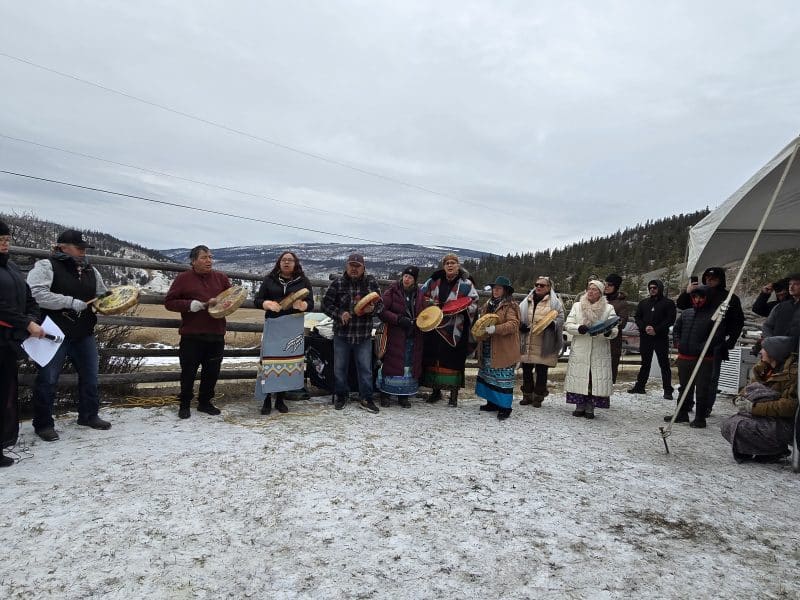
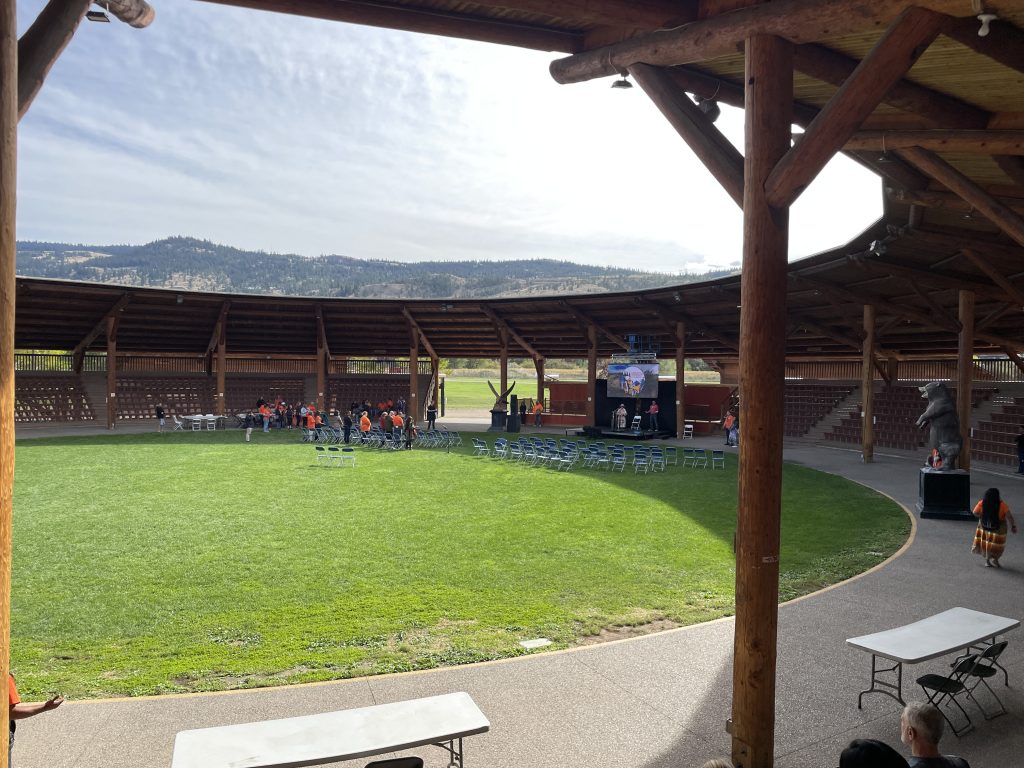
A prayer filled the Tk’emlups te Secwepemc Powwow Arbour, the voices of Indigenous peoples gathering together and honouring their ancestors, those who lost their lives to residential “schools,” survivors and their families. Rows of chairs closer to the front of the platform were empty, held for survivors of residential “schools” and the ones who did not live to see today.
Folks convened in silence for a few minutes before the speeches started at the National Day of Truth and Reconciliation event held on Sept. 27.
Nikki Fraser, councillor for Tk’emlups te Secwépemc, r acted as Kúkpi7 (Chief) since Rosanne Casimir was away attending events at the Kootenay residential “school” in T’eqt’aqtn’mux (Kanaka) territory.
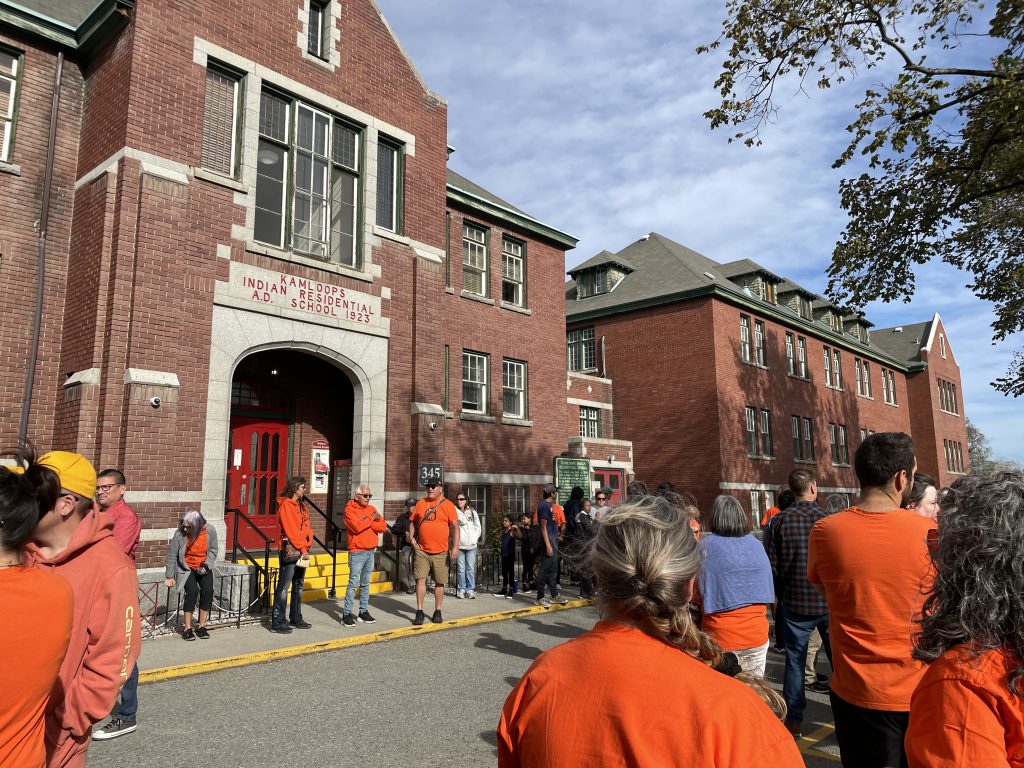
Fraser and Sara Candido, the Indigenous external relations manager for the City of Kamloops, worked together to collaborate on this event, held to honour those who attended the Kamloops Indian Residential “School” (KIRS).
Although the city and Tk’emlúps have had a working relationship for around 30 years, this was the first time the two have collaborated to host an event for Truth and Reconciliation. The collaboration is another step to working together on truthfulness, Fraser shares.
“Lots of communities, even within Canada, but across B.C., their municipal governments don’t have that working relationship with the local First Nations governments right within their ancestral lands,” she says. “We’ve been working together before reconciliation was even a big term or even a thing within Canada.”
The decision to host the event on Sept. 27 was made to encourage more engagement with the community, as well as hold space on Sept. 30 for commemoration and healing in Indigenous communities, Candido says.
“On Sept. 30, our team and our people, our survivors, are working on a day that is supposed to be meant for them, to reflect, to heal, to be with family. We wanted to move it a few days ahead so that our people had that time to do that self care,” Fraser adds.

The National Day for Truth and Reconciliation was first observed by the Government of Canada in 2021 in response to a Truth and Reconciliation Commission call to action to “ensure that public commemoration of the history and legacy of residential “schools” remains a vital component of the reconciliation process.”
Sept. 30 also marks Orange Shirt Day, an Indigenous-led movement founded in 2013 by Secwepemc Elder Phyllis Webstad, who was forcibly separated from her family as a child and taken to St. Joseph’s Mission.
The collaborative event at the Tk’emlups Powwow Arbour also offered non-Indigenous Kamloopsians an opportunity to learn ahead of the statutory holiday or to take new insights into their own lives, Candido says.
“We felt like part of reconciliation would be to actually do this together [and] to do it beforehand so people can actually take that day to reflect on what they’ve learned,” Candido says. “It could also help a lot of settlers here, including myself, reflect and make your own reconciliation plan.”
Actions non-Indigenous people can take toward reconciliation include educating themselves and demanding elected representatives take action in response to ongoing discriminatory colonial policies as seen within the child welfare system, which disproportionately apprehends and underfunds Indigenous children and youth.
In a speech opening the event, Kamloops deputy mayor Stephen Karpuk spoke to the ongoing work that should be reconciliation.
“It will take a lifetime to learn, to reflect on what we have to unlearn and to learn the truths,” he says. “That journey will never end for me.”
More than 150,000 First Nations, Métis and Inuit children were forced to attend government-funded schools across Canada starting in the 1870s. Before B.C.’s last residential “school” closed in 1996, the province had 18 federally-run institutions, including the KIRS where many children are known to have died, according to federal and church records and most importantly, testimonies of survivors.
The city hopes to do more to support survivors and their descendants in collaboration with the guidance of Tk’emlups.
“I was just taught this great teaching from an elder: In order for us to move forward for the next seven generations, we have to acknowledge the seven generations before us with history,” Fraser says.
National Day for Truth and Reconciliation in Kamloops
Schools in Interior B.C. also participated in the morning, with around 750 kids from Clearwater to Kamloops coming together to visit KIRS and connect with Elders. The students had the opportunity to make cedar roses and have bannock, Candido says.
After the kids visited the grounds, the Powwow Arbour opened for the general public. Speeches commenced the main event in the afternoon, followed by a walk from the arbour to the KIRS.
The support of the wider community and interest in truth and reconciliation has been instrumental each year, Fraser shares.
“We are always talking about reconciliation, but sometimes talking doesn’t really have the action behind that,” Fraser says. “The reason why it’s growing is because of education. People are becoming more aware. They’re educating themselves.”
Self-motivated education, like reading and research, goes a long way, but Fraser says truth comes directly from history and the survivors of residential “schools.”
“You can read the 94 calls to action, but it won’t really correlate or click unless you know what has happened here, what people experienced and still are experiencing,” she says.
Fraser acknowledges how the effects of the “schools” are still alive today.
“We still have people with over-representation in poverty, over-representation in jails, over-representation of people who are unhoused, over-representation of people in child welfare,” she says, indicating just a few of the effects caused by colonial policies that aimed to dispossess Indigenous peoples from their land and rights.
These ongoing legacies of residential “schools” are outlined by the Truth and Reconciliation Commission in a special report.
When it comes to reconciliation, Fraser says there are people who are not part of the conversation yet and there are always newcomers.
“Some are settlers that have been here for two generations in their family. They are actually working towards the 94 calls to action.”
For example, Kamloopsians working in local businesses or non-profits can take action by committing to “meaningful consultation, building respectful relationships, and obtaining the free, prior and informed consent of Indigenous peoples.”
It is an ongoing process where people engage and learn from each other, giving space to Indigenous voices.
“We are starting to see that across the country. People are just taking the initiative to ask those questions,” Fraser says. “It starts small, it ripples out, and it makes an impact. I think that’s what we need.”
The Wren is a community driven local news outlet. Your questions and ideas help guide what we dig into. Your feedback after we publish a story helps ensure we're always improving our reporting to better serve you
What do think about this story?