As a firefighter, Ashely O’Neil could handle the heat and demands of the job, but a desire to overcome the day-to-day struggle with personal protective equipment (PPE) in 2018 changed the course of her career.
The 37-year-old Ktunaxa Nation citizen hailing from ʔaq̓am (pronounced Aq’am) near Cranbrook has served many communities in Saskatchewan, B.C. and Montana as a structural firefighter and found the existing PPE provided on multiple job sites to be disruptive and distracting as a first responder.
Firefighter coveralls can last one or two tours, depending on usage and the total number of incidents, she explains to The Wren.
Many industrial-grade coveralls issued in 2018 were oversized for women so she devoted a lot of time to repairs due to constant ripping.
“I started thinking about how my aunt always made my Halloween costumes or my regalia, and I was like, I have aunties who can consult,” says O’Neil. “Then I started really thinking about it deeply, and I (realized) I’m not the only woman struggling out here because I’ve seen other girls out on the fire line struggling as well.”
In addition to ill-fitting coveralls, most bras and underwear for women are manufactured with synthetic fabrics and wires that would melt in a fire and are not deemed fire resistant, she explains. She also learned how fire resistant fabrics, while effective at repelling fire, come with a series of risks.
“So that’s kind of where it all came into play…well, why don’t I start a (fire resistant) clothing business for women,” says O’Neil. “It kind of evolved from there.”
She began researching which materials would be fire resistant and what chemicals could be used to make PPE safe and launched AshFireWear in southeastern B.C. in 2021.
She was driven to create gender-neutral gear that would protect firefighters while ensuring the fabrics were not toxic.
”It doesn’t matter what gender you are, we are all human and we all can get sick,” she says. “We wanna protect our brothers too.”
AshFireWear, which she runs part-time, was recognized as the Female Business of the Year for 2024 in May by All Nations Trust, an Indigenous-owned financial institution.
The importance of safer wildfire PPE
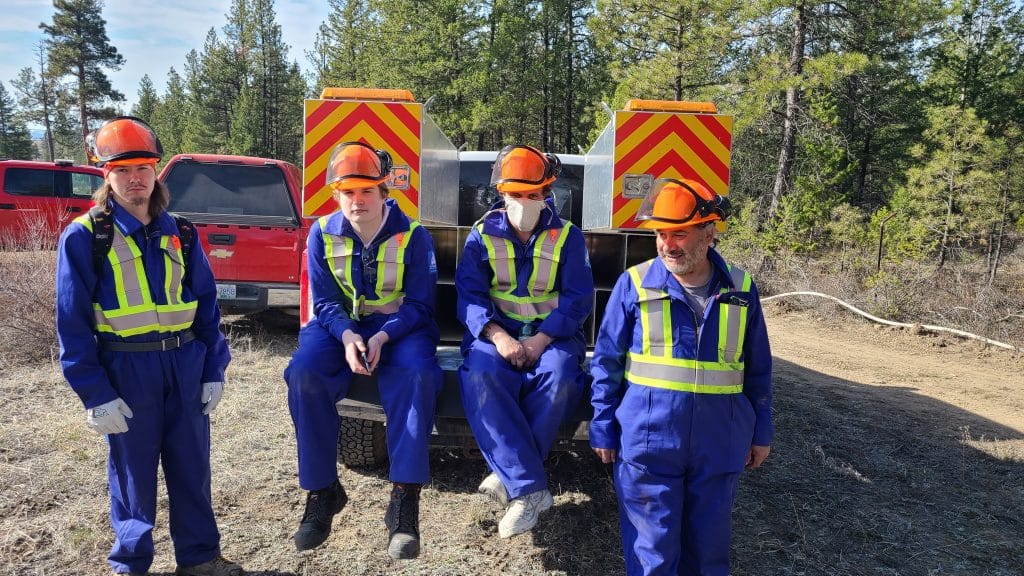
While researching the chemicals in fire-resistant clothing, O’Neil found many contained cancer-causing agents such as “forever chemicals” or PFAS.
“I started researching all the firefighters that are dying or have had cancer, and the percentage is quite high,” she explains.
Firefighters are more likely to die from cancer than the general population and studies are linking cancer to the fire resistant chemicals used in PPE. Indigenous communities are also disproportionately affected, research shows.
“You can’t actually throw it in the garbage,” she explains. “You actually have to send it off to a recycling facility, which there is one located in Quebec.”
At the recycling facility, O’Neil says employees don Hazmat suits and spray the PPE to break down the resistant compound before burning them.
“So that’s actually accumulating greenhouse gases. It’s not great for the environment.”
The PPE manufactured through AshFireWear, on the other hand, is both eco-friendly and weaved to fit the National Fire Protection Association standards.
“It’s safe for the people wearing it and it’s also safe for the environment because it’s a natural fibre,” says O’Neil of the high-thread-count, 100 per cent cotton which has been sprayed with an eco-friendly fire-resistant spray.
“So it breaks down better into the environment. It needs sunlight, dirt and soil.”
Embracing her roots: Bringing back cultural burns

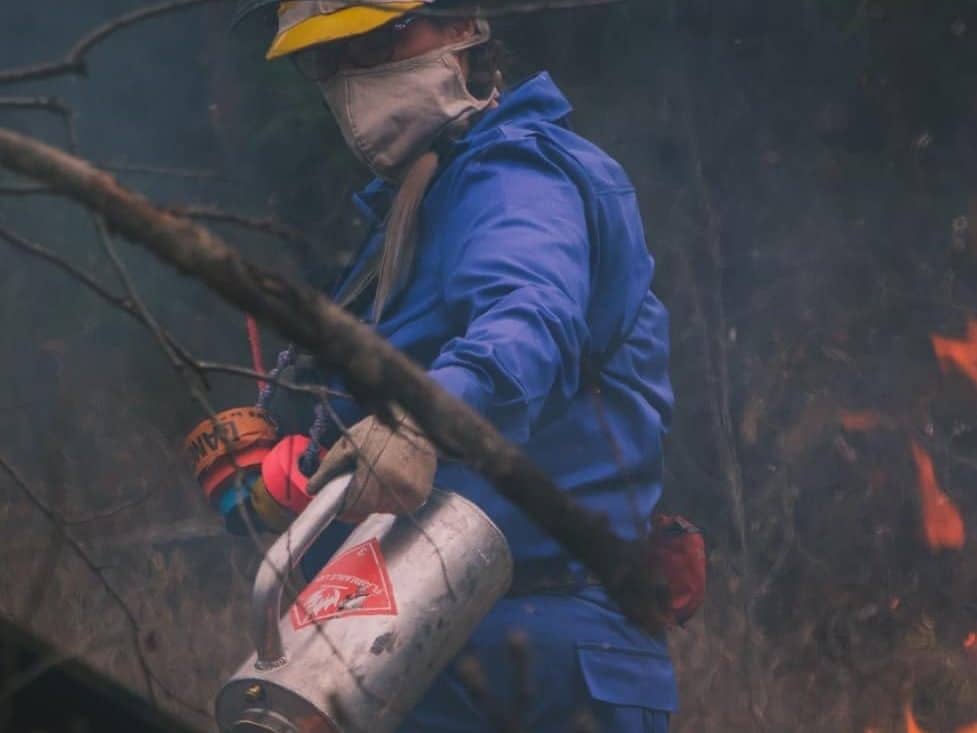
While running AshFireWear, O’Neil has continued to fight fires. Within less than a week of moving back to ʔaq̓am to fight fires in her own territory last year, the St. Mary’s River Fire ignited and took roughly 50 homes down along the reserve.
“Two months before that we did a prescribed burn with the City of Cranbrook,” says O’Neil. “It shows how [good] prescribed burns are for the community. If we didn’t do those burns, we would’ve lost a heck of a lot more.”
O’Neil credits the historical teachings of her ancestors for the community’s success and has spent the last few years working to train the next generation of Indigenous wildland firefighters in the Interior and beyond.
“The Ktunaxa people have been on this land for over 14,000 years and before the colonization happened, before the people came over on the boats, the Ktunaxa people took care of this land for a very long time.
“They understood fire and it has been proven in our old-growth trees that our people did burn the land on a regular basis,” O’Neil explains. “They understood putting fire on the land cleaned it. It blessed it and took down certain trees that no longer need to be there, promoted growing new trees, new forest, putting nutrients back in the ground for berries, medicine plants and things that we survived off of throughout the winter months.”
She feels the past success of the community can be chalked up to previous fire treatments Indigenous communities had done.
“We would burn a chunk of land and then we’d come back three years later and it was green and luscious and full of life and animals that we could live off of,” O’Neil says. “Then that was taken away from us.”
Colonial policies that banned and discouraged Indigenous land stewardship, including cultural burns, alongside climate change has contributed to longer and more intense wildfire seasons, research shows.
“We’ve had over 100 years of fire suppression,” O’Neil says. “Because firefighters did such a great job of putting out fires and not letting them naturally burn. So that’s the turmoil we’re in now.”
Today, O’Neil can be found working at the Aq’am Community Enterprises running the fire programs with the Indigenous Initial Attack for Cranbrook fire zone on a contract focused on cultural and prescribed fire crew management.
“People can contract us out for burn plans with a registered burn,” says O’Neil, adding it took eight months to get the team certified and to stand up a firewood business with heavy equipment.
“I’m trying to bring back cultural burning,” O’Neil adds. “So where we have control over our own lands again and conduct these either small prescribed burns, cultural burns or on a larger scale just to try to …. take down some of this accumulated fuel that’s been accumulating for a very long time.”
As the wildfire representative for the National Indigenous Fire Safety Council, O’Neil supports other Indigenous communities in building the internal capacity to fight fires.
She’s optimistic about building a fire school of excellence on ʔaq̓am First Nation south of the Cranbrook Airport to train wildland firefighters and structural firefighters with a forestry section to yield new talent.
“If you’re a newbie and you want to learn, we’re here to teach you,” she says. “If you’ve got experience and you want more experience, then absolutely, come check it out.”
The Wren is a community driven local news outlet. Your questions and ideas help guide what we dig into. Your feedback after we publish a story helps ensure we're always improving our reporting to better serve you
What do think about this story?