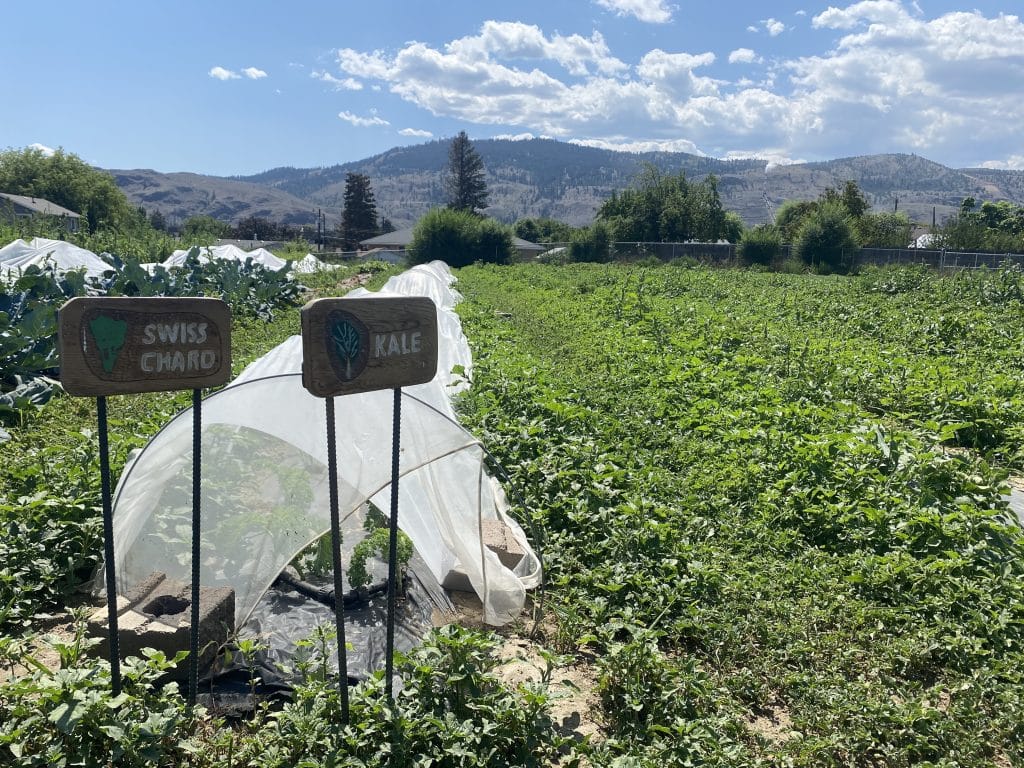
Gardengate is a two-and-a-half acre farm situated on Kamloops’ (Tkʼemlúps) North Shore, slightly north west of McArthur Island Park. On most days throughout spring, summer and fall, volunteers are tending to gardens, lining fields where cattle once roamed and peckish deer are still very much present.
Today the property is surrounded by urban development, including South Hills Psychiatric Rehabilitation Centre. Some of the gardeners are from South Hills. Others are community volunteers who may be interacting with someone who has a mental illness for the first time. No prior experience is necessary; just an eagerness to learn.
Gardengate is more than a small farm: it is dedicated to growing community.
“Connecting to community is a big piece of what we do…in terms of just providing that as an opportunity for people, because even if you live in Kamloops, maybe you’re not necessarily aware or not comfortable getting out to interact beyond your peer group,” Robert Wright of Gardengate says.
When someone is referred to Gardengate, the main goal is to help create stability in their life. This includes vocational rehabilitation, life skills or pre-employment training, all centred around one question: where do they want to go next?
Some people just want to improve their life skills, like how to grow and prepare their own food.. Others are looking to develop the hard skills that will allow them to find work. What matters most is that participants leave feeling like they’ve accomplished something.
“As a mental health program, we’re working with people that are at different places in their wellness, they might be living at South Hills, or they will be living in community either independently, in group residence or in family care,” Wright says. “[I love] being able to come in and operate a program where you do the best that you can every single day. That culture is really, really important to us here.”
The skills most people work on developing, Wright continues, are ones many of us take for granted, like getting to work on time, learning how to interact and work with coworkers or developing the interpersonal skills needed to move forward in life. Everyone learns at their own pace, and a team of supportive staff are onsite at all times to help participants achieve their goals.
The program also tackles food insecurity. The farm is lush with just over an acre of fruit trees. There are opportunities to harvest plants outdoors and in an 800 square foot greenhouse, where seeding begins in January. There is also a small section where participants sell fruits and vegetables to seniors who want to save on groceries.
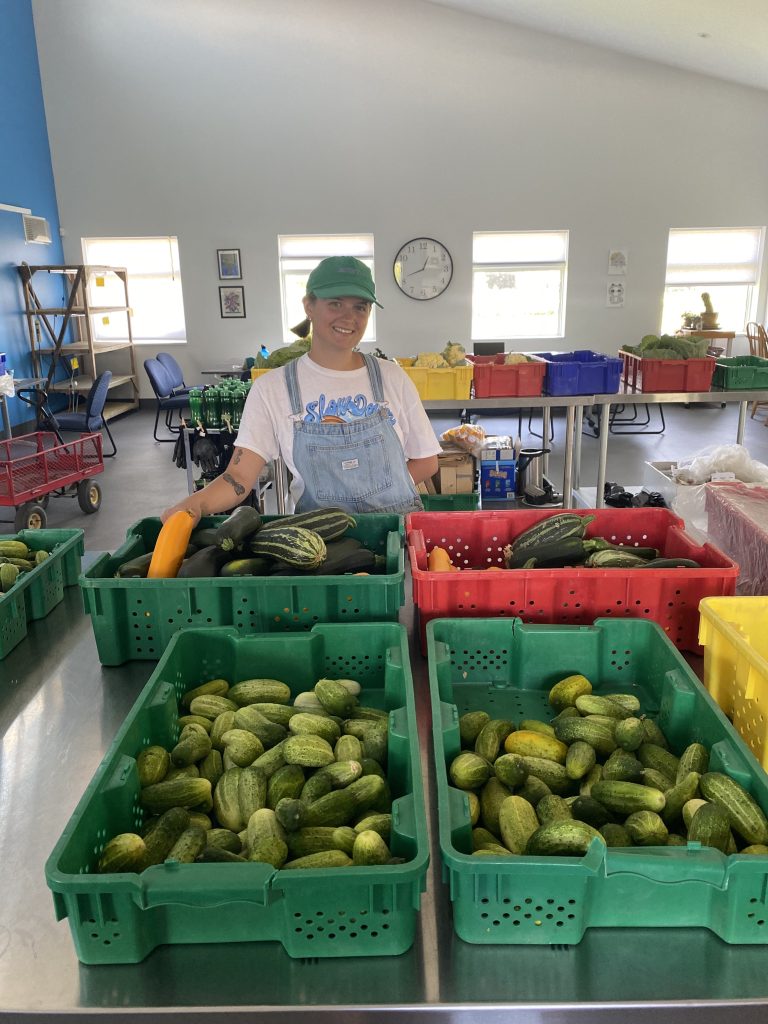
The gardeners are welcome to any of the produce for themselves, and the farm provides regular bulk donations to local food banks. On an annual basis they produce 18,000 pounds of food, so there’s more than enough to go around.

How it all began
Laura Kalina used to stare out her office window at an empty field strewn with old tires and a few roaming cattle and think, what a perfect place for a garden. It was the late 90s – before South Hills was built and soon after the collapse of Kamloops’ canning industry, in a neighbourhood historically known for its fruit and vegetable farming.

The retired Interior Health dietician, who is also the founder of Kamloops Food Policy Council, worked next to Overlander Residential Care and wanted the garden to be accessible to its clients. Kalina approached Interior Health’s board about transforming the land. She applied for a $50,000 grant from the Ministry of Community Development, partnered with Open Door Group who introduced the curriculum and hired Hamish Plumber, a farmer and social worker. In 2000, they launched Kamloops’ first horticulture therapy program.
Horticulture therapy uses plants and horticultural activities to promote health and wellness among its participants. The benefits of people-plant engagement include reduced stress and anxiety, improved mental health, increased social connections and a maintained sense of purpose and worth. In its early years it was a program for those with disabilities. Now Gardengate is a space of healing and recovery for individuals living with addictions or mental health conditions, funded by Interior Health.
“Land-based learning and healing is so important,” says Kalina, who works with several Indigenous organizations using the approach. “It’s about preventing people from being in hospital and helping support people where they are. Your community is only as healthy as all of its members.”
Since planting its first seeds, Gardengate has helped over 1,000 people gain volunteer experience, obtain employment skills and learn to grow and prepare healthy meals – something particularly relevant today given rising food costs, Kalina says.
Although funding is steady, Gardengate has seen some challenges. Last year, about a dozen deer who decided to make Gardengate their home for the summer devastated the property, Wright says. This year, he and his team put up netting and decided not to plant some of things they’re attracted to. For drought preparation, they’ve also installed a drip underneath the mulching to conserve water.
Thanks to local partnerships, Gardengate has grown from one classroom to a fully operational farm. Kamloops Food Policy Council (KFPC) funded their new commercial kitchen, a training centre and business incubator for local food entrepreneurs belonging to their food hub, The Stir. The kitchen is also used by Gardengate participants who want to take cooking classes.

“Gardengate is a great program that seems to be filling a missing need,” says KFPC’s Food Hub Director, Kent Fawcett. “I think using food as a lever for mental health is really important. Especially for myself, I’ve found food very connected to my own mental health. It’s great to be able to tell people about the good that is happening in the community because of partnerships like ours.”
Jess Payette, The Stir’s Storefront Coordinator, says in her experience, the impact extends beyond what’s happening on the farm.
“Being in spaces with folks who have different lived experiences than you can be really key to build empathy and a community mindset,” she adds. “So if I’m seeing something that’s being passed by the city and I’m like oh, that would actually really affect that client I met the other day at Gardengate, I speak up about that. Having these interactions, even if they’re small and fleeting, can really have a butterfly effect in the way that our community interacts with each other in more meaningful ways.”
A fresh start
“People aren’t coming here to spend the rest of their lives,” Wright says. “When they do move on from this program, they’re able to rely on themselves for those things and not on myself or my co-workers. This is a program for people to grow and develop, so that they don’t think they need us anymore.”
For participants from South Hills, which serves mental health patients within the Interior Health Authority, the average volunteer period is approximately six months before their return to their home community. If they’re from Kamloops, the volunteer period can range from one to several years if the individual chooses to stay on. One thing that remains consistent, Wright says, is everyone gets equal access to services, whether they’re local or coming from the Kootenay’s, the Okanagan or Williams Lake.
“When somebody comes to live at South Hills…this is their home. So connecting people to those resources is just as valuable as somebody that already lives here.”
Deirdre has been coming to Gardengate for three years. The Kamloops resident was working full-time when her mental health deteriorated just before Christmas in 2019. She ended up at South Hills, enrolled in a variety of clinical programs to get her back on track.
“A lot of people think that just because you’re smiling or outwardly showing you’re happy, means you don’t have something going on. That was me for a long time,” she shares. “Even the people who are smiling need help sometimes.”
Timid and quiet by nature, South Hills staff recommended she join Gardengate to get out and meet people. Deirdre wasn’t sure at first – she had no gardening experience – but with a bit of encouragement she began volunteering once a week.
“There’s nothing really like Gardengate that I found either here or in Victoria where I used to live,” she says. “Other programs are a lot more clinical and they talk about getting out and doing things, but they don’t help you get out and do things.”
Slowly, Deirdre started coming out of her shell. After a lifetime of struggling with social anxiety, she was becoming more comfortable interacting with others and finally felt part of a community. She was even learning how to cook for herself using the farm’s kitchen. Most of all, she was grateful that she had something to look forward to outside her regular routine at the hospital.
Then, COVID hit.
The team at Gardengate were starting preparations for the 2020 harvesting season when they received news that their organization would be temporarily shut down. It was the beginning of March and Wright had no idea if the closure would be for a few weeks, or a few months.
He wasn’t so concerned about the crops; he worried about the people like Deidre who depended on the program.
Deirdre equally wondered what she would do without Gardengate. Yes, clinical programs were helping, but Gardengate was becoming a home away from home.
As a mental health expert, Wright and his team immediately knew the impacts a long term closure could have on program participants. So, they sat down and made a plan. At the top of their mind was needing something for participants to come back to.
“We had our COVID plan done and together within a week,” Wright says.
The centre still shut down for a few months, but in June 2020, they were given the okay to slowly start re-opening. With COVID protocols in place, Wright picked up the phone.
“Every single person we called who was already receiving services pre-COVID, except for one person, wanted to be here. Our plan was in place. We didn’t have a single outbreak during COVID.”
The first person who adamantly said yes was Deirdre, who credits the program for helping her in her mental health recovery.
“Probably a year ago, I wouldn’t have thought I would ever get a job. I didn’t think that would happen,” she shares.
Since re-opening post-COVID, Deirdre has been attending Gardengate every Monday and Thursday. She has also moved out of South Hills and into a residential facility that supports those with mental illness in their recovery. Although she is not working at this time, she hopes to volunteer at a veterinarian clinic while attending a couple of mental health groups in the community.
Her future is brighter, but there is still some hesitation. The road to recovery is a long one. Thankfully, Gardengate is happy to have her for as long as she’d like.
“I’m kind of terrified to go back into that world. But at the same time, I want to go back to that world and at least work part time. I’d like to continue volunteering here even if it’s just once a week, because I enjoy it so much.”
Then, showcasing some of the confidence she’s built during her time on the farm, she smiles and adds, “I even got to drive the tractor – I can’t wait to do it again.”
Wright acknowledges that Gardengate isn’t a solution to mental illness on its own, and it also isn’t for everyone.
“Some people might come in and try it for a little bit of time and it’s just not for them, and that’s okay,” he says.
Still, those that do benefit can really turn their lives around. He’s seen some people move on to paid employment, and others to volunteer placements that require less support. That alone, he says, is a big win for some.
The biggest reward of all is when Wright runs into a past participant and they’re still doing well he says. He’s quick to add that he doesn’t attribute it to the program, because the person has done the work for themselves. But he does always hope that the time they spent at Gardengate played a part in their recovery.
“The biggest part of what we’re trying to do is normalize those experiences for people, and support them in learning ways to manage their wellness, but also manage their symptoms that they experience. Mental illness doesn’t have any prejudice, it can afflict anyone.”
The Wren is a community driven local news outlet. Your questions and ideas help guide what we dig into. Your feedback after we publish a story helps ensure we're always improving our reporting to better serve you
What do think about this story?