
Stylish and sustainable: Kamloops fashion designer is leading the next generation
Delanye Dixon creates garments that are fit for the red carpet, and our planet, out of her Kamloops home.

The Kamloops slow fashion designer’s self-named brand, Delayne Dixon, has been worn by Serena Ryder, Carmen Electra, red carpet reporters and a Real Housewife of Beverly Hills.
Dixon works full time as a fashion designer showcasing her garments at events like Paris and New York fashion weeks, retailing in Wolf & Badger locations in the U.S. and creating zero-waste looks out of her Kamloops (Tk’emlúps) home.
Dixon’s work is edgy and feminine, known for bold fabrics that boast both patterns and textures. This trademark can be seen in her most popular designs; the Cascade Newsprint Skirt, which features a newsprint patterned fabric, with a cascading ruffle down the high side of an asymmetrical hemline, and the Mesh Newspaper Dress, made from a newsprinted, mesh fabric with a rouched bow across the chest. Edgier textiles featured in her work include faux snakeskin and metallic fabrics.
Although Dixon’s brand isn’t primarily advertised as eco-conscious, the 33-year-old is part of a new generation of designers who are mitigating fashion’s impacts on our environment, hand making garments and sourcing more sustainable fabrics in an effort to change the industry’s practices.
Passion for slow fashion: ‘We’re all just struggling artists’
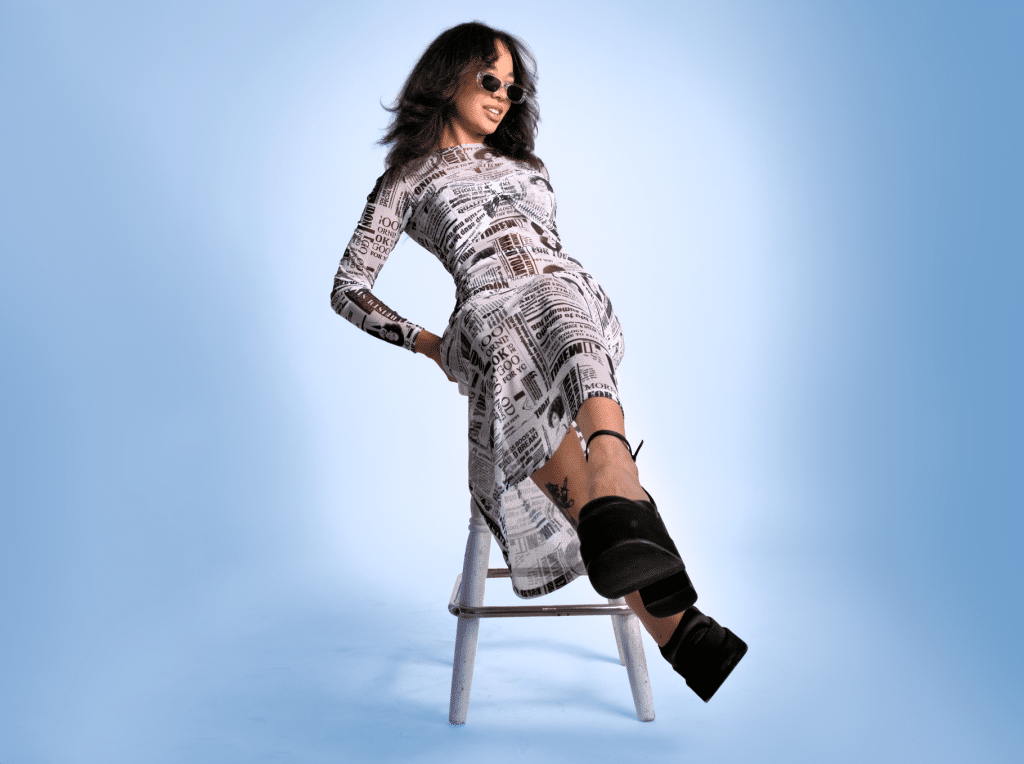
Dixon became interested in fashion in highschool when she was inspired by the show What Not to Wear.
“I learned styling tips from them,” Dixon says. “I just dressed up for the last couple years of high school, like literally in pumps. It was so extra, and I just was like…I’m gonna do what I want.”
After highschool, Dixon went to the Art Institute of Vancouver, now LaSalle College, to study fashion. Before that, she didn’t know how to sew.
“I had made maybe a pair of pajama pants and a pillowcase,” she says. “My academic advisor put me in a program where I learned everything, design, marketing, a little bit of merchandising, and then I ended up really liking the design side of things. So after my first year, I switched my program to the full design degree.”
Dixon completed her bachelor’s of design in fashion in 2012 and started working on her brand.
Like many entrepreneurs, her business wasn’t always her full time job. “I was definitely not making money for the first five years,” Dixon admits.
After graduation, she moved to Kamloops and worked as the visual merchandiser at Boathouse for two and a half years before moving into a receptionist role at Chatters Hair Salon for four more years.
While working at Chatters in 2019, Dixon took a trip that changed the trajectory of her design career.
“I always wanted to go on a bucket list trip to Europe by myself,” Dixon says. “So, I took my paid time off and went to Europe for two and a half months.”
Dixon lined the trip up to coincide with one of the world’s largest industry events, Paris Fashion Week.
“I brought a whole suitcase of my collection there,” she says.
Paris Fashion Week is the most popular fashion week worldwide. The event is mentioned online three times as much as the second most popular show, Milan Fashion Week, according to Brandwatch. Part of the hype around this fashion week location is the prestige of the designers who present their collections there, like Louis Vuitton and Ralph Lauren, and the public figures who attend as audience members.
Upon returning to Kamloops Dixon learned Chatters no longer had hours for her.
“That was probably the best thing that happened to me, because I was forced to go full time. No safety net.”
Dixon sums up this chain of events by saying,”I lost my job in October, and then by February, I was in Vogue.”
She has now been working full-time as a designer for over four years.
Although the Kamloops slow fashion designer has broken into both the retail and couture markets, making one-off designs for high-end clients, she says, “ultimately, we’re all just struggling artists.”
More consumers are drawn to slow fashion
Fast-fashion describes the production of clothing in excess. These garments are often poor quality, and utilize unethical labour and environmental practices to keep prices low and production constant. According to University of Denver Magazine, the average fast fashion brand creates around 52 micro seasons, or collections, a year.
Slow fashion is a term used to refer to often smaller fashion brands that produce garments in limited qualities, or only after purchase, and use more sustainable and ethical labour practices and materials.
Dixon has had to navigate competing with fast-fashion giants, imagining she needed a lot of stock.
“I realized very quickly that that was sort of a waste of time and money,” she says.
These days, she works at a slower pace.
“Everything I do is made to order now, and that ensures that I don’t have overstock,” Dixon says. “I think doing things in smaller quantities is also a really good way to eliminate any waste as much as possible.”.
Dixon started creating a Zero-Waste line using scraps of past seasons and “a lot of dead stock” in her designs. Dead stock fabrics refer to any textile that can no longer fulfill its intended use, often seen in large-scale clothing productions when more fabric was purchased than needed to produce a run of garments.
“Otherwise that fabric would be discarded and thrown out,” Dixon explains.
“I definitely try to be as sustainable as possible. I wouldn’t say 100 per cent of my fabrics are linens and organic stuff. However, I don’t use real animal by-products,” Dixon says. “If I can, I’ll use mushroom leather.”
Dixon also teaches a fashion forecasting class through the Visual College of Art and Design.
“It’s all about trends and runway and sustainability. I just had a lecture about shopping sustainably,” Dixon says. “A lot of the younger generation … aren’t buying designer brands as much. They are buying things here and there, but they’re mixing [designer pieces] with thrifted items.”
This trend of mixing new items with used or upcycled clothing speaks to the larger movement of slow fashion that Dixon is a part of. In a 2023 survey from Bain & Company, U.S. consumers were ready to pay, on average, 12 per cent more for a sustainably-made product.
Dixon acknowledges there are financial barriers to buying sustainably made clothes.
“It’s hard not to shop fast fashion in these times when things are so expensive,” Dixon said.
If you can’t afford to buy slow-fashion items, Dixon suggests thrift shops.
Additionally, shopping from small businesses also supports the environment.
“Any small business owner does a little happy dance whenever you buy something from them, because it’s paying their bills,” Dixon says.
The community

Dixon recognizes the importance of community in both creative work and business, and tries to uplift other local artists through collaboration.
When assembling her Vogue campaign, Dixon included Kamloops-based photographers.
“It was nice to include other local people, and have them have [Vogue] in their portfolio.”
Photographing her garments is one of the most collaborative aspects of her work. These shoots allow Dixon to work alongside makeup artists, models and sometimes photographers, but Dixon is the photographer behind most of the images on her Instagram and website.
“I’ve received so much support from people locally and online … I am very passionate about what I do, but I definitely get the motivation when people are supportive.”
She’s optimistic about the sustainable fashion community and her work.
“I’ve got this brand underneath me, and it’s gonna grow,” she says.If you want to support Dixon’s slow-fashion brand, you can visit her website delaynedixon.com.
The Wren is a community driven local news outlet. Your questions and ideas help guide what we dig into. Your feedback after we publish a story helps ensure we're always improving our reporting to better serve you
What do think about this story?
Author

Related Articles

How will Kamloops MLA candidates support healthcare?
Here’s how Kamloops MLA hopefuls will address the shortage of primary healthcare providers in small-urban and rural areas.
Here’s how MLA candidates will improve safety for all in Kamloops
Here’s how candidates answered the question: How would you create safety for everyone in Kamloops?

Here’s what The Wren’s readers want to know ahead of the 2026 provincial election
From family doctors to the provincial deficit, these were the most-asked questions in The Wren’s provincial election survey.
